




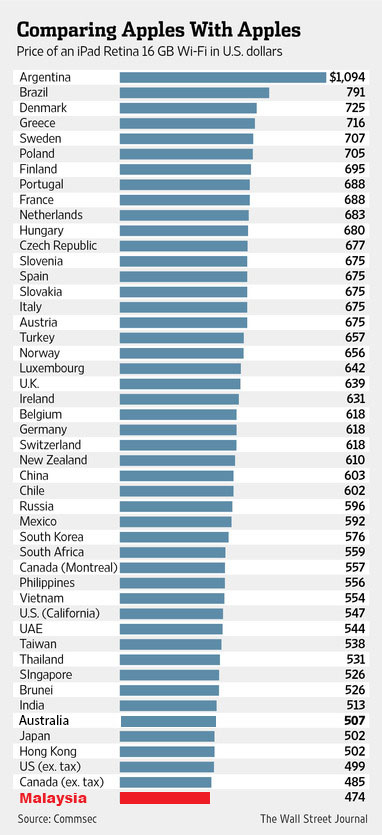
KUALA LUMPUR, Sept 23 — The Wall Street Journal reports that consumers in Argentina pay the most globally for iPads. This is in comparison to Malaysia, which is the world’s cheapest place to buy the Apple Inc product, at less than half the cost in Argentina.
A 16-gigabyte iPad with Wi-Fi and a retina display costs US$1,094.11 (RM3,475) in Argentina, compared to US$473.77 in Malaysia, according to CommSec, a unit of Australia’s Commonwealth Bank.
Countries in northern Europe and Latin America also carry high price tags for the iPad, such as Brazil where consumers pay US$791.40 and Denmark where the gadget carries a US$725.32 price tag.
According to WSJ, CommSec has been keeping an iPod index since 2007 (it later added the iPad) as a method of monitoring whether currencies are appropriately valued.
The index provides a way to explore the economic concept of purchasing power parity; this means that a good should trade at the same price in different countries when expressed in the same currency given free markets.
Theoretically, price differentials between countries are not sustainable in the long run due to market forces that will prompt consumers and businesses to shop overseas for cheaper products.
In reality, however, several factors, which include import restrictions, freight and travel costs and local taxes, mean the market does not work perfectly.
The article in the Wall Street journal reports that CommSec uses its table of prices to get an idea of whether currencies are in line with economic fundamentals. The currency of a country where goods are cheap relative to the rest of the world should go up as foreigners demand that currency to take advantage of arbitrage opportunities. In short, that currency is undervalued.
 The CommSec looks at the Australian price of the iPad to see whether the Australian dollar is fairly valued.
Not surprisingly, the results are not clear-cut. The iPad costs US$506.66 in Australia, the sixth cheapest place to buy the product in the world after Malaysia, Canada, the US, Hong Kong and Japan.
The cost of the iPad in Australia divided by the cost in the US (US$499) suggests a purchasing power parity exchange rate of around 1 Australian dollar per US dollar.
The Australian dollar currently buys US$0.94, suggesting the currency is undervalued.
Compared to prices in China (US$602.52), where many iPads are manufactured, Australia’s currency looks too costly.
CommSec said it believes the results of its study roughly show the currency is at present fairly valued.
The Reserve Bank of Australia believes the Australian dollar is overvalued — the result of a decade-long mining boom.
The currency fell in August to a three-year low below 0.90 to the US dollar as investors worried about a falloff in global demand for Australia’s commodity exports. Since then it has strengthened to a three-month high of US$0.94.
A weaker dollar would help make Australia’s non-mining exports more competitive, taking up the slack from a falloff in mining activity, as reported in the WSJ.


