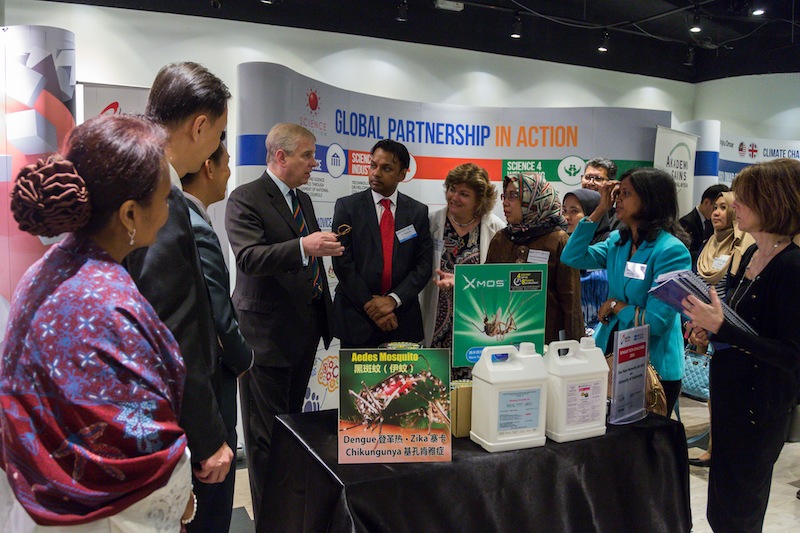
KUALA LUMPUR, July 14 — Agensi Inovasi Malaysia (AIM), SME Corporation Malaysia (SME Corp) and PlaTCOM Ventures Sdn Bhd, in collaboration with the British Council, organised the Dengue Tech Challenge 2016, a proactive approach taken to support proposals for collaborative projects that bring together experts from Malaysia and the United Kingdom to focus on commercialisation of dengue-related research and products in Malaysia.
Dengue fever is a viral infectious disease transmitted by mosquitoes. Despite concerted dengue control programmes, dengue fever remains a major public health challenge in Malaysia.
According to the World Health Organisation (WHO), as of 20 June 2015, there were 53,823 cases of dengue with 158 deaths reported in Malaysia in 2015.
This is 34 per cent higher compared to the same reporting period in 2014. In one specific period, from June 14 to 20 2015, there were 2,348 cases of dengue reported, which was 8.6 per cent higher than the number of cases reported in the previous week.
Despite continuing efforts in fighting this disease, prevention and control efforts face many challenges and, to date, the approaches have largely been reactive.
The aims of the Challenge are to:
- support commercialisation of dengue research between organisations from Malaysia and United Kingdom;
- provide proactive solutions to dengue outbreaks in Malaysia; and
- provide a platform for industry-academia commercialisation collaboration activities in Malaysia and United Kingdom.
PlaTCOM Ventures Sdn Bhd is the national technology commercialisation platform of Malaysia and a wholly-owned subsidiary company of Agensi Inovasi Malaysia (AIM) formed in collaboration with SME Corporation Malaysia under one of its six High Impact Programmes (HIPs) in the SME Master Plan 2012-2020.
The British Council is the UK’s international organisation for cultural relations and educational opportunities spanning across 191 offices in 110 countries and territories.
This Challenge is funded through the High Impact Programme 2 (HIP2) of PlaTCOM Ventures and the Newton-Ungku Omar Fund of the British Council.
HIP2 provides end-to-end facilitation aimed at assisting Malaysian SMEs to accelerate the development and commercialisation of innovative products/solutions/services in all sectors.
The objectives of HIP2 are as below:
- support the development of new technologies or further develop existing technologies through “filling in the gaps” when specific market barriers stop good innovations from reaching the market;
- support the development of new technologies or further develop existing technologies for the creation of new businesses and generation of economic wealth for Malaysia;
- undertake market driven R&D towards commercialisation of R&D outputs;
- encourage institutions, local companies and inventors to capitalise their intellectual work through Intellectual Property (IP) commercialisation;
- stimulate the growth and increase capability and capacity of Malaysian technology-based enterprises.
The Newton Fund is now a £735 million fund which, through science and innovation partnerships, promotes the economic development and social welfare of partnering countries.
It aims to strengthen science and innovation capacity and unlock further funding through which the UK and partner countries will build strong, sustainable and systemic relationships.
The Newton-Ungku Omar Fund uses science and innovation partnerships between UK and Malaysia.
The applications received can be categorised to diagnostic, treatment, vector control, vaccine and awareness solutions. The majority of the proposals submitted were on diagnostic technologies with a popular trend in point-of-care, high specificity and sensitivity and low cost of production.
Treatment solutions were either drug- or natural-based but the challenge was to provide sufficient scientific data to substantiate proof of concept.
Vector control technologies include auto-dissemination of chemical compounds, and mosquito trapping and deterrence methods. Gamification was also one of the solutions proposed to increase the awareness and knowledge related to the disease and the vector.
After stringent assessments, four teams were selected as winners. The total amounts approved are RM3,308,450 (for the Malaysian SMEs) and £552,017 (for the UK institutes).
The winning teams and their projects are:
- X-Vax Sdn Bhd and University of Cambridge with the project “RetroMAD1 Antiviral Drug as a Therapeutic and Prophylaxis for Dengue”;
- RVR Diagnostics Sdn Bhd and University of Bristol with the project “Point-of-Care Molecular Detection and Serotyping of Dengue Virus”;
- Flexilicate Sdn Bhd and University of Southampton with the project “Rapid, Point-of-Care Dengue Detection Device”; and,
- One Team Networks Sdn Bhd-University of Strathclyde with the project “Lure-and-Kill Technology for Dengue Vector Control.”
In addition to the admission into the High Impact Programme 2 and the grant for commercial development, each of the winning organisations will receive access to Thomson Reuters’ products to support them in their continued efforts to commercialise their dengue-related technologies.
We certainly hope that through this initiative, we can tackle head-front with dengue and defeat it. Thanks to the partnership between PlaTCOM Ventures and the British Council, we can now bring together the brightest minds from Malaysia and also the UK, and join hands in this fight for our country, Malaysia.
It has always been and will be about “Innovating A Better Future Together.”
* Michelle Lim Woodliffe is the HIP2 programme manager.