


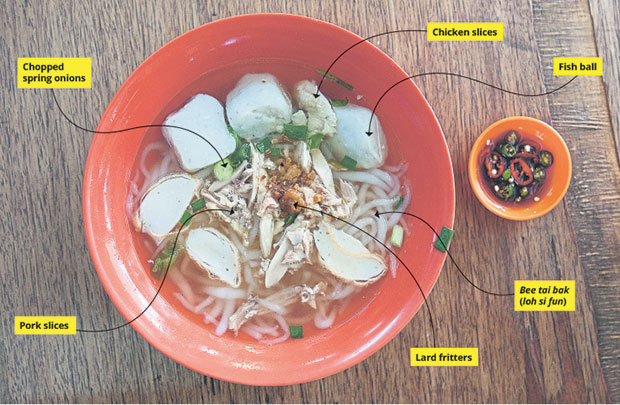
GEORGE TOWN, Nov 8 — Known as loh shi fun in Cantonese (loosely translated as mouse noodles), it is better known as bee tai bak in Penang but no matter what it is called, these short smooth rice noodles are seldom seen nowadays.
In the old days, the humble bee tai bak was a homemade dish where the noodles were made using rice flour, tapioca flour and water. The cooked noodle dough was then pressed through a simple mould to result in odd, uneven, and short noodles, that some say resemble silvery thick needles while others say look like rat’s tails.
The noodles are then cooked in several ways, mostly in clear chicken broth or stir-fried with some meat and greens.
Nowadays, the bee tai bak rice noodles are widely manufactured so you will be hard pressed to find a hawker stall selling homemade noodles instead of the manufactured ones. Even finding hawkers that still sell bee tai bak soup in Penang is not easy.
Though the bee tai bak can be stir fried before being served, in Penang, it is more commonly cooked in a clear soup with some fish balls, pork slices, chicken slices, bean sprouts and topped with spring onions.
Often sold together with koay teow th’ng and served in the same soup base, the bee tai bak is considered an alternative noodle for those who prefer something with more bite.
Though it is served in the same broth as the koay teow th’ng, the bee tai bak somehow has a different flavour. Perhaps because it comes with slightly different ingredients and the consistency of the noodles.
While the koay teow is smooth, soft and flat with hardly any bite to it, the bee tai bak has more substance with a springy consistency and is somehow more filling than the flat rice noodles.
Just like the humble koay teow soup that is light and perfect for days when you need something light and warm, bee tai bak is also equally light and easy on the palate.
It is an uncomplicated, simple and unassuming dish that many tend to forget about and this could probably be why it is often forgotten.
The bee tai bak is not something that is specifically a Penang hawker specialty as it can be found in many other states and in China, Singapore and even Indonesia.
Though its origins are unknown, it is assumed that the noodles originated from China before it was introduced in Malaysia and other countries in South-east Asia.
Some hawker stalls in Penang still do sell bee tai bak, usually in clear broth, so here are four stalls to try out:
Eng Loh Coffeeshop, Penang Street
GPS: 5.418336, 100.340932
Time: 8am-4pm
Kedai Kopi Chong Heap Seng, Jalan Gottlieb
GPS: 5.430693, 100.299894
Time: 7am-12pm
Pek Kong Cheng hawker centre, Jalan Pasar, Bukit Mertajam
GPS: 5.364565, 100.460437
Time: 6pm-midnight
Thean Sean Food Court, Jalan Air Putih
GPS: 5.404826, 100.286561
Time: 7pm-11pm


