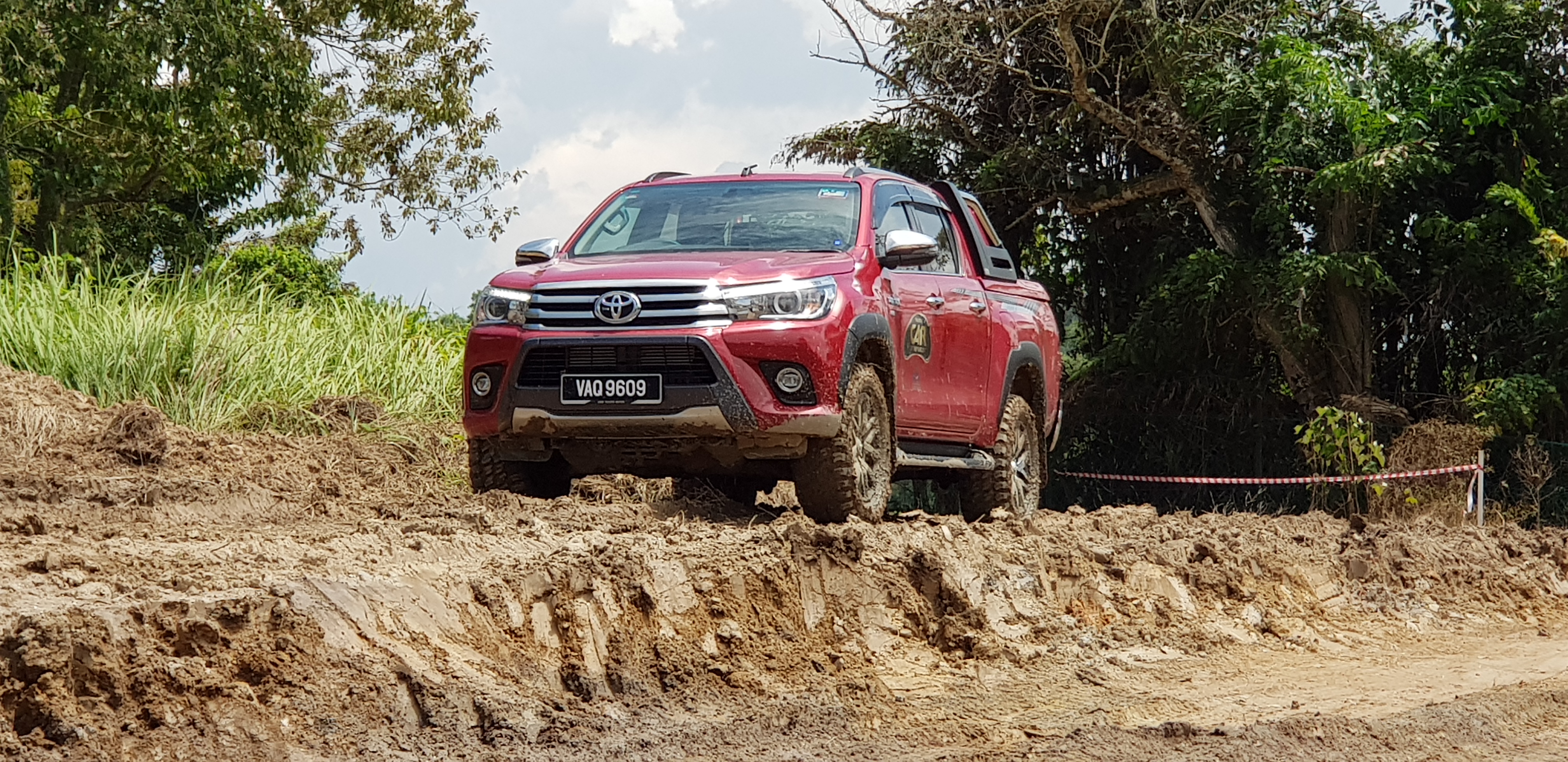
KUALA LUMPUR, Nov 21 — The new specifications for the Toyota Hilux 2.8 make it one of the most technologically-advanced 4 x 4 trucks available in the Malaysian market. For quite a number of years now, the Toyota Hilux has been the market leader in its category, known not only for its toughness but for its durability and reliability as well.
We recently had a rare opportunity to take the new Hilux 2.8G to an off-road location and put it to the test, and we were really surprised as to what it can do when the going gets tough.
It was early November, and an extended period of heavy rains that even resulted in floods in certain parts of P Malaysia – the site at MAEPS in Serdang was not spared either — the track that was originally meant to be a high speed taxi ride turned out to be a quagmire of sorts, with slippery and muddy patches — soft ground conditions and loose, black topsoil didn’t help much — high speeds would be dangerous, and so it became a mud terrain test course instead.
Even the original All-Terrain (AT) tyres had to be replaced.
The new 2.8 litre turbo-diesel delivers 177PS at 3,400rpm, and a whopping 450Nm of torque, available in full from 1,600 to 2,400 rpm. Drive is to the rear wheels under normal circumstances, and part-time 4WD system allows drive to be channeled to the front wheels as well. A six-speed automatic transmission is standard issue.
The Hilux 2.8G has a few features that are really useful when off-road. The first is just its 286mm minimum ground clearance — whilst it is just a number, it really means how deep you can be in mud until you get all ‘hung up’, i.e., with your vehicle body well and truly stuck in the mud, and your wheels scrambling for grip, like a tortoise stuck on rocks, legs flailing in the air; I guess you can get the picture. The Hilux’s ground clearance also means the bottom doesn’t get scraped that easily, and even if it does, there are bottom guards to protect items like the engine sump and the fuel tank.
Two features, namely the Hill Ascent Control (HAC) and the newly-added Downhill Assist Control (DAC) are useful when ascending or descending a steep slope.
The most important feature probably is the Active Traction Control (A-TRC), a more sophisticated form of traction control not found in any of the Hilux’s competitors — it works quietly in the background, transferring drive to the other side of the axle (both front and rear axles) whenever one side experiences wheel slip. When you are off-road, the system is also helping you to find traction when your wheels are sliding and slipping.
Thus, if you happen to be on an off-road trip with your friends who may be driving other 4WD vehicles, where they get stuck, you would most likely be able to get through with ease. Besides, if you really get stuck, you can always engage the rear diff lock, but in our case, we never had to, because the Hilux never got stuck.
We have put together a video showing the Hilux at work at the MAEPS test track, which shows the Hilux getting through some of the muddy areas with relative ease.
Personally, I am impressed — and so I went and got one for myself!