


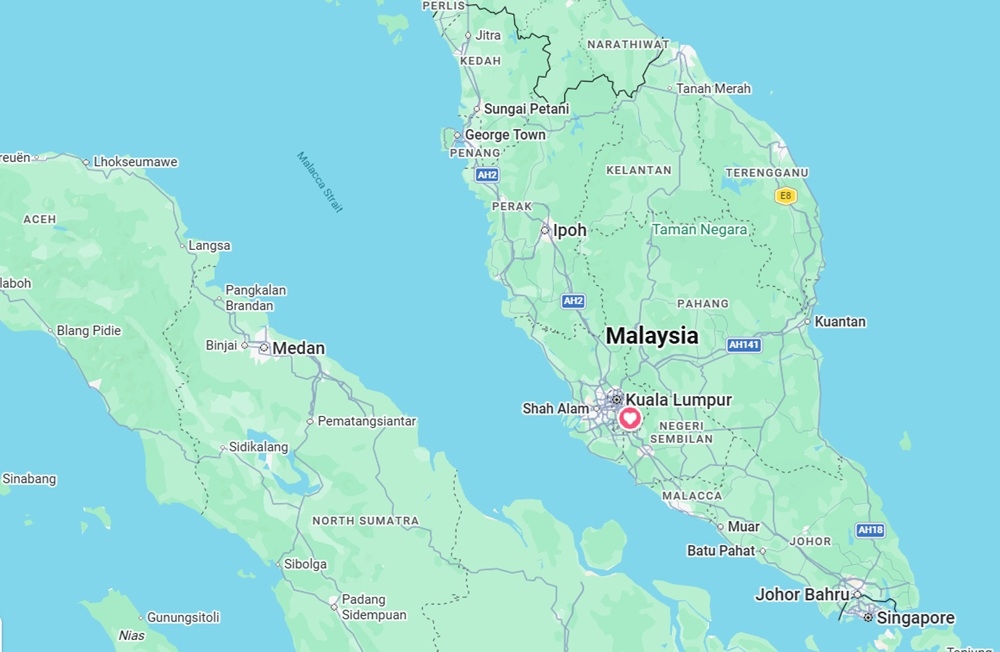
APRIL 20 — Stand on the bridge of a ship crossing the Strait of Malacca at night and you will see the modern world moving past you. Oil tankers carrying Middle Eastern crude glide east toward China, Japan and Korea. Container ships loaded with Asian exports head west toward the Indian Ocean and eventually the Suez Canal on their way to Europe. Somewhere between Singapore and Sumatra, nearly a third of the world’s maritime trade squeezes through a channel barely wide enough in places for two ships to pass comfortably.
Today strategists in Washington talk about it constantly. Chinese analysts worry about it openly. Singapore’s leaders, with characteristic calm, remind everyone that the strait must remain open, neutral and governed by international law.
For many observers this sounds like a modern geopolitical dilemma. It isn’t. More than a thousand years ago, another struggle unfolded across these same waters. It may well have been the first trade war in the Strait of Malacca.
The gate to China
Long before global supply chains and supertankers, the Indian Ocean was already the world’s busiest commercial highway. Arab merchants sailed from the Red Sea. Indian traders crossed the Bay of Bengal. Chinese ships came south carrying silk, ceramics and silver. And between them all sat one crucial passage: the Strait of Malacca. Whoever controlled it controlled access to the markets of China.
In the early medieval period that gatekeeper was the Srivijaya Empire, a powerful maritime kingdom based in Sumatra. Srivijaya was less a traditional land empire than a network of strategic ports and harbours spread across Sumatra and the Malay Peninsula. Ships moving between India and China had little choice but to pass through its waters. Stop in its ports. Pay its duties. Trade on its terms. For centuries, that system worked.
Then the Cholas arrived.
The empire of the Bay of Bengal
By the late tenth century, a new power was rising on the southeastern coast of India. The Chola Empire, under kings like Rajaraja Chola and later his son Rajendra Chola I, built one of the most formidable states in medieval Asia. Their capital in the fertile Kaveri delta commanded thriving ports on the Coromandel Coast. Their armies conquered most of southern India and Sri Lanka.
But the Cholas were not just conquerors of land. They were masters of the sea. Tamil merchant guilds — the Ayyavole, Manigramam and Anjuvannam — had already spread across Southeast Asia, establishing trading communities from Sumatra to China. Their ships rode the monsoon winds across the Bay of Bengal carrying textiles, spices, precious stones and metals. Trade was the lifeblood of the empire. And Srivijaya stood directly in the way.
The raid that shocked Asia
In 1025 AD, Rajendra Chola launched something unprecedented in Indian history. A naval fleet crossed the Bay of Bengal and struck directly at the ports of Srivijaya. The Chola ships attacked key harbour cities across Sumatra and the Malay Peninsula — including Kadaram, widely believed to be modern Kedah. Ports that had once enforced Srivijaya’s control of the strait suddenly found themselves under assault from a navy arriving from across the ocean.
The goal was not conquest. The Cholas did not try to colonise Southeast Asia. Instead, they did something far more strategic. They broke the monopoly. By striking the ports that regulated trade through the Strait of Malacca, the Cholas weakened Srivijaya’s ability to control maritime traffic and opened routes for Tamil merchants to reach China directly. In modern language, it looked remarkably like a trade war.
A global economy — a millennium ago
What makes this episode remarkable is not just the violence of the raid, but the scale of the system in which it occurred. The eleventh century Indian Ocean was already a globalised world. Three powerful regions dominated its trade routes: Song dynasty China, the Fatimid Caliphate in Egypt, and the Chola Empire in India. Between them stood Southeast Asia, whose ports connected these great economies.
Ships carried spices from the Indonesian archipelago, cotton textiles from India, ceramics from China and silver from the Middle East. Ports from Aden to Guangzhou were linked by merchants, navigators and seasonal winds. Control the chokepoints, and you controlled the flow of wealth. The Cholas understood that. So did Srivijaya.
The strait that empires always notice
Fast forward a thousand years. Today the Strait of Malacca remains one of the most important maritime corridors on Earth. Nearly 100,000 ships pass through it every year. For China, it is the artery through which much of its oil supply flows — what strategists call the “Malacca dilemma.” For the United States, it is a strategic chokepoint that could become critical in any future conflict in Asia. For Singapore, sitting at the southern mouth of the strait, it is both a blessing and a responsibility: a global trade artery that must remain open to all.
The same conversation — about chokepoints, access and control — echoes again in modern geopolitics.
The other strait
Look westward and you will find another narrow gateway under constant tension: the Strait of Hormuz. In recent weeks, tensions between Iran and the United States have once again pushed the region to the brink. Markets reacted instantly. Oil prices jumped sharply as traders feared the possibility of disruptions to shipping through the strait. Nearly a fifth of the world’s oil supply passes through Hormuz. Any threat to that narrow waterway sends shockwaves through global energy markets — from New York to Tokyo.
The geography is different. But the strategic logic is identical to Malacca. The world’s vast oceans are often controlled by very small pieces of water.
The sea remembers
History rarely repeats itself neatly, but it does echo. The Cholas could raid Srivijaya’s ports, but they could not permanently dominate Southeast Asia. The Portuguese later seized Malacca in 1511, only to watch Asian trade networks adapt and survive. Empires rise. Empires fall. But the ships keep sailing.
And every generation eventually rediscovers the same uncomfortable reality — that global commerce depends on fragile maritime corridors that have been contested for centuries.
Tonight, somewhere in the dark waters between Sumatra and Singapore, another convoy of ships will glide through the strait. Most of their crews will be thinking about cargo, weather and schedules. But the water beneath them carries the memory of a much older story. The first trade war in the Strait of Malacca happened a thousand years ago. The argument over who controls the world’s chokepoints never really ended.
* This is the personal opinion of the writer or publication and does not necessarily represent the views of Malay Mail.


