


JANUARY 23 — On January 7 this year, the Kota Kinabalu High Court allowed the application of a father, Abdul Manap bin Bakusai @ Abu Bakar, and his three children to rectify their MyKad records pertaining to their religion, namely to change it from Islam to Christianity.
The presiding judge, Datuk Celestina Stuel Galid, held that the plaintiffs had successfully proved, on the “balance of probabilities,” that they had never been Muslims, and that the error was caused by improper entries made by the officers of the National Registration Department.
The plaintiffs discovered the error after receiving their identity cards. After unsuccessful attempts to rectify the matter through the National Registration Department, they filed an application before the court to correct their religious records on their identity cards.
The documentary evidence adduced by the plaintiffs included baptism certificates, letters from churches, as well as their grandparents’ identity cards, all of which were accepted by the court as supporting the plaintiffs’ case.
Abdul Manap, who is illiterate, had relied on officers of the National Registration Department to complete the MyKad application forms on his behalf and affixed his thumbprint to the forms.
The court found that the National Registration Department had not established that the plaintiffs professed Islam, relying instead on the religious records appearing on the identity cards and the application forms. There was also no affidavit evidence to justify why the fourth plaintiff’s MyKad recorded her religion as “Islam” when her application form stated otherwise.
The court emphasised that the present case did not involve renunciation of Islam. In granting the plaintiffs’ application, the court also expressed concerns over the act of assigning religion to an individual without a proper basis, observing that such an act would be contrary to the individuals’ wishes and would infringe their freedom of religion guaranteed by the Federal Constitution.
Indeed, the wrongful entry of religious records on MyKad has been a recurring administrative problem for years.
A study by Pg Ismail Pg Musa and Siti Zubaidah Ismail examined applications for renunciation of Islam received by the Syariah High Courts in Kota Kinabalu and Keningau, Sabah, between 2000 and 2010. According to their article published in 2015 in Jurnal Syariah, the largest category — constituting 52 cases — were in fact filed by non-Muslims of diverse ethnic backgrounds, including Dusun, Kadazan, Rungus, Iban and Murut communities.
The applicants sought to rectify the word “Islam” on their identity cards, with the primary reason being that the presence of the commonly Muslim-associated patronymics “bin” and “binti” in their names had led the National Registration Department to classify them as Muslims.
The study concluded that the majority of the so-called “conversion” cases were, in substance, efforts to establish the applicants’ true religious status rather than attempts to renounce Islam.
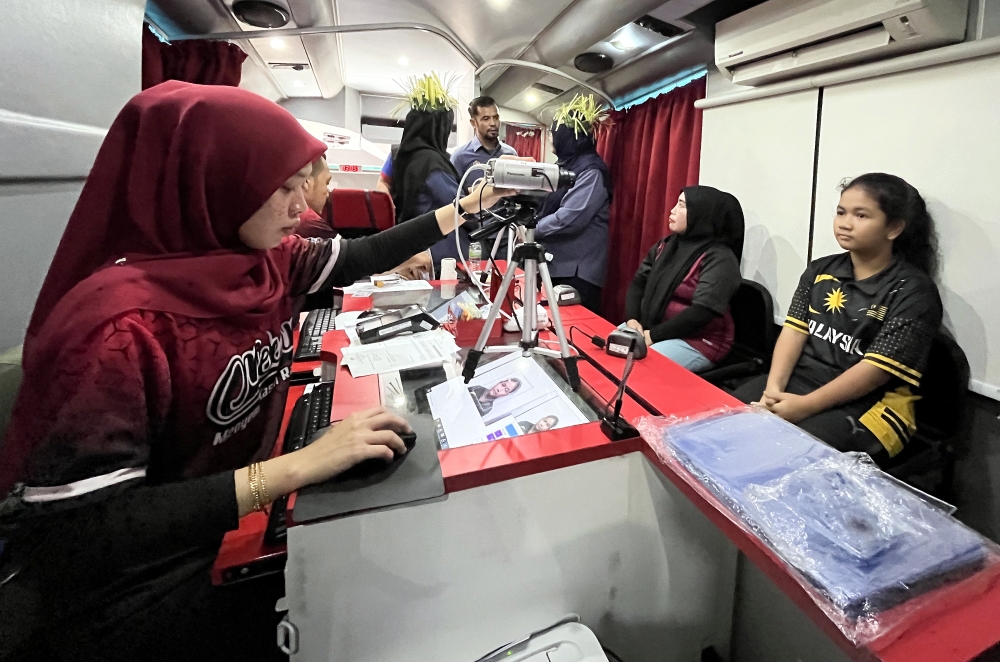
Although the data were collected fifteen to over twenty years ago and were limited to cases handled during a specific period by the Kota Kinabalu and Keningau Syariah High Courts in Sabah — without including comparable applications filed through the civil courts or other Syariah courts elsewhere in Malaysia to rectify erroneous religious information on identity cards — the recent decision of the Kota Kinabalu High Court in the case of Abdul Manap and his children demonstrates that such human errors should no longer be allowed to continue.
When a non-Muslim whose MyKad is erroneously recorded as “Islam” does not seek rectification, the individual will be misclassified as a Muslim, with far-reaching consequences for daily life.
So long as the MyKad continues to state “Islam,” such a person is legally unable to marry another non-Muslim. If the individual does not pursue legal remedies, or is prevented from doing so by illiteracy or lack of access to legal advice, and subsequently has children without having lawfully married, the children would be deemed illegitimate under the law. This, in turn, gives rise to further legal and social complications.
Moreover, if the erroneous religious records on the identity cards remain uncorrected, upon the individual’s death, his estate will be administered in accordance with Syariah law. While it remains possible to obtain a judicial declaration on the deceased’s religious status, errors in the religious information recorded on identity cards are, in principle, avoidable.
In Malaysia’s dual legal system, where civil and Islamic legal regimes operate concurrently, the misclassification of religion as “Islam” on an identity card carries far-reaching legal consequences, particularly in relation to marriage, inheritance and the individual’s freedom of religion.
It is therefore imperative that the National Registration Department exercise heightened diligence in processing identity documentation, especially concerning religious information. This is to prevent unnecessary litigation, personal distress, adverse legal consequences, and the substantial expenditure of time and financial resources that such errors inevitably entail.
*Dr Kuek Chee Ying is a senior lecturer at the Faculty of Law, Universiti Malaya and may be reached at [email protected]
** This is the personal opinion of the writer or publication and does not necessarily represent the views of Malay Mail.


