


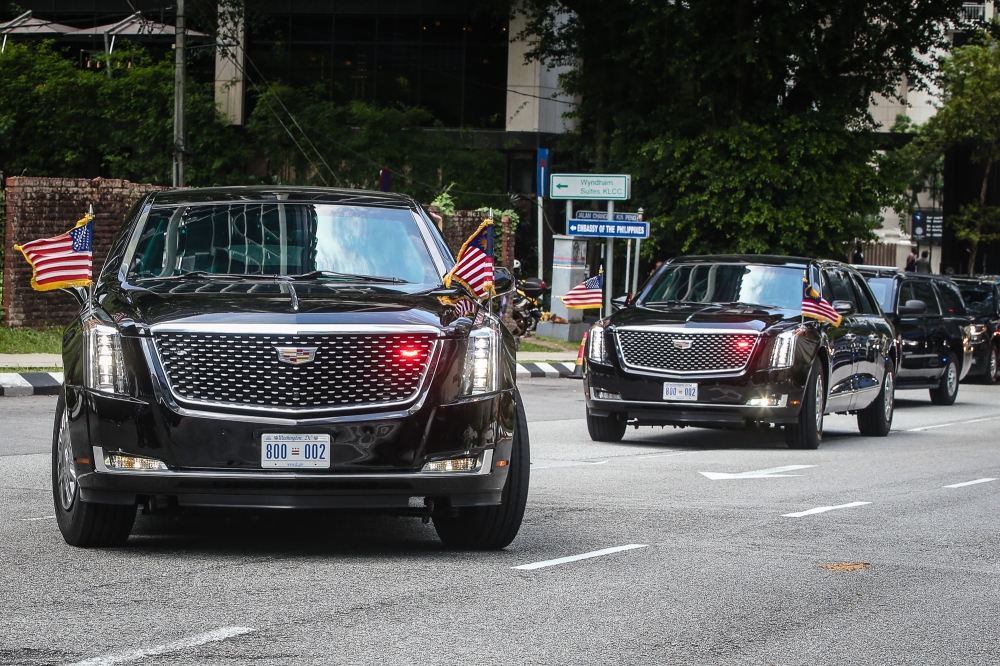
OCTOBER 26 — There are moments in international relations when two figures—so starkly different in temperament, philosophy, and style—end up driving the same vehicle of history. In 2025, that vehicle is “The Beast”: the armoured limousine that carries not just the President of the United States but, symbolically, the weight of global expectations, fears, and opportunities.
When Donald Trump re-enters the Asean and East Asia Summit circuit, and Malaysia’s Prime Minister Anwar Ibrahim sits across from him in Kuala Lumpur, the “Beast” is no longer just a car. It becomes a metaphor for the unpredictable yet necessary convergence between American power and South-east Asian pragmatism.
When Anwar was invited into the Beast by President Donald Trump, it was not a mere break of protocol, but the willingness of the US to get into the heaviest armoured vehicle in the world. It is not just bulletproof, according to Associate Professor Chin Jit Kai, but nuclear protected.
IINTAS had, in fact, predicted that Anwar would one day ride with Trump into The Beast prior to his visit in Malaysia—a moment of historic symbolism and strategic importance. What does this signify? A private, bilateral dialogue with the President of the United States inside the most secure vehicle ever built.
According to Professor Jit Kai Chin, “The Beast” is not merely bulletproof; it is engineered to withstand chemical, biological, and even nuclear attacks. Weighing nearly nine tonnes, it features armour plating, run-flat tyres, satellite communications, and a secure launch system for “the football”—the US nuclear command briefcase. To be inside such a fortress on wheels is not only a mark of trust but also a privilege to discuss matters of immense global consequence.
Only three leaders have ever shared that space: Vladimir Putin, Mohammed bin Salman (MBS), and now, Anwar Ibrahim. For Malaysia, and indeed for the broader Gulf Cooperation Council (GCC) and Asean, this moment stands as a powerful affirmation of strategic respect and diplomatic recognition.
A meeting of contrasts and consequences
Trump represents raw, transactional politics—his decisions are often impulsive but carry the gravity of the United States’ economic and military preponderance. Anwar, by contrast, is a deliberative statesman whose political survival has been forged through decades of reformist struggle and moral clarity. Yet, when the two meet, their political energies create a paradoxical synergy. Trump’s volatility demands an interlocutor who can anchor, temper, and redirect it; Anwar’s strategic patience requires a foil who can amplify Malaysia’s voice on the world stage.
Their meeting in Kuala Lumpur thus symbolises more than diplomatic choreography. It is a balancing act between the tempestuous power of America’s populist presidency and the steady hand of Malaysia’s civilizational diplomacy—one rooted in moderation, inclusion, and non-alignment. This fusion of extremes is what gives Asean its quiet resilience and Malaysia its renewed prominence.
Anwar’s moral realism and strategic flexibility
Anwar Ibrahim’s statecraft can be described as moral realism: a synthesis of ethical leadership and pragmatic flexibility. He understands that in an era where every superpower pursues self-interest cloaked in moral rhetoric, small and middle powers must navigate through complexity without losing their soul. Anwar’s Malaysia is the bridge-builder—between East and West, Islam and Confucianism, and now between Trump’s Washington and Xi Jinping’s Beijing.
When Trump’s convoy—“The Beast”—rolls into Kuala Lumpur, Anwar sees opportunity in the chaos. The US–China trade war is not merely an economic confrontation but a test of regional autonomy. Under Malaysia’s Asean chairmanship, the region has chosen “Quiescent Diplomacy”: quiet engagement, firm neutrality, and results-oriented dialogue. Anwar’s instinct is not to balance Trump and Xi, but to synchronize their competing agendas toward the collective benefit of Asean’s 700 million people.
In this sense, Anwar is not just a host; he is a conductor orchestrating great-power rivalries into regional harmony. He knows that Trump’s desire for quick deals can be redirected toward mutually beneficial trade pacts, provided Malaysia and Asean frame them as victories for all sides—an art of diplomacy that only a leader seasoned in both Islamic and Asian ethics can execute.
Trump’s search for legacy and leverage
Donald Trump’s return to the global stage, meanwhile, is marked by a paradox of his own making. His “America First” rhetoric isolates allies, yet his craving for historical immortality forces him to seek grand bargains. Asia, for Trump, is both a market and a mirror—a region that validates American primacy when it cooperates and exposes American vulnerability when it resists.
In Trump’s worldview, leaders like Anwar are valuable precisely because they are independent. They represent voices that cannot be bought or bullied but can be persuaded through respect and mutual recognition.
That is why, behind the bluster of tariffs and executive orders, Trump has repeatedly shown fascination for leaders who can command both domestic legitimacy and moral authority.
Anwar, in this calculus, is a partner who can deliver what Trump’s diplomacy often lacks: credibility. When Anwar speaks of an “Asean-led peace,” it appeals to Trump’s instinct for winning without endless wars.
When Malaysia promotes neutral corridors for trade between China and the US, it offers Trump the optics of strength without confrontation. Trump’s political genius—however erratic—lies in recognizing that optics matter as much as outcomes, and Anwar provides both.
“The Beast” as a metaphor for power and resilience
The sight of Trump’s “Beast” gliding through Kuala Lumpur’s avenues captures a deeper symbolism. The vehicle, a fortress on wheels, embodies the American obsession with security—thick armour, sealed compartments, self-contained air systems. It moves through the world invulnerable yet isolated. That isolation mirrors the very dilemma of US foreign policy: supreme in strength but insecure in purpose.
Anwar’s diplomacy, in contrast, is open-air. He believes in exposure, dialogue, and the slow work of consensus. Yet, both approaches must meet halfway if global peace is to be sustained. “The Beast” must occasionally open its doors, and Anwar’s Malaysia must occasionally shield itself from the harsh winds of global competition.
Between security and openness lies the narrow road to coexistence—and Kuala Lumpur is where that experiment unfolds.
The wider stakes for Asean and the world
The meeting between Trump and Anwar does not occur in a vacuum. It comes at a time when Asean is managing border flare-ups, economic uncertainty, and digital insecurity. From Cambodia and Thailand’s fragile ceasefire to the REE (rare earth element) competition involving Indonesia and Malaysia, the region’s stability depends on leaders who can think beyond their national horizons.
Anwar’s chairmanship of Asean offers precisely that. His emphasis on an “Asean Power Grid,” an “Asean Trans-Railway,” and a “Digital Peace Accord” aligns regional prosperity with interdependence rather than rivalry. Trump, for all his protectionism, understands the power of deals that look good and deliver jobs. If Anwar can frame Asean’s initiatives as economically advantageous to the US—without compromising regional autonomy—he may achieve what few have done: turning America’s transactionalism into a catalyst for multilateral cooperation.
The road ahead
History often remembers meetings that changed the course of global relations—the Nixon–Mao handshake, the Reagan–Gorbachev summit, the Kim–Trump spectacle. Kuala Lumpur 2025 could join that list, not because of theatrical breakthroughs but because it embodies something subtler: the coexistence of force and faith, audacity and restraint.
Anwar Ibrahim’s quiet persuasion and Trump’s loud unpredictability are two halves of a global paradox—both necessary for a world drifting between confrontation and cooperation. “The Beast,” in the end, is more than the American president’s car; it is the vessel carrying humanity’s struggle between might and morality. And in Kuala Lumpur, for one crucial week, both men are its drivers.
* Phar Kim Beng, PhD is the Professor of Asean Studies at International Islamic University of Malaysia and Director of Institute of International and Asean Studies (IINTAS).
** This is the personal opinion of the writer or publication and does not necessarily represent the views of Malay Mail.


