


SEPTEMBER 25 — When people think of South-east Asia, they often imagine a single geographic or cultural unit: ten, soon eleven, countries strung between the Indian and Pacific Oceans.
Some reduce it to a simple binary of “maritime South-east Asia” and “continental South-east Asia,” as if seas and rivers alone defined the contours of its diversity. But South-east Asia has always been more than a tidy cartography.
It is a multiplicity of lived experiences, political trajectories, economic contradictions, and historical legacies.
To understand this region as merely a sum of its physical parts is to miss the profound complexities that animate it.
Today, South-east Asia is at once aspirational, fractured, dangerous, emancipatory, rules-based, vulnerable, and scholarly. Each of these facets reveals a South-east Asia of its own.
Together, they form a mosaic of identities and challenges that no summit communiqué, trade agreement, or diplomatic slogan can fully capture.
The aspirational South-east Asia of Asean centrality
The first South-east Asia is the one crafted by state leaders and diplomats, the South-east Asia of Asean centrality. Since the founding of Asean in 1967, and later the East Asia Summit in 2005, leaders have repeatedly affirmed their collective vision of a peaceful, prosperous, and integrated region. They inscribe this aspiration in flowery language at every summit.
Here, South-east Asia is a beacon of multilateralism. It is the imagined community where unity is assumed, cooperation is the norm, and centrality is safeguarded. The Asean Charter, the Bali Concords, and the Kuala Lumpur Vision 2045 all depict this region as a cornerstone of stability, one that balances the interests of great powers while deepening intra-regional solidarity.
This is the South-east Asia that embraces centrality not only as a diplomatic principle but also as an insurance policy against marginalisation in a world where the United States and China dominate strategic calculations.
But aspirational language is not reality. Which brings us to another South-east Asia.
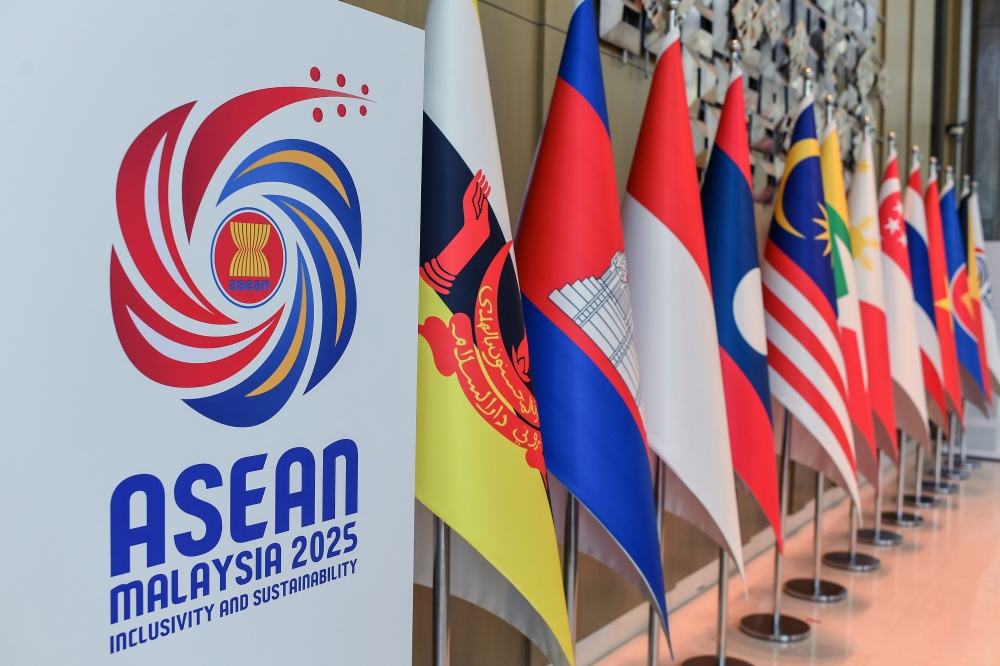
The South-east Asia of gaps between rhetoric and reality
The second South-east Asia is found in the statistical tables of trade and investment, where lofty declarations collide with stubborn economic realities. Since the launch of the Asean Free Trade Area (AFTA) in 1992, tariffs on 99 per cent of traded goods have been reduced to between zero and five percent. On paper, this is an extraordinary achievement.
And yet, intra-Asean trade remains stuck at around 23 per cent of the region’s total trade — a level virtually unchanged since the 1970s, when Asean had only five members. Even as the grouping expanded to ten members in 1999 and prepares to welcome Timor-Leste as its eleventh in October 2025, the figure has barely budged above 25 per cent.
This South-east Asia is defined by the chasm between rhetoric and reality. Tariffs may be gone, but non-tariff barriers, logistical inefficiencies, and protectionist instincts continue to stifle real integration.
Leaders may extol Asean’s collective economic weight, but the fact remains: the region trades more with China, the United States, and the European Union than it does with itself. Aspirations are grand; delivery is modest.
The dangerous South-east Asia of scams and trafficking
A third South-east Asia is darker, more sinister, and far less visible in summit speeches.
This is the South-east Asia where digital scamming syndicates, cybercrime networks, and human traffickers thrive. Along the porous borders of Cambodia, Myanmar, and Laos, entire towns have been converted into hubs of fraudulent call centres, online scams, and bonded labour.
Here, technology and exploitation intersect. Thousands of people, many from within South-east Asia itself but also from China, India, and Africa, are lured by false promises of employment only to find themselves trapped in modern-day slavery.
Cybercrime has become a regional scourge, costing billions of dollars annually, corroding trust in digital platforms, and undermining the credibility of governments that cannot or will not confront the problem.
This South-east Asia is not aspirational; it is dangerous. It represents a geography of insecurity that Asean’s communiqués rarely acknowledge yet which gnaws at the region’s moral fabric and reputational standing.
The emancipatory South-east Asia of Bandung
There is also a South-east Asia still animated by a spirit older than Asean itself: the drive to break free from colonial legacies and imperial domination. This is the South-east Asia that looks back to the 1955 Bandung Conference, where Asian and African leaders gathered to declare no imperialism, no domination, no exploitation.
This South-east Asia aspires to align itself with the Global South, insisting that Afro-Asian solidarity is not a relic but a living principle. It is wary of being pulled apart by the competing gravitational pulls of Washington and Beijing. It insists that the region should remain faithful to the Bandung ethos of independence and dignity.
In this vision, South-east Asia is not merely a passive arena of great-power rivalry but an active shaper of a new, post-colonial global order. The Global North may attempt to divide the Global South, but South-east Asia insists that it is part of an unbroken tradition of resistance to domination.
The rules-based South-east Asia of trade and technology
There is another South-east Asia that is pragmatic rather than ideological: the South-east Asia seeking to anchor itself in a rules-based international order. This version is focused on food security, sovereignty, and supply-chain resilience. It recognizes that the region’s abundance of semiconductors, rare earths, and critical minerals places it at the heart of twenty-first-century geopolitics.
Malaysia’s National Semiconductor Strategy, Vietnam’s rare earth deposits, and Indonesia’s nickel reserves exemplify how South-east Asia is positioning itself as indispensable to global production networks.
This South-east Asia seeks not just integration but protection — protection from weaponised tariffs, supply disruptions, and external shocks. It wants to be a secure node in the global economy, bound by international trade law and best practices, rather than a vulnerable hinterland at the mercy of others’ strategic choices.
The vulnerable South-east Asia of climate change
Yet another South-east Asia exists in the rising seas and shifting monsoons. This is the South-east Asia tied intimately to the fate of the South Pacific.
Among all the world’s regions, this geography is among the most vulnerable to climate change. From the sinking villages of the Mekong Delta to the storm-ravaged coasts of the Philippines, climate change is not a distant threat but a present reality.
Here, South-east Asia’s survival depends not only on adaptation but also on solidarity with Pacific Island nations.
The fates of Tuvalu, Kiribati, and Vanuatu are bound up with those of Indonesia, Malaysia, and Thailand. If South-east Asia aspires to centrality, it must also recognise its responsibility: to champion a global response to climate change commensurate with the risks it faces.
The academic South-east Asia of the historians
Finally, there is the South-east Asia preserved in the pages of scholarship. This is the safest South-east Asia, unthreatened by trade deficits, cybercrime, or rising seas. It is the construct of historians and scholars such as D.G.E. Hall, Nicholas Tarling, Osman Bakar, Wang Gungwu, Anthony Reid, Khoo Kay Kim, and James Scott.
This South-east Asia is pristine, defined by debates over early trade networks, the rise of states, and the cultural exchanges that shaped the region across centuries.
In the academy, South-east Asia can be conceptual, bounded by theory rather than politics, a canvas on which intellectuals map civilizations, migrations, and revolutions. This South-east Asia will never be fully congruent with the South-east Asias of policymakers or traffickers. Yet it remains indispensable, offering a lens of depth and continuity that tempers the immediacy of political crisis with the perspective of history.
Conclusion: Embracing the multiplicity
To speak of South-east Asia, then, is to speak of many South-east Asias. It is a region of aspirations and failures, dangers and emancipations, rules and vulnerabilities, histories and futures.
The challenge for policymakers, scholars, and citizens alike is to resist the temptation of simplification. We must hold together these multiple South-east Asias in our minds at once.
For Asean to be meaningful, it must bridge the gap between its aspirational centrality and its trade stagnation.
For South-east Asia to be secure, it must confront the scourges of scams, trafficking, and cybercrime.
For the region to be dignified, it must honour its Bandung legacy. For it to be prosperous, it must safeguard its rules-based order in trade and technology. For it to survive, it must address climate change head-on. And for it to remain intelligible, it must be continually studied, debated, and re-imagined by scholars.
Only by acknowledging these multiple South-east Asias can we begin to craft policies, partnerships, and futures that are faithful to the complexity of the region. To collapse South-east Asia into a single category — whether continental, maritime, or otherwise — is to betray its richness.
It is time we embrace South-east Asia not as a singular geography but as a plural condition.
* Phar Kim Beng, PhD, is professor of Asean Studies at the International Islamic University of Malaysia and director of the Institute of International and Asean Studies (IINTAS).
** This is the personal opinion of the writer or publication and does not necessarily represent the views of Malay Mail.


