












SEPT 3 — Indonesia, the region’s largest democracy and home to more than 270 million people, has once again reminded the world that its political equilibrium sits on fragile ground.
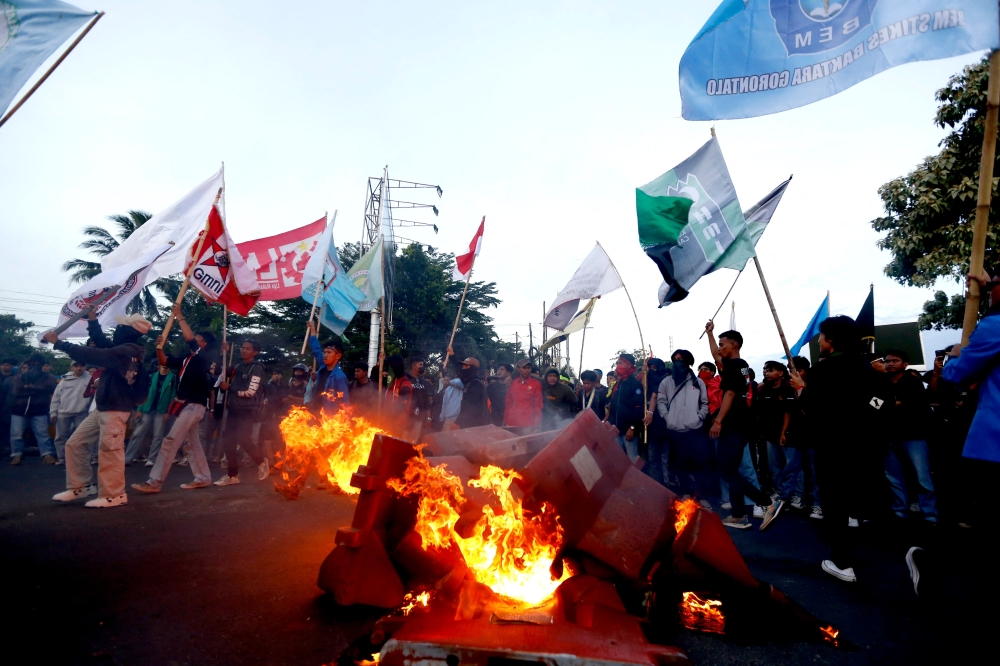
The spasms of violence that erupted across its provinces — triggered by public fury over parliamentary perks, excessive allowances, and a tragic protester’s death — were not random bursts of anger.
They were collective expressions of frustration by a society increasingly weary of ostentation in power and neglect in governance.
For a brief moment, chaos overwhelmed order.
Police posts and government buildings burned, protests spread across Java and Sumatra, and the death toll mounted.
Faced with the collapse of public safety, President Prabowo Subianto called upon the Indonesian military to reinforce overstretched police forces.
Soldiers took to the streets, manning checkpoints and guarding infrastructure.
The visible presence of the armed forces quelled the unrest, but only temporarily.
Repression has created a fragile calm, not a sustainable peace.
Deeper grievances remain
At the heart of the anger lies the perception of betrayal: while ordinary Indonesians struggle with low wages, rising taxes, and inadequate opportunities, lawmakers insulated themselves with luxury.
Such acts of tone-deaf governance erode trust in democratic institutions.
The youth, the largest segment of Indonesia’s population, view their futures as compromised — blocked by nepotism, entrenched elites, and institutions more interested in privilege than service.
Herein lies the paradox: Indonesia is too important to fail.
Its stability is not just a national matter but a regional necessity.
Implications for Asean
As the largest economy in Southeast Asia and the anchor of Asean, Indonesia provides the ballast for the region’s collective credibility.
Without Jakarta’s steadying presence, Asean’s claim to be a central platform in Asia’s turbulent geopolitics would quickly unravel.
Consider the alternative.
If protests escalate once more, and the military entrenches itself deeper into civil governance, Indonesia risks sliding into a hybrid order — part democracy, part military tutelage.
Such regression would not only betray the spirit of Reformasi that toppled Suharto in 1998, but also send shockwaves across Asean, where democratic aspirations already hang by a thread.
Myanmar’s military dictatorship has plunged that country into civil war; Thailand continues to wrestle with its own civil-military balancing act.
If Indonesia falters, the prospect of a Southeast Asia defined by authoritarian drift grows ever stronger.
Asean, already struggling with crises on multiple fronts — from the Thai-Cambodian border clashes to the humanitarian catastrophe in Myanmar — cannot absorb the shock of Indonesian instability.
Its institutions rely on Jakarta’s weight and moral authority.
Indonesia has long positioned itself as the custodian of Asean’s diplomatic balance: a mediator in conflicts, a convener of summits, and a voice bridging the Global South with the West.
If that voice loses credibility, Asean’s convening power diminishes.
Reform, not repression
The way forward must not be repression but reform.
Indonesia must heed the cries of its citizens.
Parliamentary privileges should remain suspended, and independent investigations into protest-related deaths must be credible and transparent.
The military must step back from civil affairs, lest it revive the notorious Dwifungsi doctrine that once blurred the lines between civilian and military rule.
Above all, the government must engage in meaningful dialogue with civil society, students, and labour unions — not as a performance, but as a partnership to rebuild trust.
Indonesia’s future, and by extension Asean’s, hinges on whether Jakarta can turn this moment of crisis into an opportunity for renewal.
A stable, democratic Indonesia strengthens Asean’s hand in managing great power rivalries, negotiating trade pacts, and responding to humanitarian disasters.
A fractured Indonesia, however, would render Asean rudderless at a time when the world expects it to act as a fulcrum of peace and order in the Indo-Pacific.
The calm in Jakarta today may feel like a reprieve, but it is only that — a reprieve.
The embers of discontent are still glowing beneath the surface.
If Indonesia wishes to be the cornerstone of Asean’s future, it must act decisively to restore the trust of its people.
For in the end, the stability of Asean depends on the stability of Indonesia.
* Phar Kim Beng, PhD is the Professor of Asean Studies at International Islamic University of Malaysia and Director of Institute of Internationalisation and Asean Studies (IINTAS).
** This is the personal opinion of the writer or publication and does not necessarily represent the views of Malay Mail.