FIGUERES (Spain)— The walls are candy pink and studded with golden loaves of bread. Perched atop the fort-like walls are gigantic eggs that will never hatch, sitting forlornly among shiny figurines in a multitude of poses while an opaque blue geodesic dome, meant to represent a fly’s eye, rises above all that.
Absurd, delusional, hallucinatory, over the top or maybe even tacky; however you may choose to describe the Dali Theatre-Museum is proof that the Spanish artist Salvador Dali has succeeded in bringing you into the parallel universe that he inhabited. Befittingly the world’s largest Surrealist object, it is a mind-bending showcase that blurs the lines between reality and imagination.
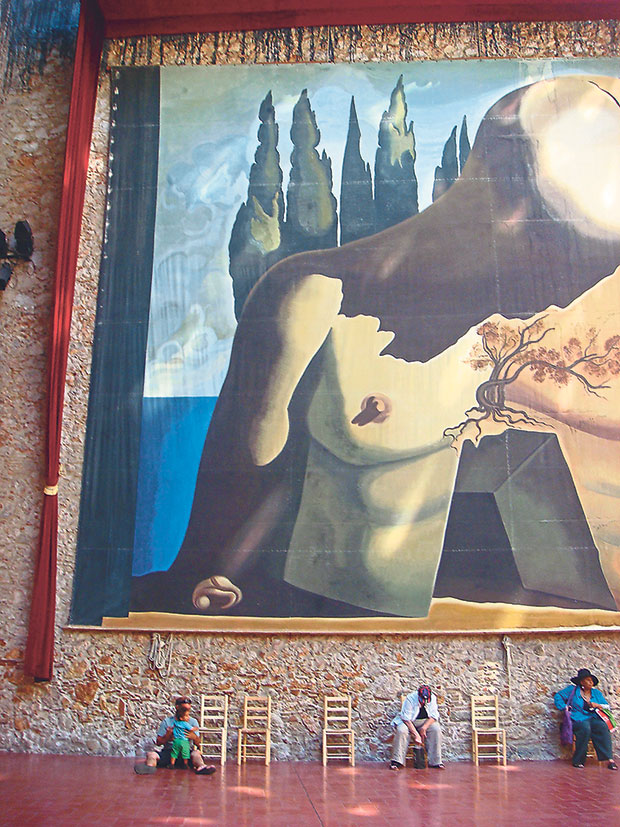
As he had demonstrated through his oeuvre of Surreal art, Dali’s world is one where clocks melt, animals take on human-like forms in gigantic proportions and vice versa, people are depicted in ways that only exist in the wildest of imaginations.
Suspension of disbelief is an expected reaction when faced with his works so you would want to leave your reality behind before stepping inside the gallery that he chose to construct in his hometown of Figueres, about 130 kilometres from Barcelona.
Dali personally saw to every detail of its conception and curation, starting from the very location itself. What used to be the town’s Municipal Theatre had been left in ruins following a fire, a heap of razed rubble that stood in eerie abandonment.
Yet, that was exactly what appealed to Dali, besides his personal sentiments: Dali’s first exhibition, in 1919, had been held in the vestibular hall of the Theatre while the church that stood across from it was where he was baptised.
Furthermore, his works had always dodged the norm and defied expectations. They are, if you will, theatrical expressions of how he viewed life. Could there be a more suited location to build his eponymous museum?
Construction began in the 1960s and the first phase opened to the public in 1974 but the project continued to expand, adding more buildings and courtyards that adjoin the old theatre.
The museum as it is today is considered to be Dali’s last great work (he died in 1989). As its name hints at, it houses more than just art but you can also expect plenty of dramatic flair among more than 1,500 exhibits.
It is the largest and most diverse collection of Dali’s works under one roof that showcases the breadth of his interests and talent: Paintings, drawings, sculptures, engravings, photography, holograms and installation pieces that belong to varied schools of art, from Cubism to Futurism and Surrealism.
The layout is such that it lets you trace Dali’s artistic journey, from his earliest inspirations and works, through his obvious obsession with science and all things mechanical, and includes pieces by other artists that were from his personal art collection as well as by peers he invited to exhibit at his museum.
On any given day, the museum is packed, particularly in summer when it’s practically a carnival in full swing — which Dali would likely approve of as it is a good fit with his statement-making ideas.
Between the excited chatter and jostle of the crowd and the multitude of displays, your senses will be on full alert as you try to take in as much as you can.
Finding some moments of solitude to ponder, mull over and digest the showcases are close to impossible. Yet, that’s what Dali’s works tend to do; they challenge your perspective, elicit emotional responses and tickle your fancy.
In the open courtyard, nude figurines stand proudly on balcony windows and look down onto a 1941 Cadillac — Dali’s personal vehicle, which his beloved wife Gala used to drive – that’s been converted into a coin-operated installation piece called Rainy Taxi. Slip a coin into the slot and it will rain inside the car.
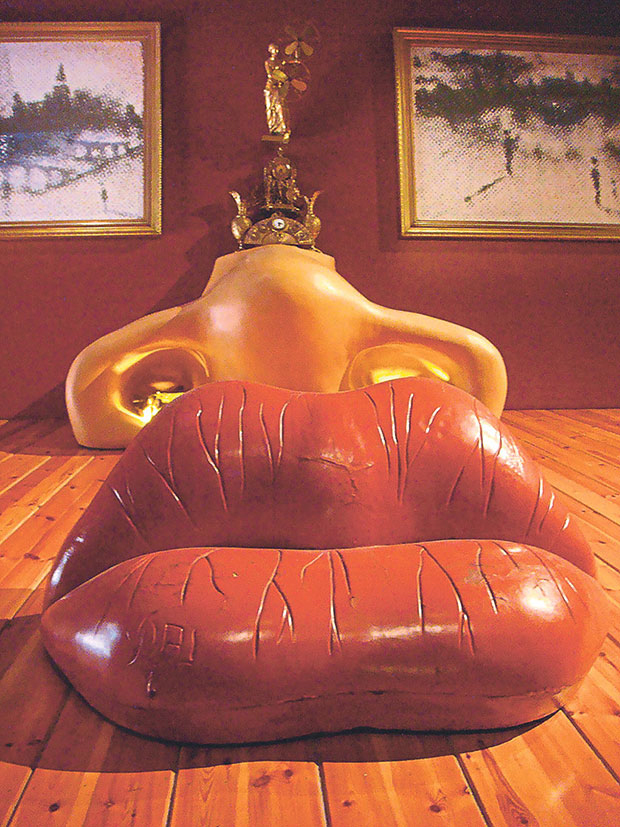
Head to the Mae West Room and what looks like separate pieces of gaudy, humorous furniture – including a sofa in the shape of plump red lips and gold drapery – all come together in an installation that, when seen through a magnifying glass placed at the top of a short flight of stairs, depicts the sultry actress’ face and pouty expression.
Dali was certainly fond of optical illusions; there’s an upside down room where bathroom fittings, including a bathtub, are fixed to the ceiling while an entire section is dedicated to more eye tricks.
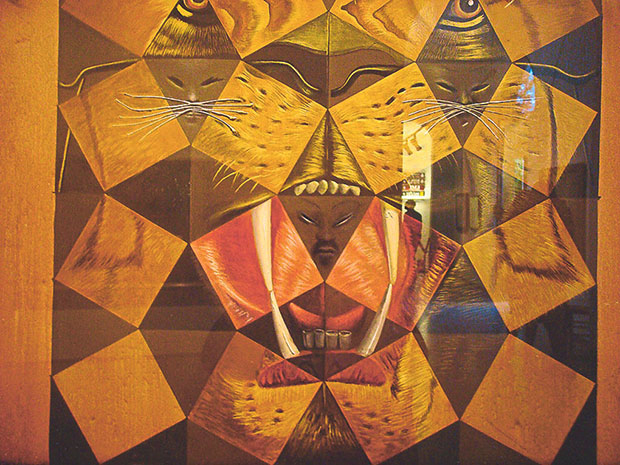
Anamorphic drawings, for example, appear to be undefined lines and curves on paper but when viewed on reflective surfaces, come together to paint a clear picture. Or two, as it is with Fifty Abstract Paintings, a vibrant collage-like piece that shows up different images depending on the distance from which you view it. From about 1.8 metres away, three faces of Lenin with Chinese features stare back at you. At three times that distance, there’s no mistaking the head of a Bengal tiger.
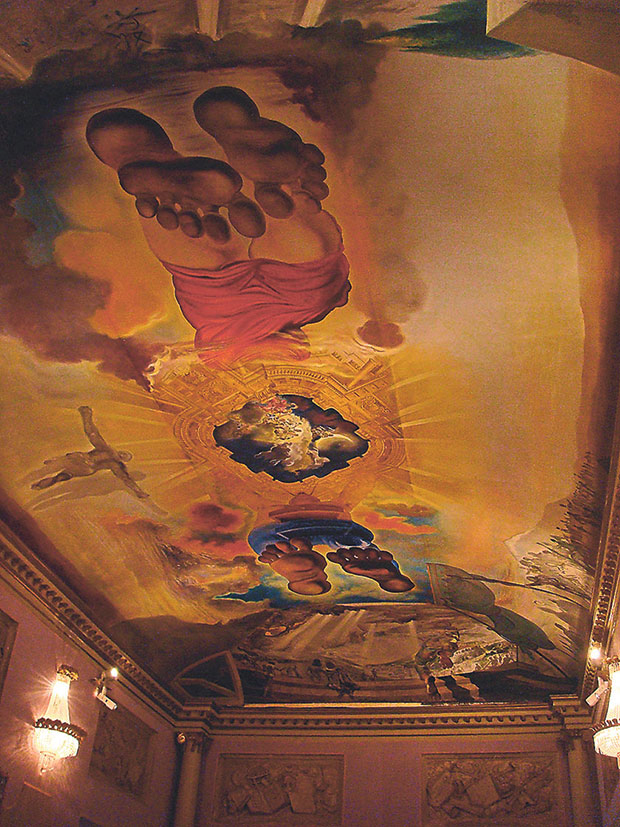
Walking through the rooms and displays, it’s quite clear that Dali nursed a narcissistic streak, often immortalising himself in his works. The Palace of the Wind is one such presentation, a room crowned by a Renaissance-style fresco where he and his wife are depicted levitating and fading upwards.
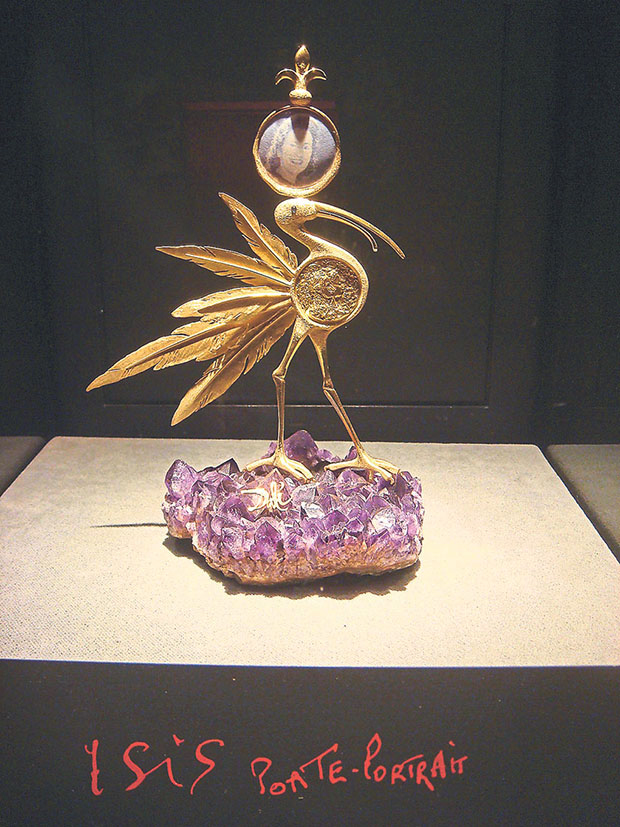
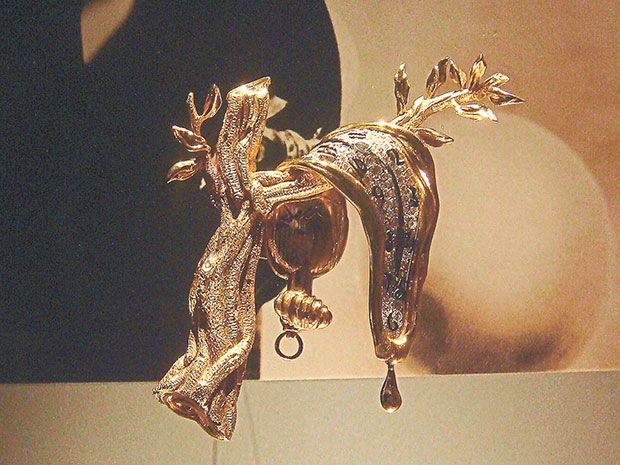
There’s also Dali Joies, a permanent exhibition of jewellery with its own entrance that’s separate from the main museum. The intricate pieces mirror his art so it’s not unlike seeing fragments of Dali’s works manifest in tangible, jewel-crusted forms.
Created over a three-decade period and originally drawn on paper (his original sketches are part of the exhibition), every item is a one-off piece realised through a careful selection of materials – based on the symbolism of precious stones and pure metals – to bring the designs to life.
Some of the pieces have come to be regarded as equally iconic to his paintings, like the El Cor Reial or The Royal Heart, a dazzling brooch encrusted with diamonds and emeralds. Its intriguing quality is this: Nestled within a rectangular space in the middle is the ‘heart’ itself, covered in rubies, that actually pulsates like a human organ.
It’s also a good representation of the museum itself, a tribute to Dali’s art and life that he had poured his own heart into and where his spirit lives on in more ways than one: Below the geodesic blue dome, Dali lies in a crypt, forever connected to the town that birthed him and the museum that he left as his last legacy.
Dali Theatre-Museum Gala-Salvador Dali Square 5, Figueres, Catalonia, Spain.
On the Dali trail
Approximately 40km away, in opposite directions, from Figueres are two other important Dali landmarks:
Salvador Dali House-Museum, Portlligat (Portlligat, E-17488 Cadaques)
Dali and Gala first moved here in 1930 in what was initially a fisherman’s hut, which the former took 40 years to lovingly and patiently transform into their cosy residence and work space. The house is separated into three distinct sections, one each for the couple’s private use, rooms displaying his artistic creations and where they entertained guests, respectively.
Gala-Dali Castle of Pubol (Gala Dali Square, E-17120 Pubol-la Pera)
Dali turned this medieval 14th-century castle into a sanctuary for Gala. It also served as his last working studio, and where he lived following her death in 1982. Like the Theatre Museum, the artist himself saw to every aspect of this castle’s interiors and described it as an extension of their home in Portlligat.
Vivian Chong is a freelance writer-editor, and founder of travel & lifestyle website http://thisbunnyhops.com/