


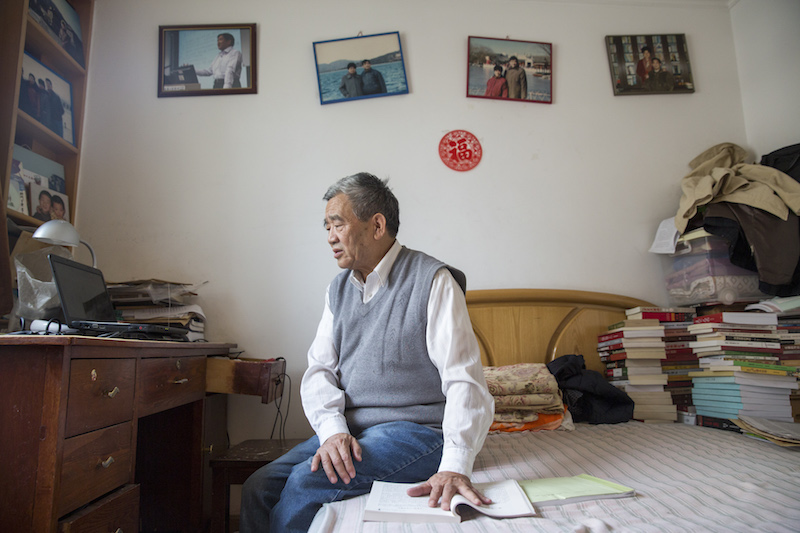
BEIJING, Jan 22 — It seemed that China’s censors had finally muzzled Yang Jisheng, the famed chronicler of the Mao era. Last year, he had finished writing a widely anticipated history of the Cultural Revolution. But officials warned him against publishing it and barred him from travelling to the United States, he has said, and he stayed muted through the 50th anniversary of the start of that bloody upheaval.
Now Yang has broken that silence with the publication of his history of the Cultural Revolution, The World Turned Upside Down, a sequel to Tombstone, his landmark study of the famine spawned by Mao’s policies in the late 1950s. The 1,151-page book is the latest shot fired in China’s war over remembering, or forgetting, the dark side of its Communist past, a struggle that has widened under the hard-line president, Xi Jinping.
“I wrote this book to expose lies and restore the truth,” Yang writes in the book, which has been quietly published in Hong Kong, beyond the direct reach of Chinese censors. “This is an area that is extremely complicated and risky, but as soon as I entered it, I was filled with passion.”
Since Xi took power in 2012, Communist Party authorities have denounced historians who question the party’s lionisation of its past and exhume grim events like the Cultural Revolution, which Mao started in 1966, opening a decade of purges and bloodshed.
Tens of millions were persecuted and perhaps one million or more people were killed in that convulsive time. But officials say dwelling on such events is subversive “historical nihilism” aimed at corroding the party’s authority.
In a sign of how Chinese politics has chilled, Yang has said little publicly about the book.
“Since the book was published, I’ve been told not to discuss it with foreign media,” he said in a brief telephone conversation. He would not say whether he had authorised The World Turned Upside Down to be published in Hong Kong.
“There’s quite a lot of pressure,” Yang said. “I just wanted to restore this big story and the facts behind it, to recover the history.”
Yang, 76, was a university student in Beijing when the Cultural Revolution erupted. He threw himself into the early phase, when Mao unleashed student radicals to purge school leaders and Communist Party cadres.
Yang later worked as a journalist for Xinhua, the state news agency, watching as the fervour of the Cultural Revolution fractured into disarray and disillusionment. After a career in journalism, he turned to writing histories of contemporary China.
Up until several years ago, Chinese newspapers and magazines still published laudatory profiles of Yang. But now he is often denounced by Maoists emboldened by the hard-line pronouncements.
Party journals have attacked his conclusion that up to 36 million people died in a famine from 1958 caused by the Great Leap Forward, Mao’s reckless attempt to leap into a communist utopia, which Yang chronicled in Tombstone. That book was published in Chinese in Hong Kong in 2008.
“Yang Jisheng is not a historian,” an editorial in Global Times, an ardently pro-party Chinese newspaper, said last year. “He leaves the impression that he’s not interested in history, and virtually all his later works display strong political tendencies.”
Now that The World Turned Upside Down has appeared in stores, the next battle will be over whether people get to read it in China, where such books are banned.
The book began appearing in late December in Hong Kong, which keeps its own system of law, including much greater freedom than is found in mainland China. That freedom has shrunk in recent years. Publishers there have been spooked by the 2015 abduction to China of five Hong Kong booksellers who pedalled lurid, poorly sourced potboilers about China’s leaders.
Even so, Hong Kong remains an enclave for books banned in mainland China. Piles of Yang’s book in bookstores there suggest that mainland readers have been buying copies to sneak across the border, despite customs checks.
“Mr Yang’s work is quite influential inside China,” said Jian Guo, who with Stacy Mosher translated Tombstone into English and is translating The World Turned Upside Down with Mosher.
“Yes, some of his books, including Tombstone, are banned on the mainland,” Guo said. “But an electronic version of Tombstone has been floating around since 2008, and an enormous amount of pirated copies has been distributed by small book vendors.”
Guo, a professor at the University of Wisconsin-Whitewater, said the abridged translation of Yang’s latest book would include about two-thirds of its original content.
“We expect to publish in 2019,” Eric Chinski, editor-in-chief of Farrar, Straus and Giroux, said in an email. The company also published an abridged translation of Tombstone in 2012. — The New York Times


