


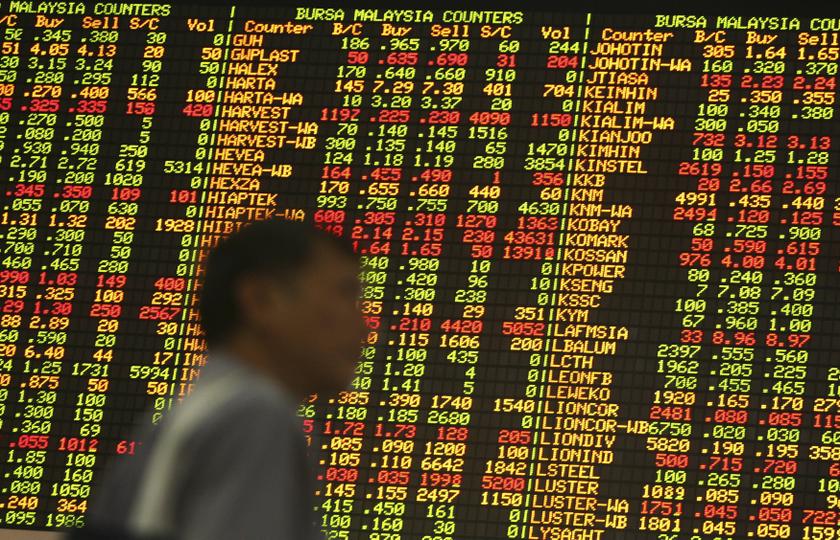


KUALA LUMPUR, June 30 — Malaysia’s benchmark stock index, one of the first to begin rebounding from the global financial crisis, is headed for its smallest first-half return since 2008. The FTSE Bursa Malaysia KLCI Index has gained just 0.8 per cent this year, after rising 127 per cent from its October 2008 low in the longest bull market among nations in the MSCI All-Country World Index.
Record household debt, equity valuations that exceed the average level of the past five market peaks and slower earnings growth at companies from Petronas Dagangan Bhd. to Maxis Bhd. are taking the sheen off Southeast Asia’s second-biggest stock market. While share purchases by the nation’s RM587 billion (US$182 billion) pension fund support prices, money managers at Samsung Asset Management Co. and BlackRock Inc. favour stocks in Thailand and China.
“Valuations are too rich” in Malaysia, Alan Richardson, whose Samsung Asean Equity Fund outperformed 96 per cent of peers tracked by Bloomberg during the past five years, said by phone from Hong Kong. “Growth prospects are constrained by high household debt levels.”
Malaysia’s bull market, defined as a gain of at least 20 per cent without a subsequent drop of the same magnitude from a recent high, has lasted 2,067 calendar days, almost five times as long as the average advance since Bloomberg began compiling the data in 1977. That compares with 1,936 days for the Standard & Poor’s 500 Index, which has climbed about 190 per cent from its March 2009 nadir.
Bull market
The KLCI’s advance from its 2008 low is 37 percentage points bigger than the average 19 previous bull markets. The gauge’s price-to-book ratio of 2.3 compares with a mean level of 2 at the last five rally peaks and a multiple of 1.5 for the MSCI Emerging Markets Index.
“If you haven’t taken a position in Malaysia, you are a little bit late for the party,” Sam Le Cornu, who helps oversee about US$1 billion (RM3.21 billion) at Macquarie Investment Management and has an underweight position in the country, said by phone from Hong Kong on June 24. “We are not finding a lot of value.”
Rising debt levels and a planned consumption tax may put pressure on Malaysian consumers. The country’s household debt rose to a record 86.8 per cent of gross domestic product at the end of last year, from 57 per cent in 2002, according to the central bank’s 2013 annual report.
Debt burden
The government introduced a goods and services tax of 6 per cent, which takes effect in April 2015, to boost revenue after running a fiscal deficit since 1998. A gauge of consumer sentiment compiled by the Malaysian Institute of Economic Research dropped to the lowest level since March 2009 in the quarter ended Dec. 31.
Malaysia is the most vulnerable country in Asia to external and financial shocks, Oxford Economics Ltd. said in a June 2 report. At 54.6 per cent, the Malaysian government’s debt-to-GDP ratio is jointly ranked with Pakistan’s as the second highest among 13 emerging Asian markets after Sri Lanka, data compiled by Bloomberg show.
“The Malaysian market will be sluggish,” said Chua Hak Bin, a Singapore-based economist at Bank of America Merrill Lynch. High debt levels will “weigh on the property market and consumer spending.”
Malaysian stocks get support from a steady stream of purchases by Employees Provident Fund, the nation’s biggest state pension fund, according to Aberdeen Asset Management Sdn.
Pension buying
The EPF said last month that investment income surged 58 per cent to RM8.83 billion in the first quarter from a year earlier, driven mainly by returns from equity investments. About 43 per cent of its funds were invested in equities, it said in a statement.
“There’s a lot of liquidity in Malaysia, and with the age profile of the country and contribution to permanent savings schemes like the Employees Provident Fund, a chunk of these funds finds its way into the equity market,” said Gerald Ambrose, a managing director of Aberdeen Asset in Kuala Lumpur. “So it’s perceived as a sort of a support.”
The nation’s economic expansion has so far been resilient to higher debt levels. GDP rose 6.2 per cent in the first three months of 2014, the fastest pace in five quarters, as a revival in global growth boosted exports. The economy may expand between 4.5 per cent and 5.5 per cent in 2014, the central bank said in March, versus 4.7 per cent last year.
Earnings outlook
Malaysia’s earnings growth is still projected to lag behind emerging-market peers. Profits in the KLCI index will climb 5 per cent in the next 12 months, versus 21 per cent for the MSCI Emerging Markets Index, according to data compiled by Bloomberg. The Malaysian gauge trades at 16 times estimated earnings, versus 11 times for the developing-nation measure.
“My concern is that we are being asked to buy stocks now at price-earnings multiples and price-to-book values significantly higher than the levels of, say, 18 months ago,” Ambrose said. “Yet there hasn’t been any increase in the earnings outlook.”
Malaysian stocks were downgraded to underweight from neutral on June 19 by JPMorgan Chase & Co., which reduced its 2014 and 2015 earnings growth forecast and said it’s less positive on consumption-driven sectors.
IHH Healthcare Bhd., Asia’s biggest hospital operator, is trading at 42 times projected 12-month earnings, close to its highest level in seven months, data compiled by Bloomberg show. Thailand’s Bumrungrad Hospital Pcl has a multiple of 30, while India’s Apollo Hospitals Enterprise Ltd. trades at 33.
Market laggards
Astro Malaysia Holdings Bhd., Malaysia’s largest pay-TV operator and the best performer on the KLCI this year, has a multiple of 29, compared with 18 for BEC World Pcl, Thailand’s biggest publicly traded broadcaster.
For BlackRock’s Andrew Swan, this year’s advance in developing-nation stocks, which sent the MSCI Emerging Markets Index to a 4.3 per cent gain, is another reason Malaysian shares are losing their appeal. He says investors tend to view the country as a “defensive” bet that holds up well in market downturns while lagging behind in rallies.
The world’s largest money manager doesn’t have “a lot of exposure” in Malaysia, Swan, the Hong Kong-based head of Asian equities at BlackRock, which oversees about US$4.1 trillion, said on June 24 in Hong Kong. “When Asian markets and emerging markets are rising, Malaysia tends to underperform, which is what’s happening again this year.” — Bloomberg


