


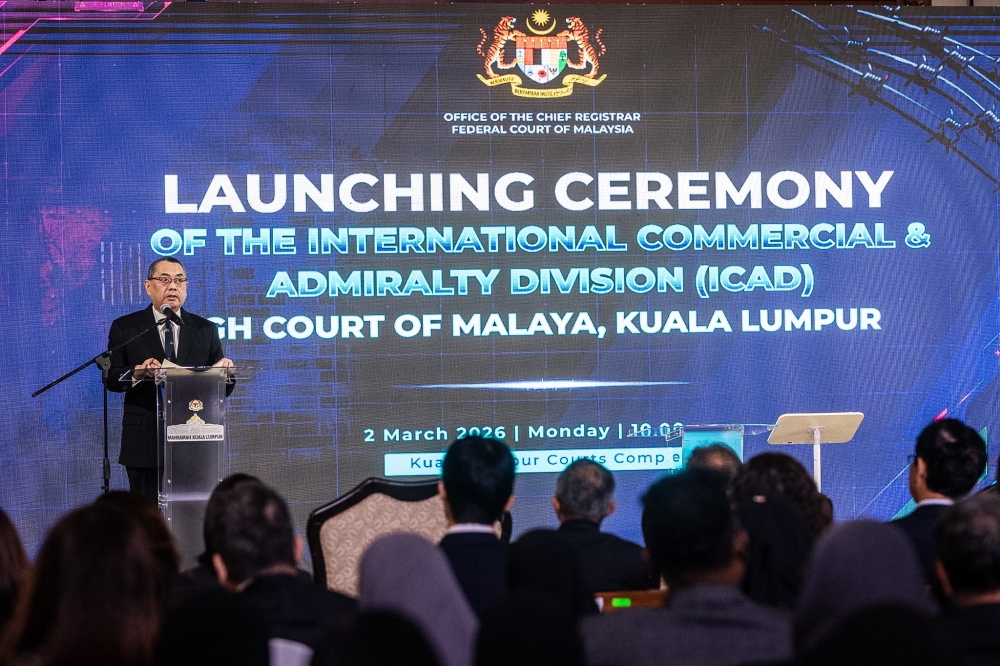
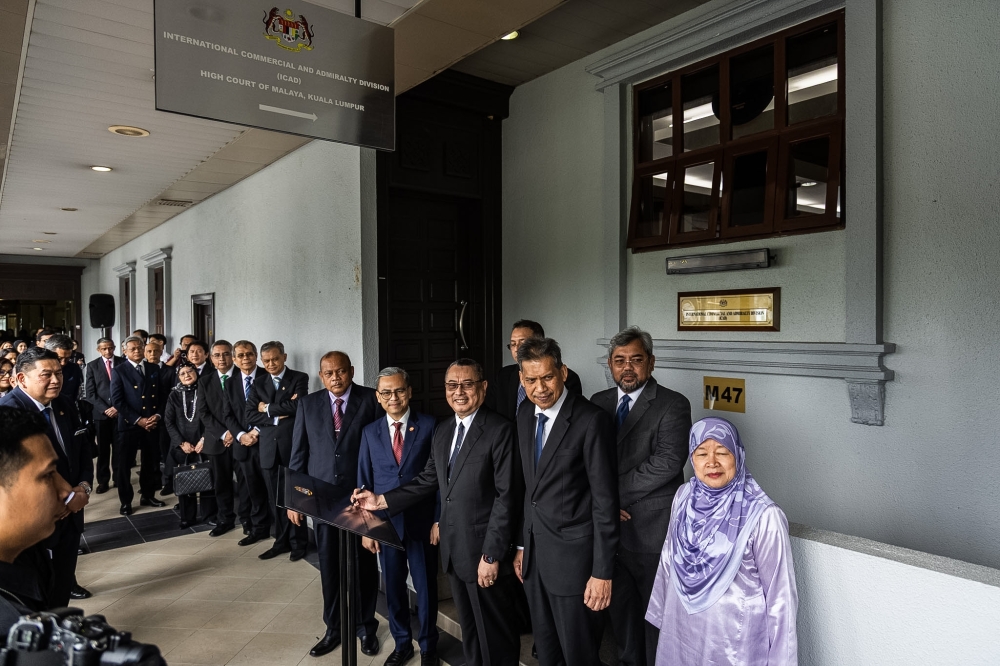
KUALA LUMPUR, March 2 — The Chief Justice of Malaysia today launched the International Commercial and Admiralty Division (ICAD) at the High Court in Kuala Lumpur, with the aim of boosting investors’ confidence with expected speedy resolution of international commercial cases within a timeline of nine months.
Chief Justice Datuk Seri Wan Ahmad Farid Wan Salleh said ICAD was created as the judiciary’s response to the reality that “time is money” for businesses and investors, as waiting for commercial disputes to be resolved would cost companies money.
“Time is money. Certainty has value. And justice, when delivered with both speed and integrity, is among the most powerful things a nation can offer to those who choose to do business within its shores,” he said in his speech at the court complex here when launching the new division.
“Today, we take that step,” he said, referring to the launch of ICAD that would match Kuala Lumpur’s economic ambitions as a city of commerce and investment.
ICAD will handle international commercial cases involving companies registered or incorporated abroad, as well as admiralty cases which includes shipping and maritime disputes.
While the High Court in Kuala Lumpur already has a commercial division (since 2009) and an admiralty court (since 2010), Wan Ahmad Farid said ICAD was necessary due to the high volume of commercial court cases.
He said creating a dedicated division just for international commercial cases would mean that these cases could be decided quicker.
“So if the case remains in the main commercial division, it will take time,” he said, pointing to the thousands of commercial cases at the High Court in Kuala Lumpur.
“So we have to separate the international division, international disputes, for the matter to be resolved as quickly as possible,” he told reporters later in a press conference.
The number of commercial cases registered at the High Court in Kuala Lumpur was 7,390 cases in 2024, and 9,671 cases in 2025.
As for the number of active international commercial and admiralty cases at the High Court in Kuala Lumpur since last year until now, there are 116 of these cases, including 54 admiralty cases, he said.
Previously, such cases could drag on for several months beyond the expected nine‑month timeline, he said.
“We hope with the formation of ICAD, everything can be resolved within nine months,” he said.
With the anticipation of more appeals from cases at ICAD, Wan Ahmad Farid announced the Court of Appeal’s recent addition of a commercial panel, which means it now has two panels of judges dedicated to hearing and deciding commercial cases.
For those who file an appeal at the Court of Appeal against decisions in ICAD cases at the High Court level, Wan Ahmad Farid said that the scheduling of hearing dates could be done very fast, once those appealing complete their records of appeal.
Wan Ahmad Farid said these two commercial panels at the Court of Appeal will reassure investors and multinational companies that their disputes will be given the same specialised treatment at the appeal stage, as those panels will have judges with the “same depth of knowledge in commercial and admiralty law” as ICAD judges.
Wan Muhammad Amin Wan Yahya will be the sole judge handling the 116 active cases at ICAD.
Asked what kind of court cases could be heard at ICAD, Wan Muhammad Amin told reporters that it could, for example, involve breaches of contract; cross-border issues; claims that were initially arbitration matters originating outside of Malaysia but are now to be enforced locally.
“And I think it’s very relevant in respect of the recent Cross-Border Insolvency Act being enacted,” Wan Muhammad Amin said at the same press conference.
Prior to being the ICAD judge, Wan Muhammad Amin had already been handling cases at the High Court in Kuala Lumpur’s Commercial Division, and currently also chairs the Malaysian Communications and Multimedia Commission’s appeal tribunal which hears appeals on MCMC’s directions and directives.
Wan Muhammad Amin was appointed as a judicial commissioner at the High Court in July 2020, and became a High Court judge in January 2023.
Before joining the judiciary, the University of Liverpool law graduate had been a lawyer in Malaysia for about 22 years practising in areas such as commercial, corporate, insolvency, employment, land and administrative law.
CJ Wan Ahmad Farid said the current workload of 116 cases for the ICAD judge is “quite reasonable”, as High Court judges would typically handle about 250 cases or even more.
“But to begin with, 116 cases will give the assurance that it will be resolved within a specific time that we have allocated,” he said.
Asked if ICAD would also be set up in other locations, Wan Ahmad Farid said currently only the High Court in Kuala Lumpur and in Shah Alam have divisions, but said there is no need for ICAD at Shah Alam at the moment.
“But if there’s a surge of cases in Kuala Lumpur in ICAD, then we will think of establishing ICAD 2,” he said, adding that ICAD’s operation will be monitored for six months and he would discuss with the Chief Judge of Malaya to form another ICAD if it is needed.
Earlier in his speech, Wan Ahmad Farid said multinational companies need legal certainty, courts that they can trust, and the confidence that disputes would be resolved competently, fairly and speedily.
“When a multinational company finds itself in a commercial dispute, every month that dispute remains unresolved carries a cost. It ties up capital. It disrupts business planning. It strains commercial relationships. It creates uncertainty on balance sheets.
“For investors and businesses operating across borders, prolonged litigation is not merely an inconvenience — it is a material risk that factors into decisions about where to invest, where to incorporate, and where to resolve disputes,” he said.
He also noted that foreign investors and multinational companies who choose Malaysia would also want to know if the process of dispute resolution would be transparent and predictable, and if the law would be applied consistently and competently.
Wan Ahmad Farid said ICAD will answer these concerns, as investors can expect certainty in the law, as well as judges with genuine expertise in complex commercial and admiralty law.
“They can expect clear timelines, active case management, and a firm institutional commitment to resolving disputes within a reasonable time. They can expect, in short, a court that understands their world and takes their concerns seriously,” he said of ICAD.
He said the assurance that disputes would be managed fairly and efficiently would strengthen confidence in Kuala Lumpur as a place to do business and to resolve disputes.
“That confidence matters not only to those already here — it matters to investors and investors-to-be who are, at this very moment, deciding whether Malaysia belongs on their shortlist,” he said.
Ultimately, Wan Ahmad Farid said the goal is to have a judiciary that is respected and also chosen by investors — even when they have options and could take their disputes to other places, but choose Kuala Lumpur “because they trust our courts and value what we have to offer”.
The launch was also attended by the President of Court of Appeal Datuk Seri Abu Bakar Jais; Chief Judge of Malaya Datuk Seri Hashim Hamzah; Chief Judge of Sabah and Sarawak Datuk Azizah Nawawi.
Also present were Communications Minister Datuk Fahmi Fadzil; director-general Datuk Zamri Misman of the Legal Affairs Division (BHEUU) of the Prime Minister’s Department; Kuala Lumpur prosecution director Datuk Mohd Nordin Ismail, and Malaysian Bar president Datuk Mohamed Ezri Abdul Wahab.


