


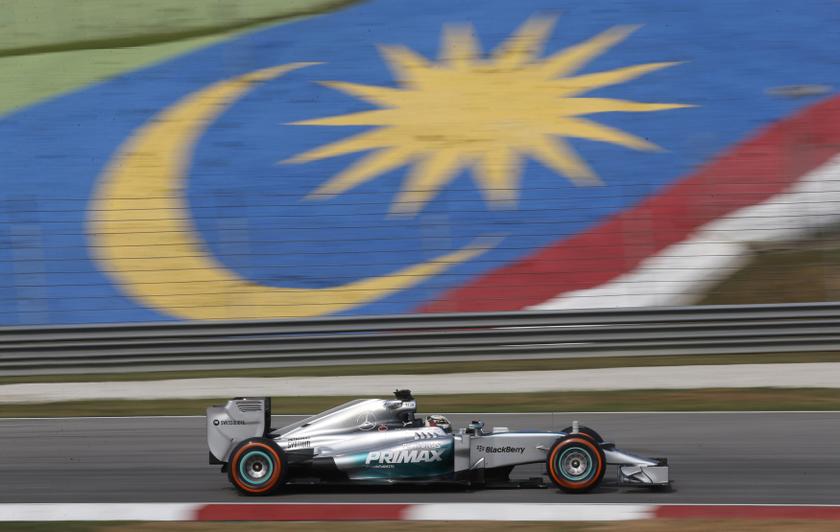
PETALING JAYA, Sept 23 — Next Sunday, the five red lights will go out for the last time at the Sepang International Circuit (SIC).
After that, the Formula 1 Petronas Malaysia Grand Prix will be no more.
Then, there will be no F1 circus in town, no celebrity spotting of F1 drivers and no eager fans turning up by the droves, braving the heat and sometimes rain to catch the race that travels around the world.
 Every time talk of contract renewal for the race came up in the past, there was more or less a sigh of relief that Malaysia would still be on the race calendar for the next few years.
That ended last year when it was announced that 2017 would be the last F1 race to be held at a circuit that was specifically built for such races by Hermann Tilke.
It was a year before the contract expired.
Truth be told, the world that exists now is different than when Malaysia took on the mammoth task of hosting the global sporting event in 1999.
It has been widely reported that globally, Formula One is suffering a dip in viewership and the change of strategy to make it more accessible to maintain and increase fans has yet to be seen with the recent change of ownership to Liberty Media.
The glitz and glamour that come with the races seem to have lost a bit of their shine. Even the once untouchable ringmaster Bernie Ecclestone no longer takes centre stage.
This is the same Ecclestone who sounded the alarm bells in 2005, saying that the circuit looked shabby and needed a facelift.
Money was duly pumped in to refurbish the circuit. Bernie was placated and four years ago gave it the thumbs-up, although maintaining that it still needed a paint job.
SIC chief executive officer Datuk Razlan Razali said at the time, that as a venue, it could not afford to lose Formula One.
An economic impact study by PriceWaterhouseCoopers in 2013 showed that the race in 2012 generated more than RM300 million in economic benefits. It also created over 4,500 jobs.
F1 has certainly served this country well by making it known the world over courtesy of international coverage on race weekend and in helping to spur interest in motorsports.
What happens now?
SIC chairman Tan Sri Azman Yahya is quick to point out that there were new things that the circuit had up its sleeves in the coming years.
One of which is a facility near the existing circuit that will provide drivers’ experience, not unlike what is offered at the Silverstone Circuit.
Improvements are also being made to the go-kart circuit so that SIC can host international events while new lighting is being installed to enable driving at the main circuit from 8pm to midnight.
Other plans include building circuits for motocross, drag and drift races, having a motorsports theme park and a three-star hotel.
“We are looking forward to it. There are 365 days in a year and F1 is just one weekend.
“Our track is booked 95 per cent of the year. It is only closed during Hari Raya and Chinese New Year or when work needs to be done,” he said.
Azman said resources that were spent for F1 could now be channelled into other facets of the business such as bringing a team into Moto2.
Azman, who has himself taken part in local races at Sepang, said that his son Nazim would be racing during the F1 weekend in the Formula 4 South-east Asia support race.
“Sepang is about motorsports,” he added.
Azman said international races such as F1 and MotoGP had given the country a chance to be known internationally.
“Having a track that was built for F1 gives us a chance to market Sepang. It is among the best designed F1 tracks,” he said.
“It is a bittersweet moment but life goes on.”
Served its purpose
Has F1 served its purpose in further expanding the base for motorsports in the country?
“The answer is a qualified yes. What did more for our motorsports base was the building of Sepang International Circuit,” said former SIC chairman Tan Sri Mokhzani Mahathir.
“That’s where it all happens. The big stage, the spotlight which shines on Malaysian talent or see them crash and burn.
“Once you and your team have raced at Sepang Circuit, no matter in what kind of race or vehicle, you know you’ve made it to the big league.”
He said the circuit would not have been built if the race was not brought to Malaysia, adding the country now had drivers in single seaters, GT series and two wheel races in many parts of the world.
“But to have one of our own, stand on the top step of Sepang Circuit’s podium, is what we all aim for,” he said.
Mokhzani said for him, being on the starting grid before each race was probably the biggest thrill.
He said there was a time when he ran the F1 operations by himself as SIC did not have a chief executive officer then.
“It was an honour to have been part of it. For that, I thank many people who worked with me from 2001 till 2016,” he said.
He said the challenges in having F1 was getting the Malaysian corporations to buy into the event.
Besides Petronas, he added none of the Malaysian corporate giants were really involved and he wished that the telcos, banks and government-linked companies that had domestic and regional presence could have used it as a platform for their corporate social responsibility and marketing programmes.
Although sad but not surprised that Malaysia pulled out of F1, Mokhzani said it was based on the economics of hosting the race.
He said that when the first contract was signed in 1996, the exchange rate was RM2.50 to US$1 but it was RM4.20 when the first race was held in 1999. That made it more expensive by some 60 per cent.
“When the last F1 contract was negotiated in 2015, the exchange rate was about RM3.40 to US$1. “With the exchange rate being where it is now, it’s no surprise that we pulled the plug.
“We’ve never been lucky with exchange rates even though the initial or re-negotiated deal with F1 was good,” he said.
He said there was always a possibility that F1 could return to Malaysia as it had the infrastructure and people to host every kind of sport.
“We know how to handle big, world class events,” he said.
He also hoped the sport became more accessible to fans, just like MotoGP adding that F1 needed to give more to circuits and promoters.
“It needs to be packaged with more than just 22 cars in one race.
“It needs to be with F2 and F3, where our own drivers can participate. Look at what’s been done with MotoGP,” he said.
“While it’s great to watch Lewis (Hamilton), Seb (Sebastian Vettel), Valtteri (Bottas), (Daniel) Ricciardo and (Fernando) Alonso race, I know the local crowd want to see their ‘geng’ on that grid even if it’s in a lower category. Look at how our squash stars, football stars, cycling stars, badminton stars have become national icons. We need that in motorsports.”


