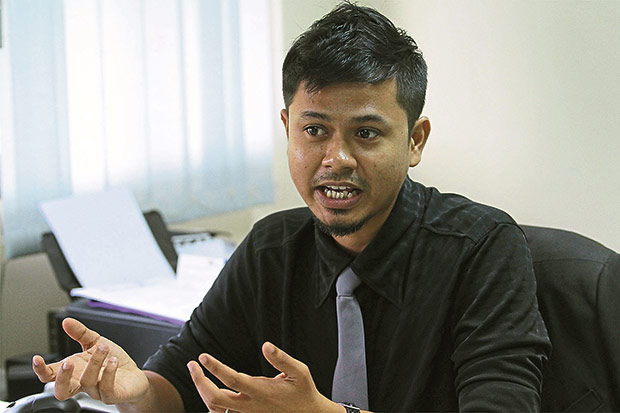
KUALA LUMPUR, Dec 6 — Although he came from a Tamil-medium school and did not have a strong grasp of English at the time, Mohammad Rahim Kamaluddin never once felt embarrassed or inferior.
In fact, he credits his six years in vernacular school for who he is today: a criminologist and senior lecturer at Universiti Kebangsaan Malaysia at age 28.
He already made a name for himself at Universiti Sains Malaysia with his impressive academic record and was on the Dean’s list.
Mohammad Rahim, who is of Chinese and Indian parentage, also received the Chancellor’s Gold Medal award, the Royal Education Award from Perlis ruler Sultan Syed Sirajuddin Syed Putra Jamalullail, and a special award for completing his PhD on time.
His results were so impressive, he was exempted from doing his Masters and given a direct entry into the PhD programme to do forensic criminology.
Here, he shares the challenges he faced, the importance of not merely scoring As and the prospects for forensic science in Malaysia.
In his own words:
I’m not saying national stream school teachers are not caring but the attachment in vernacular schools is something else. I feel Tamil and Chinese schools have their own advantages as well… our math skills, I feel is better. If we are not able to grab what the teachers are trying to say, we catch it in Tamil or Chinese… it boils down to understanding essentially and it’s how we work to achieve things. I enjoyed studying in a Tamil school and I will say my school contributed greatly to who I am now.
Challenges are everywhere, regardless of whether you are from vernacular school or otherwise. You will face struggles in school... however, that is no reason to abolish Tamil or Chinese schools. Admittedly, though vernacular school students have difficulty communicating with non-vernacular educated friends, that does not render us irrelevant. Those who struggle and rise up the ranks will be better after all. If I never struggled to be where I am, I would never appreciate what I learned... challenges are important for success.
Being Malaysian, everyone gives importance to the number of As we score... students are often asked how many As they got for examinations. Bear in mind that not all students have the ability to score straight As when they are young... some are are late bloomers. I was one of them. I got 6As in UPSR, PMR and a mix of As and Bs for SPM, but I aced the subjects I loved. I did put 100 per cent effort but that’s what I got... if I followed societal norms and came down on myself for my lack of As, I would not be a gold medalist expert today.
Find your passion and fuel it. Learning is a life-long process so don’t limit your intelligence to just securing As… our mindset needs to be changed. Many of those who secured straight As in school still struggle at university level when they need to think out of the box. We expect more achievers rather than successors… achievers are those who aim to simply achieve something but successors go beyond that, sharing their knowledge and inspiring others. They may not have great paper qualifications but it is they who understand the recipe for success better.
Also, when someone posts about their achievement, don’t ridicule... if someone speaks good English, don’t ridicule them saying they forgot their roots because that is just utter nonsense. We need to change ourselves… don’t be a jaguh kampung… we have too many of those now and what we lack are self-motivated people.
We should have a slot where students are allowed to show their creative side, their invention skills, poetry writing or anything else… one subject without structure to let them exhibit their skills and there should not be exams to evaluate these skills of theirs. Creativity is not something you grade… make it free-flowing.
I entered the degree programme for forensic science in June 2007 and when I entered there were 30 of us and the chairman of the programme asked what made us choose this field and the majority said it was because of CSI... that shows how impactful the media is in influencing career choices... but what you watch on CSI is totally different from real life. In CSI, the actors are like superheroes as they do everything from evidence collection, analysing, conducting post mortem and at the end of the day they solve the crime, but here we have separate agencies to do the necessary tasks. Police officers collect evidence, the Chemistry department’s forensic officers will do laboratory tests and then a trained forensic pathologist does the examination. It is not an easy task. Many get frustrated when they learn this truth because in the media everything looks nice, but in reality it isn’t.
In Malaysia I can say forensic science is not fully established yet but the government as well as private agencies have acknowledged the importance of this field. So, I am sure maybe in 10 years’ time, the prospects will be greater and we can be equal with foreign experts... now we still need many trained forensic scientists to make this field more established.
A degree in forensic science is just an entry pass… we need more specialists to lead the many fields in the subject and many fields in forensic science need to be established. We still don’t have a victimologist to just focus on crime victims and we still lack trained forensic document investigators to analyse writing, forensic linguists... forensic science is not a standalone subject. We borrow knowledge from many sectors to solve a legal problem.
If you have a forensic science degree, you can go anywhere... the possibilities are endless... police officers, anti-graft officers, firefighters even, detective and you can also work in insurance companies. It’s really about how well you sell your expertise and skills.