


KUALA LUMPUR, June 19 ― He was forced to leave his wife and three children in the middle of the night, “kidnapped” by the soldiers to be their porter, along with other men from his village in the Myanmar state of Arakan.
Dressed only in his pajamas ― a worn out T-shirt and sarong ― Bua, a Rohingya, had to carry a heavy sack for 10 days through dense jungle, before making an escape with several others.
More than a month later, he finally reached KL.
The 54-year-old has since married an Indonesian national and both have an eight-year-old daughter together. He recounted his harrowing experience in Malay while sitting on a rusty metal swing in front of the corner house where they live in a rented room, in Seri Kembangan.
“We walked through the jungle for 10 days and anyone who cannot keep up, gets beaten and kicked down the hill, some died,” he said.
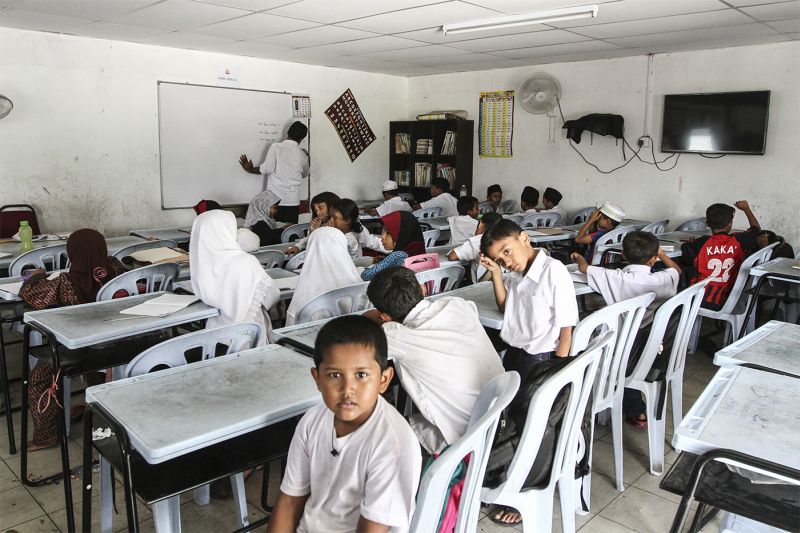
Today he is unemployed because his right leg was injured when he lost three toes during an accident at the Sungai Buloh factory where he was working three months after he arrived, back in 1993.
Every morning, he walks his daughter to the refugee school for Myanmar Muslims, The Knowledge Gerden Learning Centre about 20 minutes away, because he cannot afford the additional RM75 for the school van to pick her up.
It costs RM50 a month to attend the school, he said.
His wife, meanwhile, works at a shop that sells Chinese wedding items nearby, from 10am to 1pm for about RM500 a month.
He said he has been arrested twice by the Immigration Department and was deported to Thailand. Twice, he made his way back to KL to his family.
“If the Myanmar soldiers saw us, they would have shot us,” he said when asked why he did not go back to Myanmar.
Bua said UNHCR has already interviewed him about three times and was told that he would be resettled in the United States, but he doesn’t know when yet.
Two of his nephews in their 20s who are also here, are working at a tyre shop nearby. Both are still waiting for their UNHCR cards.
Claiming he is a good cook, he said he doesn’t really miss food from home.
“I usually cook a big pot of cabbage, some rice and salted fish.
“We are not starving, but we are barely getting by,” he said, adding that the rented room for the family costs RM250 a month.
“I begged the police to help us. I said, ‘If you don’t, who else will?’”
Another man, Kand, who is in his 30s, also a Rohingya, joined the conversation midway and lamented that he is stuck in a Catch-22 situation.
“How are we going to survive? We can’t work, even with the original UNHCR card, there is no use.
“Not only the immigration officers would detain and deport us, they also warned my boss not to hire us again and threatened them with a hefty fine,” he said, also in Malay.
He works at a night market fruit stall from 4pm to 10pm and earns RM20 a day.
Meanwhile, he said the police officers he met were more merciful and would just let him go after he showed them the UNHCR card.
“I begged the police to help us. I said, ‘If you don’t, who else will?’”
“Finance, study, passport, that's all we need”
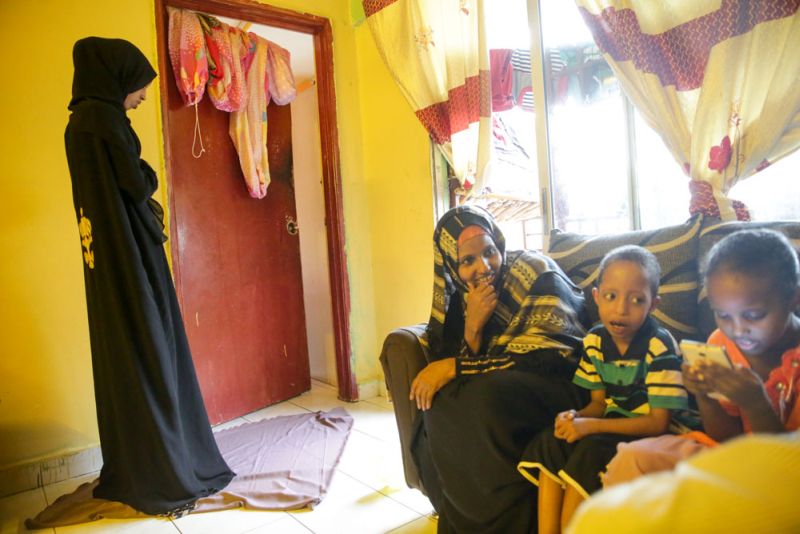
Nineteen-year-old Najma is not attending school nor working. What does she do every day?
She wakes up at 6am to pray, goes back to sleep, wakes up at 11am to cook lunch, usually canjeero, a flatbread she described as similar to roti canai, but with soup, or other times, rice or pasta, and the rest of the day, she watches videos on YouTube and goes on Facebook.
The Somalia native told Malay Mail Online that she first flew from Mogadishu, the capital of the war-torn country, to Malaysia in 2007 with her younger sister, two brothers and grandmother.
But in 2009, her grandmother died from throat cancer at the age of 60. Her father had died long before she came, and her mother was “elsewhere, no idea where.” They are not in contact.
Her 17-year-old sister attends a Somali refugee school nearby from 2pm to 6pm every day, while both her brothers, 20 and 16 work at the school.
She was attending the school too until about two years ago when she had no more friends left and decided to quit, saying it was “boring.”
In fluent English, she said she only learned the language when she first arrived in Malaysia eight years ago.
“My grandmother asked Deborah if she can teach us English, and she said yes,” she said, referring to former Miss Universe Malaysia Deborah Henry, who was with UNHCR for a house visit.
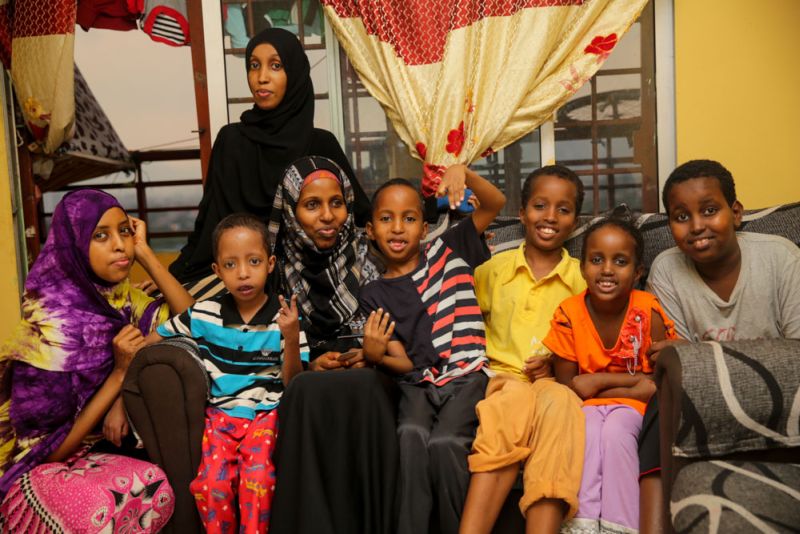
Najma said for several months, Henry would go to their apartment in Setapak and teach the four children English. But later on because of her tight schedule, Henry co-founded the Fugee School, a non-profit charity organisation that runs the school that her siblings now attend. The school is among more than 120 learning centres here supported by UNHCR.
Najma, who aspires to be a chef, said other than financial problems, “everything else is okay.”
“I don’t mind staying here as long as I get an education, passport.
“Finance, study, passport that's all we need,” she said with a wide grin.
Her aunt, 40-year old Aminah, echoed the same sentiment. She said money is tight as she does not work because she had to take care of her six-year-old son who has a heart problem.
Her husband works at an Arabic restaurant near Chow Kit.
“The hardest thing is that you can’t find work. I've given birth to five children, nothing else is hard for me, everything else is ok.
“We have a peaceful life, it’s just the finances,” she said in Somali, translated by Najma.
Her children are aged 10, nine, seven, six and five. The two youngest were born in KL.
Her aunt and uncle, along with the five children live on the 12th floor of apartment complex, while she and her siblings live a couple floors down.
Both families are renting the smallest room in each unit for RM300 a month.
Najma said UNHCR told her last August that they might be resettled to Australia but nothing has been confirmed yet.
She came so close to leaving Malaysia, she said.
Her family was supposed to resettle to the US, but her grandmother died only 10 days before the highly-anticipated trip in 2009.
Then, only 13 with two younger siblings to care for, she decided to stay in Malaysia.
Is she regretting the decision now?
“Of course I regret, now we just hope to get to another country”.
Najma said she will not go back to Somalia because “it will never be peaceful.”
She and her family are among the 1,090 Somalis registered as refugees in Malaysia.
It’s like being in “an open jail”
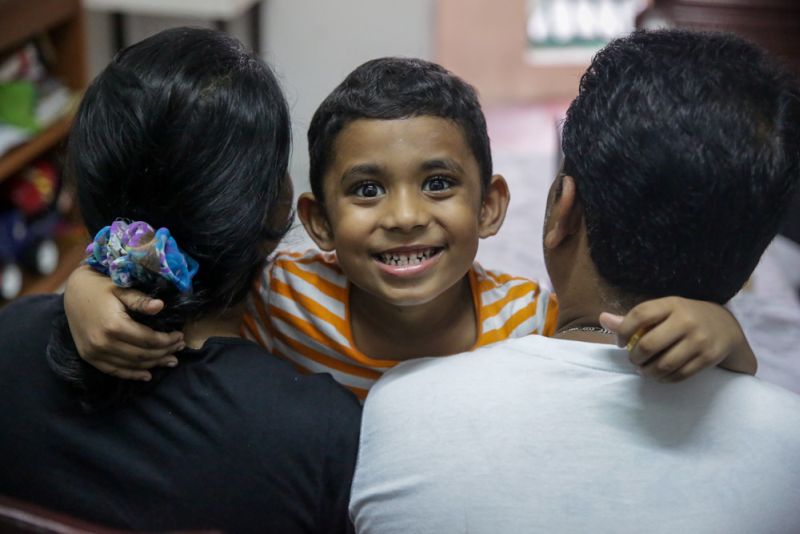
Five-year-old Kavi had just celebrated his birthday last month. The Sri Lankan national was born in India as a refugee, returned home for a while, before making his trip out to Malaysia in 2011.
Kavi and his parents are part of the 3,890 Sri Lankan refugees here because his 35-year-old father had been repeatedly arrested by authorities back home, for his work with a human rights non-governmental organisation.
The father, who requested not to be named, said both he and his 29-year-old wife miss everything about home but it is too risky to go back now.
Maybe in two years’ time, he said, for his son’s future.
“There is no future here. No idea how long we are going to be here. There is nothing for us legally.
“It is like an open jail. No family. All our friends are refugees like us,” he lamented.
He is now an assistant accountant at a travel agency, earning RM1,800 monthly, an upgrade from the teaching job at a Tamil for Malaysia refugee school which paid about RM600.
Other Sri Lankan refugees usually get daily work as movers, painters, security, or even catering, usually for about RM60 a day, he said.
His wife was working for a seamstress for about three months last year and earned RM600 a month but quit when she got pregnant. In January however, she had a miscarriage.
Kavi currently goes to a private, locally-run nursery which charges RM125 on top of an annual fee of RM650.
His father said he misses everything about home, but when asked about food, he proudly said his wife is a better cook than his mother.
“She is really good at cooking rice and curry, chapati, and thosai,” he said.
According to the UNHCR web site, there are some 152,830 refugees and asylum-seekers who are registered here, as of end of April. It is estimated that there are at least 30,000 others who are not registered.
Some 69 per cent are men, while the rest, women. Some 33,000 children are below the age of 18.
** The interviewees’ full names were not used in the article to protect their identities.


