


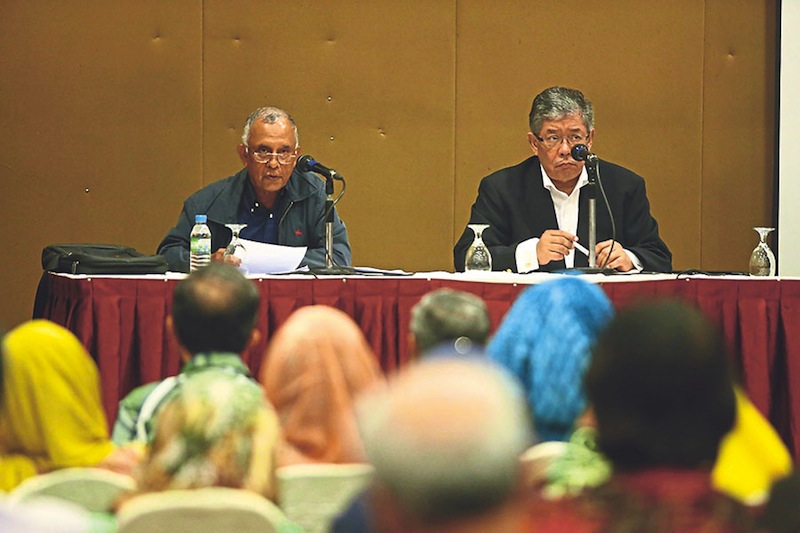


KUALA LUMPUR, April 26 — Parliament should establish more select committees if it wants to be seen as a working institution instead of just a “rubber stamp”, said G25 member Tan Sri Mohd Sheriff Mohd Kassim.
The former Finance Ministry secretary-general said select committees should be formed for discussions on issues such as democracy, human rights and personal liberties.
“Parliamentary select committees are common in all democracies, including Indonesia, and the fact that Malaysia has only one such committee in the form of the Public Accounts Committee makes our country look like a poor practitioner of good governance,” he said yesterday as a G25 representative at a talk organised by the Association of Voices of Peace, Conscience and Reason.
G25 is a group of prominent Malay senior ex-civil servants and thinkers who are calling for moderation.
Mohd Sheriff said a select committee would be a permanent parliamentary committee made up of qualified professionals.
He also stressed the importance of a select committee on the nation’s finances and annual budget as the national debt had garnered great public interest.
“When a select committee meets to discuss the Finance Ministry’s budget for the coming year, it will hold hearings so interested groups, economists, and financial experts may give evidence and for committee members, with research assistance by professional aides, to ask experts to explain if there are any concerns about the budget,” he said.
Touching on the recent call by Islamic fundamentalist groups to form a caliphate in Malaysia, he said: “We often hear fundamentalists say that the people can get more justice and become economically better under a caliphate than a secular government.
“Unfortunately, Muslims who were thoroughly indoctrinated in their religious education from young, grow up convinced that God’s law and an Islamic caliphate will make Malaysia a better country.”
He referred to those calling for a caliphate as “misguided idealistic youths”, and said history should be re-examined to better “teach them the truth about the country, the region and the world”.
“Many of them do not know from history that when religious orthodoxy was dominant in old Europe 600 years ago, all the Christian countries were socially, culturally and economically stagnant.
“After the Reformation followed by the Renaissance, religion was reduced to a lower status in state affairs, and Parliament replaced the Church in the government of the country,” he said.
“The transformation of Europe from religious feudalism to parliamentary rule was what made the Christian world progress much faster than the Muslim world in all areas of human endeavour,” he said.


