

KUALA LUMPUR, March 20 ― The hudud law that PAS is pushing for is not in line with Quranic teachings, PKR leader Latheefa Koya said today.
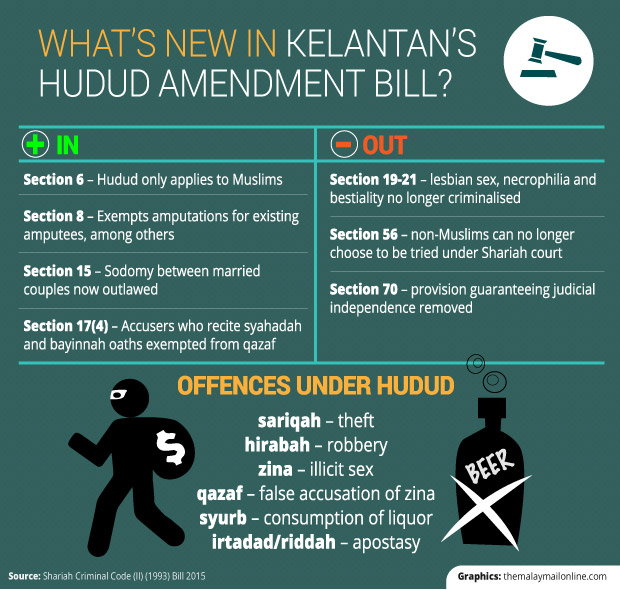
The PKR central committee member listed four differences between the Quran’s teaching on hudud and the PAS-ruled Kelantan’s 1993 hudud enactment, noting that there is no punishment for apostasy in the Muslim holy scriptures, among others.
“PAS's so-called hudud as made public in the Shariah Criminal Code amendments is certainly not found in the Quran,” Latheefa, who is also a lawyer, said in a statement.
“Therefore it ought to be rejected outright. It is their own creation, and it is creating confusion and mischief in God's name,” she added.
Latheefa also said stoning is not mentioned in the Quran as a punishment, while the Muslim holy book has different requirements for the cutting of limbs and crucifixion, as well as different requirements for the offences of rape and adultery.
According to Latheefa, the Quran’s hudud is a set of prescribed punishment for six types of crimes and that anything different cannot be considered hudud.
Kelantan passed amendments to the Shariah Criminal Code II 1993 yesterday that punishes apostasy with death and theft with amputation of limbs.
Saying that Muslims are obliged to accept the Quran’s hudud instead of “man-made” versions, Latheefa said all Muslims, including Muslim federal and state lawmakers, are obliged to reject PAS’s hudud.
Latheefa urged Kelantan PAS and PAS president Datuk Seri Abdul Hadi Awang to “suspend” all efforts to introduce their version of the Islamic penal code.
She also urged PAS Kelantan to shift its purported politically-motivated focus on hudud to goals such as eradicating poverty, improving education, ending corruption, and pushing for a peaceful and harmonious society.
PAS, which only holds 21 seats in the 222-seat Parliament, is banking on support from Muslim lawmakers to help it remove legal roadblocks to the rolling out of hudud in Kelantan.
PAS now plans to put forward two private members’ bills in Parliament to enable Kelantan to enforce hudud ― one will seek approval for the state to legislate punishment for crimes under the Penal Code. The other seeks to amend the Shariah Courts (Criminal) Jurisdiction Act 1965 to enable Islamic courts to mete out punishments like the death penalty for apostasy and amputation of limbs for theft, as the law currently limits the punishments Shariah courts can impose to imprisonment.