

KUALA LUMPUR, March 19 — On the surface, Umno’s backing for rival PAS’s bid to enforce hudud in Kelantan appears clear; with a shared Malay-Muslim demographic, religious obligation and racial unity are the overt motivations.
But political analysts believe Umno’s purpose for openly backing its rival party’s controversial plan is based on both political expedience and gain. One, it frustrates an opposition pact that has grown stronger over the elections and two, it is an opportune distraction from Putrajaya’s painful policies.
“It does appear that at a strategic level, baiting PAS with an opportunity to implement hudud introduces a wedge in Pakatan Rakyat at the point in time when Barisan Nasional (BN) is going to be unpopular with voters when GST (goods and services tax) comes into effect,” Ibrahim Suffian, who heads independent pollster Merdeka Center, told Malay Mail Online.
Among others, Ibrahim pointed out that Umno minister Datuk Seri Jamil Khir Baharom’s proposal for PAS to table private member’s Bills in Parliament to allow Kelantan to enforce the Islamic penal code came the same week the GST Act was passed last April.
The reason hudud is attractive to PAS is two-fold: it resonates with the religious foundations of the Islamist party and its powerful conservative ulama, or clergy, faction view it as platform to gain influence both within the party and Pakatan Rakyat, in which it is the junior partner by virtue of numbers despite being the oldest opposition party in Malaysia.
The latter reason is also why the Islamist party has been adamant in tabling the amendments to Kelantan’s Islamic criminal law despite the vehement objections from partner DAP and, to a lesser extent, PKR.
“Many PAS conservatives also want to have greater influence and opportunities and they see that this will have to be via the quicker Umno/BN route rather than the Pakatan one,” Centre for Policy Initiatives head Dr Lim Teck Ghee told Malay Mail Online.
Independent analyst Khoo Kay Peng said PAS believes that enforcing an Islamic criminal justice system will help reinvigorate the party as it has been losing Malay votes since 2008, noting that Umno is only too happy to play along.
“It (Umno) has prioritised Malay unity over BN revival. (The party has) lost hope to regain Chinese votes. Of course, they know it will break up Pakatan, too,” Khoo told Malay Mail Online.
Yet, Umno is unlikely to have any intention to follow through on the promised support in Parliament, Ibrahim noted, as it would face resistance from Barisan Nasional’s non-Muslim and Borneo component parties.
While Kelantan Opposition Leader Datuk Md Alwi Che Ahmad, who is from Umno, said the party will vote for the amendments to the state’s hudud law, Umno’s Johor Baru MP Tan Sri Shahrir Samad said there is no directive to back the Islamic penal code and that Muslim MPs should vote based on their conscience.
Even so, the purported ploy has had the desired effect. Shortly after the Kelantan government tabled amendments to the state’s Shariah Criminal Code Enactment II 1993 yesterday, DAP national organising secretary Anthony Loke accused the state PAS chapter of backstabbing the DAP and said his party will review its position in PR.
Both Lim and Khoo believe that PAS’s action yesterday’s has rendered ties in PR beyond repair, but the former said the pact itself could still be salvaged.
“We are close to the point of a breakup of the opposition coalition but some quarters in the opposition, including PAS moderate elements, may try to work out a face-saving negotiated settlement, although it is difficult to see what this can be.
“Whatever happens, the coalition between PKR and DAP will remain intact and may even be strengthened if PAS decides to go its own way,” the political analyst added.
Ibrahim told Malay Mail Online that PR is unlikely to disintegrate over the tabling of Kelantan’s hudud law amendments — or at least not before the PAS party election in June that will see a battle between the conservative and progressive factions — as doing so could jeopardise the pact’s rule in Selangor and Penang,
“I think there will be a more measured response to this particular episode, as opposed to an emotional knee jerk reaction to call for the dismissal of PAS. Perhaps they'll put the relationship on ice until the PAS party election in June,” said Ibrahim.
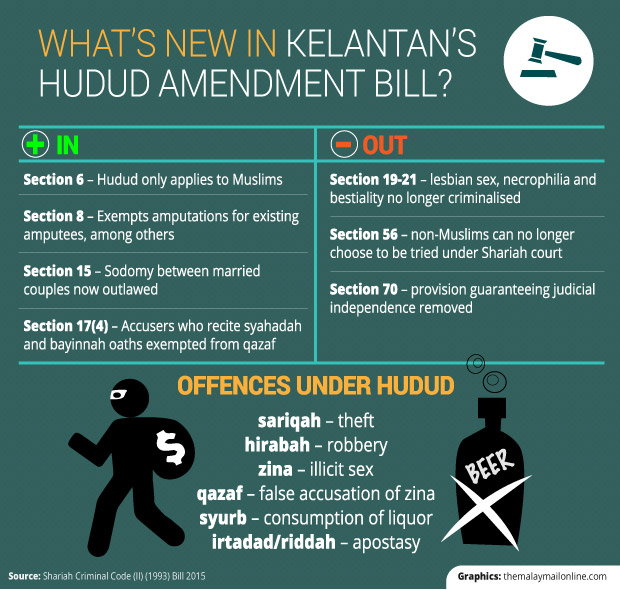
Kelantan tabled the Shariah Criminal Code (II) (1993) Bill yesterday, despite repeated objections from PAS’ Pakatan Rakyat allies, DAP and PKR.
The Islamist party also reportedly plans to table two private members’ Bills on the same matter in Parliament sometime later this month, which, if passed, will enable Kelantan to implement the Islamic criminal justice system.