


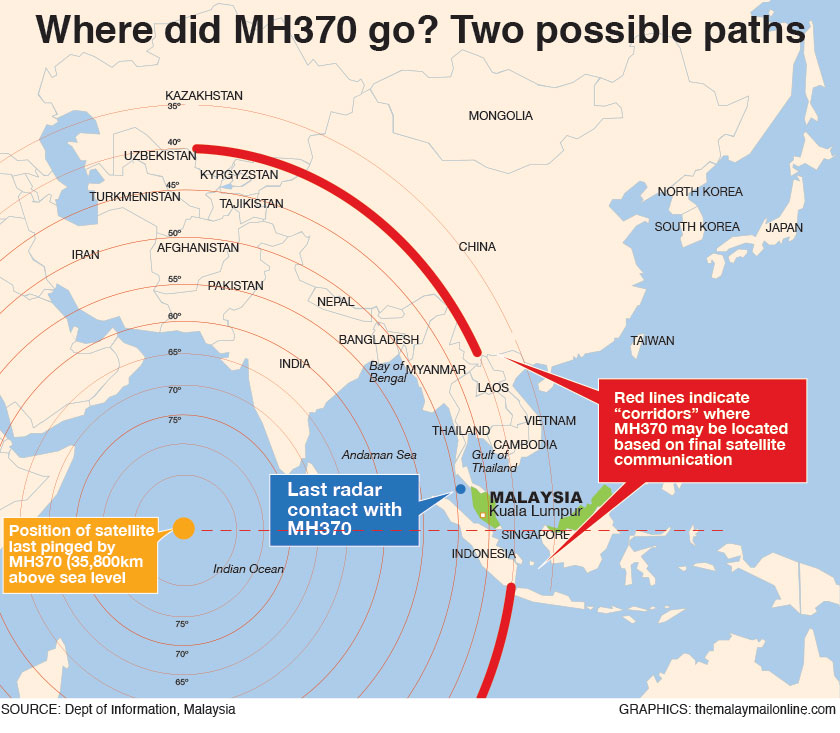


Citing a report purportedly from Russian intelligence that the Boeing 777-200ER was hijacked by terrorists and flown to near Kandahar, Afghanistan, a group representing the families of the 239 on board urged investigators to reconsider the “northern corridor” that was written off following advice from a UK satellite firm.
“It is high time that the government should start thinking out of the box by exploring and re-examining all leads, new and old,” MH370 families said in a statement uploaded on their Facebook page today.
“Based on this spirit, we respectfully request your kind consideration to re-engage the Russian and Afghanistan governments in order to examine and verify the claim that MH370 landed in Afghanistan. We are confident that (the) government of Malaysia will find that this path is worth exploring considering the lives of 239 passengers and crew on board MH370,” they added.
Various news outlets recently picked up a report from Russian newspaper Moskovsky Komsomolets that quoted an anonymous Russian intelligence source as saying that the crew and passengers of Flight MH370 were being held hostage in Afghanistan.
The source also claimed that the terrorists would likely bargain with either the US or China.
Search for MH370 had previously been divided between two corridors: a northern arc from northern Thailand to the border of Kazakhstan and Turkmenistan in central Asia, or a southern one from Indonesia to the southern Indian Ocean.
Citing analysis from UK-based satellite operator Inmarsat, Prime Minister Datuk Seri Najib Razak announced on March 24 that the Beijing-bound flight had ended in the southern Indian Ocean, southwest of Perth, Australia, after it disappeared in the early hours of March 8.
Assets were subsequently withdrawn from the northern corridor and assets are now concentrated in an area off the west coast of Australia.
But a massive search scouring huge swathes of the remote ocean has yet to recover a single piece of physical evidence, like debris or human remains, despite the Australian authorities announcing two weeks ago that a series of acoustic pings, possibly from the plane’s black box, have been detected.
Australia said last Monday that search countries would “regroup and reconsider” if nothing is found in the Indian Ocean in the next few days.
Last Friday, US online magazine Slate questioned the calculations that Inmarsat had used to conclude that the missing jet’s last position was in the southern Indian Ocean, instead of along a northern arc up to Kazakhstan.
“It’s really impossible to reproduce what the Inmarsat folks claim,” Slate quoted Hans Kruse, a professor of telecommunications systems at Ohio University, as saying.
Slate reported independent experts as saying that Inmarsat’s analysis of the plane’s data-less electronic handshakes, or “pings”, with a satellite, was “riddled with inconsistencies” and that the data presented to justify its conclusion appeared to have been “fudged”.


