


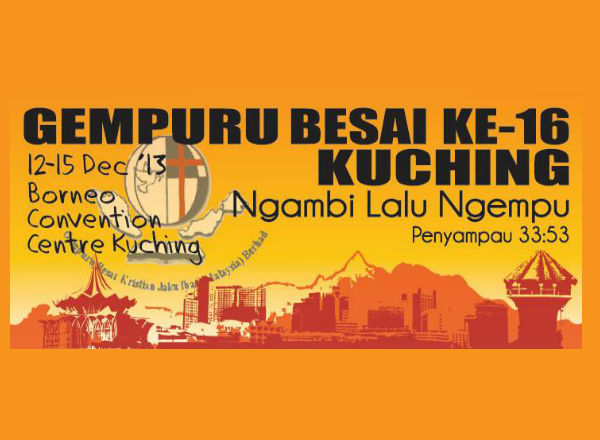


KUALA LUMPUR, Dec 14 — Citing the 1963 Malaysia Agreement, Christians from Sarawak’s dominant Iban ethnicity group held a rally in Kuching today to press for full religious freedom promised their community half a century ago as concerns rise within the country’s minority groups over Putrajaya’s attitude towards their respective creeds.
The Iban Christians pointed out that the indigenous tribe had largely decided to support the 1963 formation of Malaysia due to “special safeguards” promised to Sarawak in the 18-point agreement, which they said had been made part of the covenant that led to the country’s founding and its supreme law, the Federal Constitution.
In a media statement, Pastor Greman Ujang Slat, the leader of a nationwide network of Iban-speaking Christians, said that 75 per cent of the Iban tribe had in 1962 asked for the safeguard of “complete religious freedom” in their submissions to the Cobbold Commission of Inquiry.
As the chairman of Iban-speaking Christian network Gempuru Besai Raban Kristian Jaku Iban Malaysia(GBKJIM), he issued a public proclamation to affirm the stand by Iban Christians, who make up 52.6 per cent of Sarawak’s Christian community.
He said an estimated 6,000 to 7,000 Iban Christians had gathered at the 16th Gempuru Besai or “grand gathering” in the Borneo state capital to vow they “will remain faithful to God in giving our utmost best in securing, for this and the future generations, complete religious freedom (freedom to profess, practice and propagate any religion) that our forefathers fought so hard for us to retain in the formation of Malaysia.”
Among the five points contained in their declaration was the pledge to “pursue a decade of unprecedented unity among the Iban tribe and with other people groups of Sarawak.”
The Gempuru Besai is held annually and was this year held from December 12 to December 15 in Kuching’s Borneo Convention Centre.
Last month, the Sabah Council of Churches similarly pointed out that the north Borneo state was assured “complete freedom of religion” in the 20-point agreement drawn up before it agreed to form Malaysia together with Sarawak, the Federation of Malaya and Singapore in 1963.
“We have repeatedly said under the terms of the 20-points to the Malaysia Agreement, Sabah is to continue enjoying complete freedom of religion after the formation of Malaysia in 1963,” said the council president, Bishop Datuk Dr Thomas Sen in the November 26 statement.
It reminded the federal government that the churches in East Malaysia were older than the country itself, and called on all Malaysians to recognise and honour the right of Bumiputera Christians to call their god “Allah” in the practice of their faith.
In the original 20-point agreement drawn up before the formation of Malaysia, it was agreed that there should be no state religion in North Borneo, and the provisions relating to Islam in the present Constitution of Malaya would not apply to North Borneo.
The Sabah Constitution was amended in 1973 by the state government to make Islam the religion of the state of Sabah.
In October, the Court of Appeal ruled that the Home Ministry’s decision to ban the use of the word in the Catholic Church weekly Herald was justified, saying that the use of the word “Allah” was not integral to the practice of the Christian faith.
The ruling — which overturned an earlier High Court decision that the ban was unconstitutional — has since sparked confusion over the use of the word by Christians in their worship, especially with conflicting opinions within the government itself on how far the ruling would affect practising Christians.
Since the ruling, churches in Sabah and Sarawak have become more vocal in pressing for their right to use the term that they say is entrenched in the 20- and 18-point agreements with the two states, insisting they will continue their age-old practice of referring to God as “Allah” in their worship and in their holy scriptures.
The Catholic Church has since appealed to the country’s top court this week for clarity on the religious row that has drawn deep lines between Malaysia’s non-Muslim minorities and its 60 per cent Muslim population, with the Federal Court fixing February 24 next year to hear the application for appeal.
Several ministers also said recently that the 10-point solution issued by Putrajaya in 2011 — which allows the printing, importation and distribution of the Al-Kitab, the Bahasa Malaysia version of the Christian bible, containing the word “Allah” — should stand, despite the appellate court ruling.
The Najib administration issued the 10-point solution shortly before the Sarawak state election in 2011 to end a Home Ministry blockade of shipments of Christian holy scriptures in the Malay language containing the word “Allah”.
According to a 2010 census, Muslims are Malaysia’s largest religious group, followed by Buddhists. Christians are the third largest at 2.6 million, which comes up to about 10 per cent of the entire Malaysian population.
Bumiputera Christians, who form about 64 per cent or close to two-thirds of the Christian community in Malaysia, have used the word “Allah” when praying and speaking in the national language and their native tongues for centuries.


