




KUALA LUMPUR, Oct 25 — The Goods and Services Tax (GST) announced in Budget 2014 today will make Malaysians realise that “the government takes money from our pockets to spend”, a political analyst said today.
Wan Saiful Wan Jan, chief executive of the Institute for Democracy and Economic Affairs (IDEAS), also said that the consumption tax will force Putrajaya to be more accountable and transparent over its expenditure.
“So I expect that with GST, the people will demand for more accountability when the government spends,” Wan Saiful said in a statement today.
“Malaysians have for so long felt that the government spends the ‘government’s money’. They don’t realise that the government spends the people’s money. With GST, everyone will realise that the government takes money from our pockets to spend,” added the political analyst.
Malaysia will finally implement the long-delayed GST at 6 per cent beginning April 2015, Prime Minister Datuk Seri Najib Razak announced today as Putrajaya seeks to tackle its chronic budget deficit.
The replacement to the current Sales and Services Tax comes amid public concerns that it will increase the cost of living through a hike in the inflation rate, especially after a fuel subsidy cut in September.
To offset the new tax, Najib also announced that personal income tax will be reduced by 1 to 3 percentage points, depending on the income bracket.
“Generally, families with a monthly income of RM4,000 will no longer pay tax. Other existing taxpayers will also enjoy tax savings,” he said.
A one-off payment of RM300 under the 1 Malaysia People’s Aid (BR1M) will also be made following the implementation scheduled for April 1, 2015.
Najib said that the GST will not be imposed on essential food items like rice, sugar, salt, and cooking oil; piped water supply; government services like the issuance of passports, licenses, healthcare services and school education; or transportation services like buses, trains, LRTs, ferries, boats, and highway tolls.
Sales, purchases and rentals of residential properties, as well as selected financial services, are also exempted from the GST.
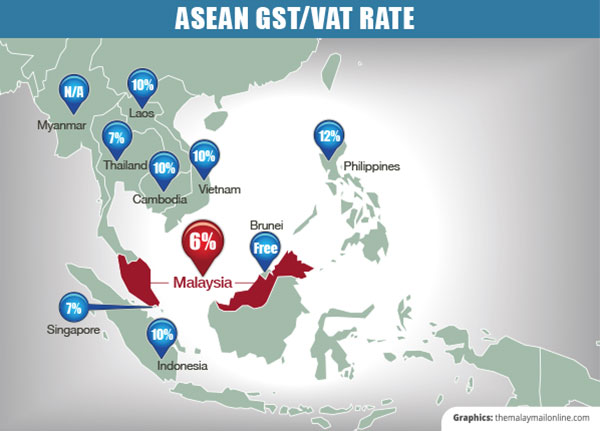
The prime minister pointed out that Malaysia’s GST rate of 6 per cent is among the lowest in Asean countries, noting that the GST is fixed at 7 per cent in Singapore and Thailand.
While Wan Saiful today expressed support for the GST, he noted that there were other ways for Putrajaya to increase revenue, from an economic perspective.
“For example, if they give more attention to what the Auditor-General reports annually, they could save billions every year. That is why I said that I look at it from a political perspective,” he said.
“On the Budget as a whole, I hope the government takes its own announcement seriously enough and does not behave in the same way it behaved in the last few years. We have seen the government repeatedly coming back to Parliament with supplementary bills because it ran out of money mid-year,” added Wan Saiful.
The analyst called such behaviour a “sign of incompetence and lack of respect to parliamentary processes”, saying: “I am sure the government is much better than that.”
The GST is a consumption tax, meaning all Malaysians will be taxed according to their level of spending, regardless of income. This differs from income tax that is only applicable after a certain salary level is exceeded.
The tax was first announced during Budget 2005 and was originally scheduled to be implemented in 2007 before it was deferred.
The GST Bill was then tabled for the first reading in 2009 for implementation in late 2011, but was withdrawn during the second reading in 2010 following fierce public resistance.
But Najib signalled yesterday that Putrajaya is finally ready for the measure, following the revision of its sovereign debt outlook from “Stable” to “Negative” in July by rating agency Fitch Ratings owing to rising government debt and budget deficit.
Malaysia runs a relatively high government debt of 53 per cent of its gross domestic product (GDP) ― just under the legal ceiling of 55 per cent ― and has one of Asia’s highest household debt levels, at over 80 per cent of GDP.
Putrajaya has stated that it aims to reduce its budget deficit-to-GDP ratio to 4 per cent this year and gradually to 3 per cent by 2015.


