


KUALA LUMPUR, Jan 11 — Every once in a while, a restaurant opens, and a table in there suddenly becomes one of the most sought-after things in life, maybe second only to the latest Labubu.
But in today’s social-media-addled landscape, it’s virtually impossible for any restaurant, no matter how new or how great it is from the get-go, to make that kind of splash without some kind of co-ordinated video campaign.
Word of mouth is so last decade.
The result? These restaurants go semi-viral across the same few places, but the crowds often disappear just as quickly as they arrived.
Indeed, it takes more than just a video or two to bring diners back — especially when something new is opening every other day.
80s Home Cook Cuisine, in Kuchai Lama, found a way to stand out amid a sea of sameness, offering the unique, elaborate dishes of 1980s Hong Kong.
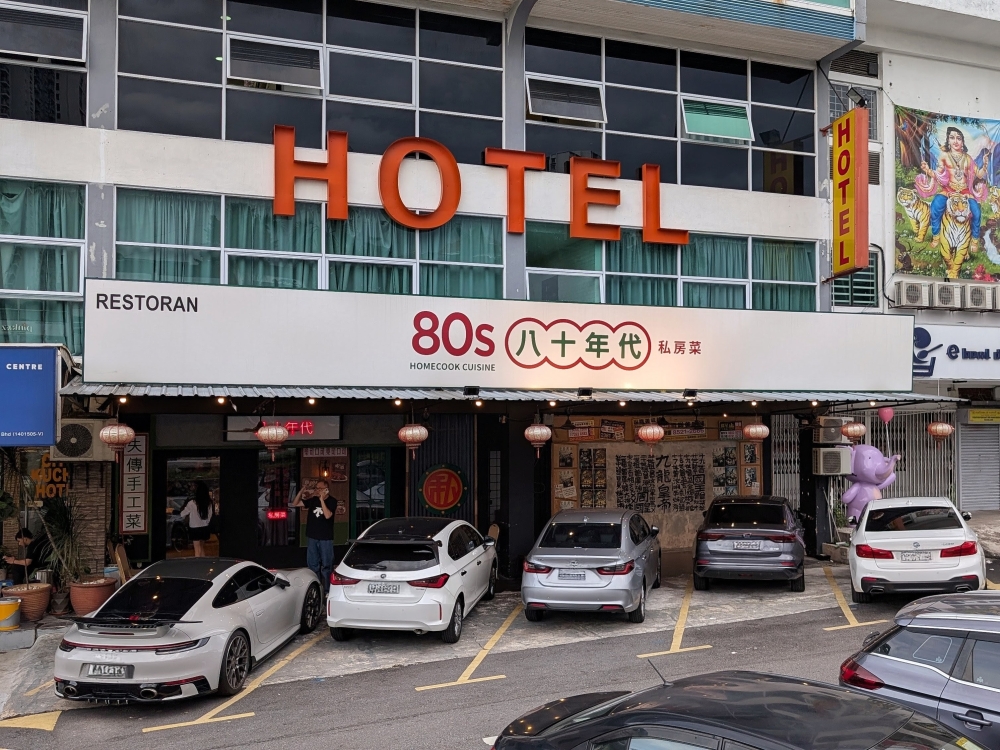
And it seems to have resonated. Nearly a year later, you still have to wait almost two months to get a reservation.
The 1980s in Hong Kong was defined by the emergence of the nouveau riche, as the city prospered economically.
It was also the golden age of Hong Kong cinema, something the interior design at 80s Home Cook Cuisine makes frequent allusions to.
This newfound wealth was naturally reflected in the dishes of the day, which married refined Cantonese technique with prized ingredients — fish maw, dried scallop, waxed meats — many of them requiring significant preparation.
These are the kinds of dishes the restaurant has chosen to focus on, with the overwhelming majority of the menu requiring pre-orders.
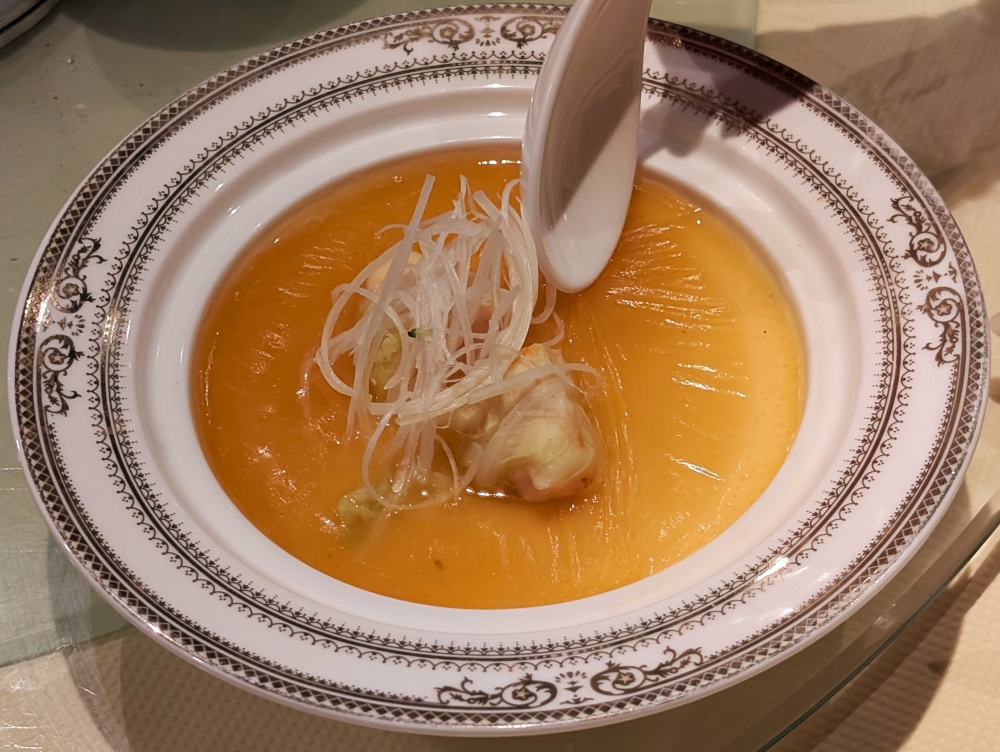
We start with the unassuming Steamed Egg Custard with Cabbage & Prawn Paste (RM25), a seemingly simple steamed egg covered by a thick blanket of chicken broth so rich that a skin of fat forms within seconds of the bowl reaching the table.
The topping of thin slips of cabbage and a shape of prawn paste quickly falls by the wayside.
The server makes a point of telling us that the egg custard is completely unseasoned, explaining that the idea is to taste the unadulterated, enriched chicken flavour.
And that’s exactly what you get: a deeply extracted, savoury chicken flavour, with little in the way of restraint or subtlety — something I would later find to be a theme across the rest of the dishes.
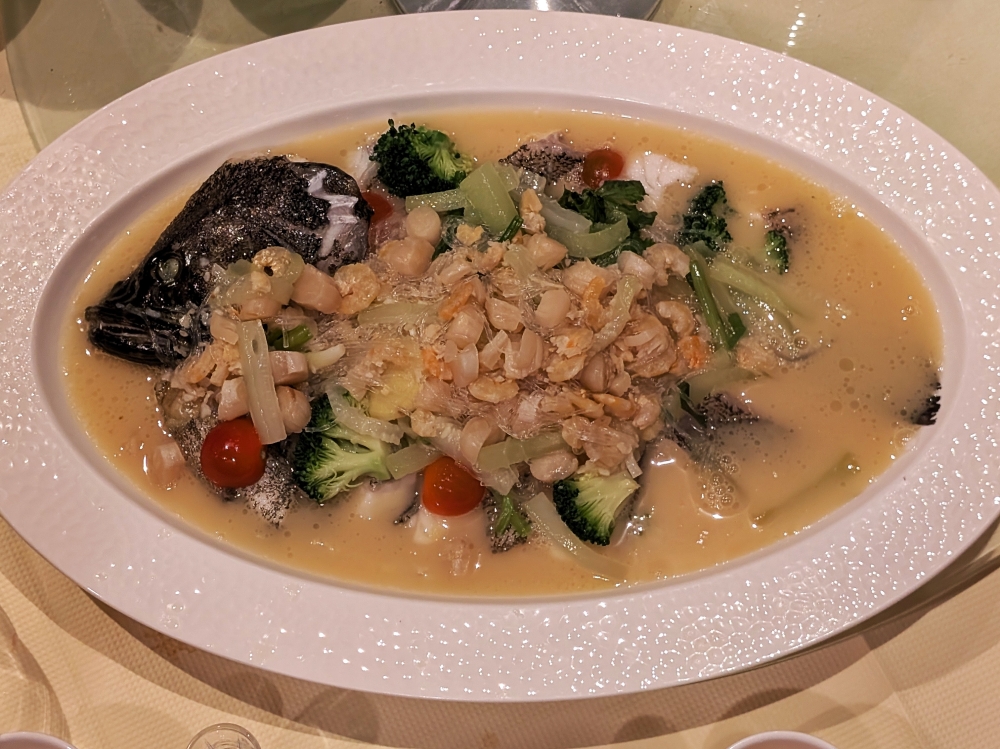
Next, the Steamed Tiger Grouper with Loofah, Dried Scallops, Dried Shrimp & Vermicelli (RM188) came highly recommended.
Unlike the more conventional steamed fish found in most Chinese seafood restaurants here, where seasoned soy sauce is the typical pairing, this dish revolves once again around a rich, extracted broth made from fish this time.
The combination of loofah, dried shrimp and vermicelli is a fairly common one, bolstered by the addition of dried scallops to further boost the overall savouriness.
In the end, the deboned fish, soft loofah and other components function as little more than vehicles for the main source of flavour, the sweet, milky-white fish broth.
Finally, the pair of dishes that followed signalled a departure from the stock-and-broth fest.
The Signature Crispy Suckling Pig Sticky Rice Roll (RM298) is a classic preparation, evoking the meticulous and theatrical presentation of that era of Hong Kong cuisine.
A suckling pig is roasted whole, its midsection stuffed into little roulades of glassy, shattering skin wrapped around glutinous rice cooked with house-made lap yuk, or cured meat, and dried scallops.
It is a more than welcome change of pace from the brothy beginning to the meal, and though it is more than flavourful enough on its own, one might consider dipping a piece in the accompanying plum sauce or sugar on the side.
I am partial to the sugar, which brings out the natural sweetness of the pork further.
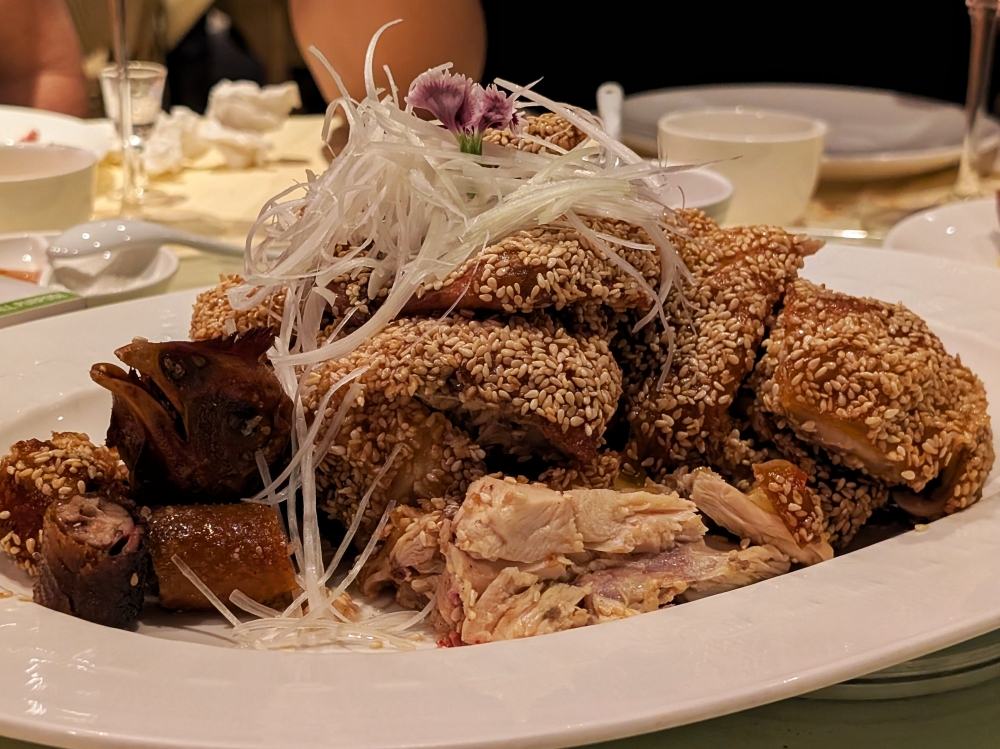
The 1980s-Style Sesame Crispy Chicken (RM138) will be the most recognisable dish for many, and functions as something of a thematic centrepiece for a restaurant dedicated to 1980s Hong Kong cuisine.
Unfortunately, it was also the weakest dish of the night.
The chicken itself was fine, the flesh succulent and the skin crispy, but the coating of sesame was overwhelmingly nutty, to a cloying degree, and ultimately quite one-dimensional.
The accompanying sesame sauce did not help matters.
Things picked up with the next dish, although the Crab Steamed with Huadiao, Chicken Oil & Chencun Rice Noodles (RM148) has little to do with Hong Kong, in my eyes.
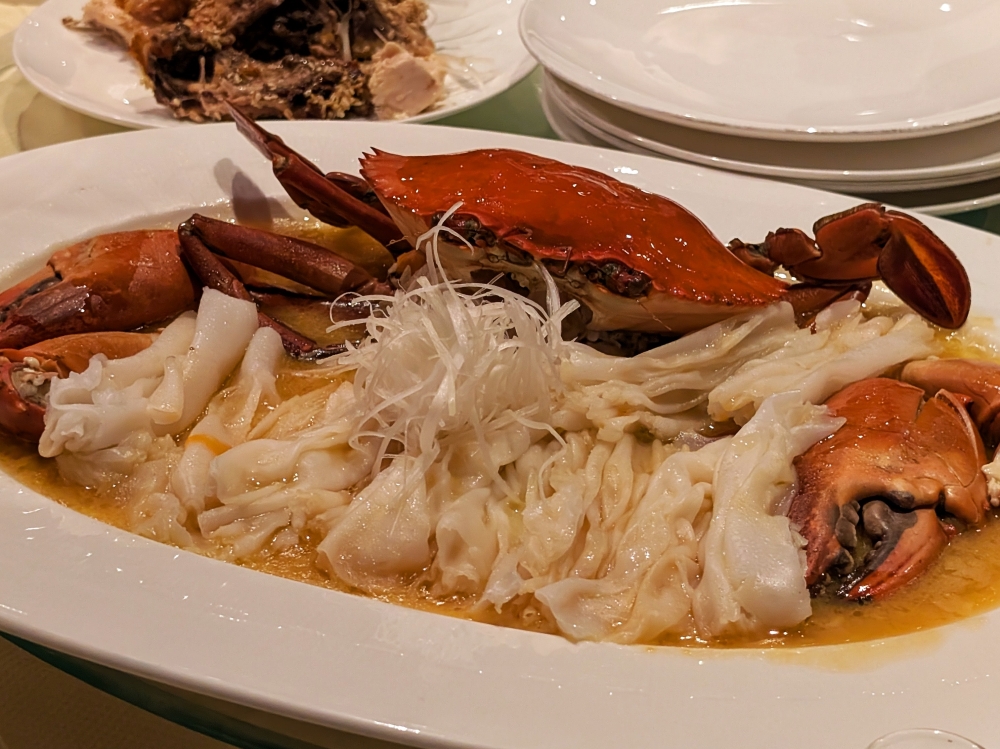
While this is essentially the same signature dish found at the famed restaurant The Chairman in Hong Kong, its roots lie in Shunde, Guangdong Province, considered the birthplace of Cantonese cuisine, and also where I have had this exact dish before.
Chencun rice noodles hail from the town of Chencun, in Shunde. While they are visually similar to cheung fun, they are elastic enough to support their own weight when held from the long end, a property that makes them ideal for carrying the flavourful sauce in this dish.
As with almost every other dish here, most components are made from scratch. In this case, the noodles are made in-house and serve as the ideal vehicle for the sweet-savoury harmony of crab fat, chicken fat and Huadiao, or aged Shaoxing wine.
After such a heady, indulgent experience for the palate, we only had room for one last dish.
We looked to the Clay Pot Rice with Black Truffle Egg, Lard Crisps & Cured Meat (RM68) to bring the meal to a satisfying conclusion, and it did, for the most part.
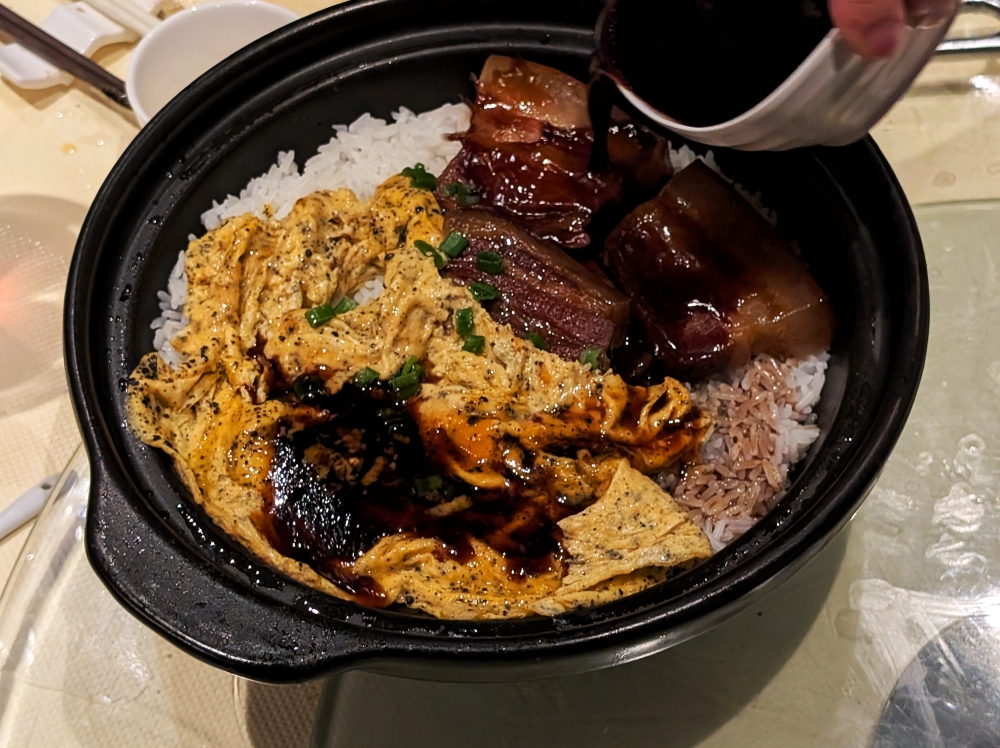
The rice arrives in its clay pot, followed by a bit of theatre as the house-made soy sauce mixture is poured in before the lid is shut and the flavours are left to integrate, much like bo zai fan.
Minutes later, it is portioned out and finished with a generous handful of oversized lard croutons, for good measure.
As is hilariously on brand for my experience with most Chinese restaurants that use truffles, every other component completely overpowered any semblance of truffle in the eggs, but I did not care much.
Between the soft, fatty bits of sweet lap yuk, the crunchy pops of lard and crispy faan ziu from the scorched rice at the bottom, I was in clay pot rice bliss.
In keeping with the 1980s Hong Kong nouveau riche and their affinity for Bordeaux, I spotted the table next to me drinking a bottle of Château Pichon Longueville Baron, and another with Château Pontet-Canet.
And why not? The corkage fee is RM50 for the first bottle, RM50 for the second, and then waived for any additional bottles. Bring more than three bottles, and it works out to a measly RM100, so it would be a waste not to.
So, yes. I am already planning a return, months in advance.
At the time of writing, the earliest available date for a table of four is March 17, while the next available date for a table of eight is March 23.
The rest of January and February are fully booked. When you do finally make it to the restaurant, just be sure to leave your inside voice at home.
As used to be the case in Hong Kong, the place is loud, rowdy and vibrant — a fitting tribute to the city’s halcyon days.
Restoran 80s Home Cook Cuisine
27 & 29, Jalan 2/115A,
Taman Pagar Ruyong,
Off Jalan Kuchai Lama, Kuala Lumpur.
Open Tuesday to Sunday, 6-10.30pm
Tel: 016-290 9233 (Reservations by WhatsApp only)
Facebook: 八十年代私房菜 The 80’s
Instagram: @the80shomecookcuisine
* This is an independent review where the writer paid for the meal.
* Follow us on Instagram @eatdrinkmm for more food gems.
* Follow Ethan Lau on Instagram @eatenlau for more musings on food and occasionally self-deprecating humour.


