


JUNE 13 — In every city, there are buildings that tell stories. Some stand as monuments to power, faith, governance, or commerce. Yet equally important are the spaces between those buildings: the places where people gather, celebrate, remember, and express themselves. In Malaysia, one such space is the dataran. Our recent visit to these spaces called Dataran make us wonder how it affects in everyday life.
More than an open field or public square, a dataran is the civic heart of a city. It is a place where urban heritage comes alive, connecting architecture with community, history with contemporary life, and memory with identity. While buildings often receive the greatest attention in heritage conservation, the dataran reminds us that heritage is not only found in structures but also in the spaces where society interacts and history unfolds.
Historically, many of Malaysia’s dataran evolved from padang or open grounds that served recreational, administrative, and ceremonial functions. These spaces were strategically located amidst important civic buildings, creating a focal point for urban life. Over time, they became stages upon which significant historical events, cultural celebrations, and public gatherings took place.
Perhaps no example illustrates this transformation better than Dataran Merdeka in Kuala Lumpur. Originally known simply as the Padang, it was once associated with sporting activities and social gatherings during the colonial period. However, its significance changed forever on the night of August 31, 1957, when the Union Jack was lowered and the Malayan flag was raised for the first time, marking the birth of an independent nation.
Since then, Dataran Merdeka has evolved from a colonial recreational field into one of Malaysia’s most important national heritage spaces. Surrounded by iconic buildings such as the Sultan Abdul Samad Building, the former Chartered Bank, St. Mary’s Cathedral, and the Royal Selangor Club, the square has become a symbolic landscape where architecture and open space together narrate the story of Kuala Lumpur and the nation.
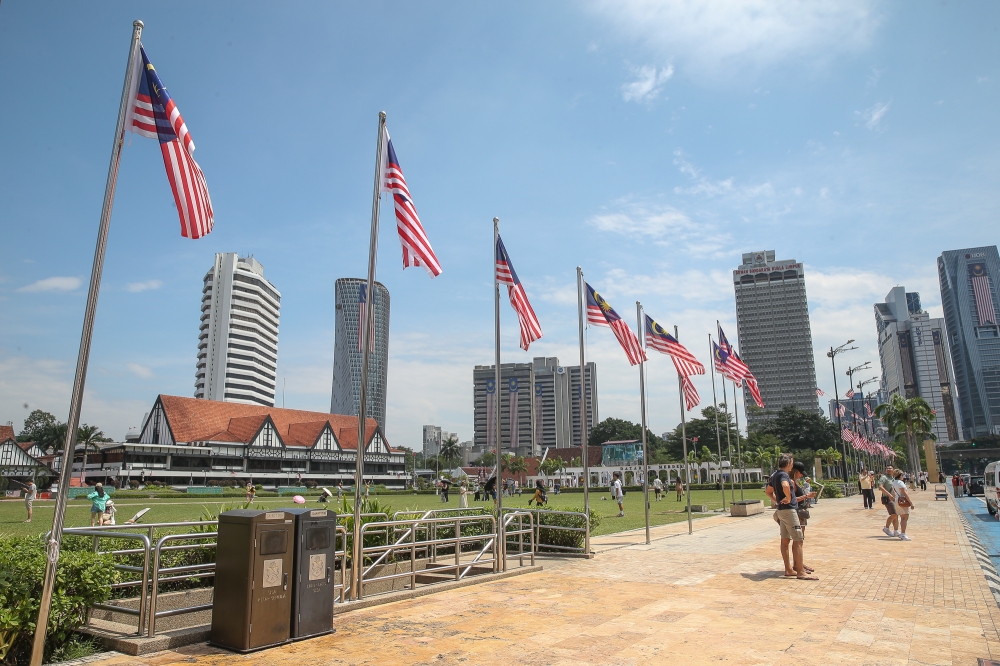
Yet the value of Dataran Merdeka does not rest solely on its historical significance. Its true strength lies in its ability to remain relevant. Today, this green square lawn continues to host national celebrations, cultural festivals, sporting activities, public performances, and civic gatherings. Whether welcoming thousands during Merdeka celebrations, hosting cultural festivals, or serving as a platform for public expression, the space demonstrates how heritage can remain vibrant when it continues to be used by the people.
A similar story can be found further north at Dataran Medan Bandar in Alor Setar, Kedah. Existed before the colonial time as a green field, Medan bandar is situated within the historic core and a part of the Malay royal town, framed by significant landmarks of Istana Balai Besar, Balai Nobat, Zahir Mosque and the marketplace. Now the square has been covered by granite surface become a focal point to accommodate more public activities and community life. Unlike the national symbolism associated with Dataran Merdeka, Dataran Medan Bandar reflects a more local and community-oriented character.
The space regularly accommodates state ceremonies, cultural programmes, religious gatherings, community events, recreational activities, and tourism initiatives. Families gather there during festive celebrations, visitors admire the surrounding heritage landmarks, and residents use it as a place to meet, relax, and participate in civic life. Its recent recognition as an Islamic Heritage Square further highlights the growing appreciation of public spaces as important heritage assets.
These examples reveal an important lesson about urban heritage. The significance of a dataran does not lie in its emptiness but in its openness. Unlike buildings that often serve specific functions, a dataran is adaptable. It can accommodate a national parade one day, a cultural festival the next, and a casual evening gathering thereafter. Its flexibility allows each generation to reinterpret its purpose while preserving its historical meaning.
In many ways, a dataran functions as the city’s living room; a shared space belonging to everyone regardless of age, background, or social status. It is where citizens encounter one another, where collective memories are formed, and where civic identity is strengthened. Such spaces encourage social interaction, foster a sense of belonging, and contribute significantly to the quality of urban life.
As cities become increasingly dense and development pressures intensify, the importance of preserving these public spaces cannot be overstated. Heritage conservation should not focus solely on individual buildings but also on the broader urban landscapes that give those buildings meaning. Without the dataran, historic structures risk becoming isolated monuments disconnected from the communities they were meant to serve.
The future of urban heritage therefore depends not only on safeguarding historic architecture but also on protecting and revitalising the public spaces that support community life. Well-maintained dataran can continue to host cultural activities, educational programmes, heritage walks, and civic events that connect people with their shared history.
The enduring appeal of Dataran Merdeka and Dataran Medan Bandar demonstrates that successful heritage spaces are not frozen in time. Instead, they evolve while retaining their identity. They accommodate changing social needs without losing their historical significance. They remind us that heritage is not merely something to be observed: it is something to be experienced.
In the end, a dataran is far more than an open space between buildings. It is a repository of collective memory, a stage for civic life, and a symbol of urban identity. It is where the past meets the present and where communities continue to shape the future.
As Malaysia moves towards increasingly modern and sustainable cities, preserving our dataran is not simply about conserving land. It is about safeguarding the public soul of our cities. For in these open spaces, heritage is not locked behind walls or displayed behind glass; it is lived, shared, celebrated, and passed on from one generation to the next.
* The authors are Associate Professor Sr Zuraini Md Ali from the Faculty of Built Environment, Universiti Malaya, and Assistant Professor Datin Nor Hayati Hussain from the School of Architecture, Tunku Abdul Rahman University of Management and Technology. They can be reached at [email protected] and [email protected]
**This is the personal opinion of the writer or publication and does not necessarily represent the views of Malay Mail.


