


JANUARY 17 — There are moments in international politics so exquisitely embarrassing that they deserve their own wing in the Museum of Geopolitical Self-Owns. María Corina Machado’s decision in January 2026 to present her Nobel Peace Prize medal to Donald J. Trump — two weeks after he ordered the kidnapping of Venezuela’s president — is not merely cringe. It is an event that future diplomats will study the way surgeons study nineteenth-century amputation manuals: with a mix of morbid curiosity and disbelief that anyone thought this was a good idea.
It is also a moment that should force the Nobel Committee to stare long and hard into a mirror and ask itself how a prize once synonymous with moral seriousness became a participation ribbon for foreign policy LARPing.
A Nobel medal for a rendition operation
The facts would be rejected by any competent screenwriter for being too on-the-nose: US special forces abduct Nicolás Maduro in an extraterritorial raid; bodies drop; sovereignty evaporates; Venezuela’s political future is violently rearranged. Less than a fortnight later, Machado — freshly minted Nobel laureate — walks into the White House to present Trump with her gold medal, framed like a trophy fish, in gratitude for “his unique commitment to our freedom.”
One can almost hear international law professors collectively sliding their lecture notes into the recycling bin.
If there is a Nobel Prize for cognitive dissonance, this is it.
The truly surreal element is that Trump, having just uprooted Venezuela’s political order, chose not to elevate Machado, not to recognise her victory in the 2024 election, not even to leverage her as a transitional figurehead. Instead, he handed power to Delcy Rodríguez — Maduro’s vice-president — because she was deemed more operationally reliable. In international relations jargon, Machado was demoted from “liberal democratic hope” to “overly idealistic opposition leader who can’t run a security apparatus.”
And so the medal ceremony reads less like Lafayette gifting Washington a token of revolutionary kinship, and more like a contestant offering roses to the reality show host who already eliminated her in the first round.
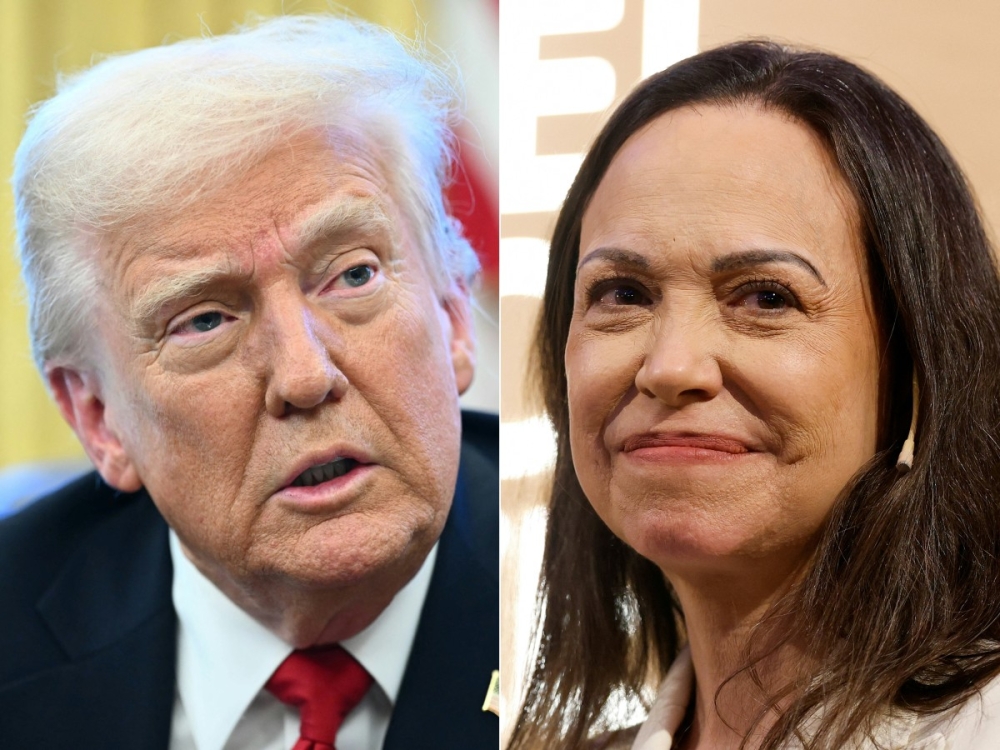
Soft power’s underwear is showing
The Nobel Committee scrambled to tweet that a medal “can change owners” but the title cannot — which is the institutional equivalent of clarifying the warranty terms on a dishwasher. If an institution must issue a public FAQ explaining how its symbols should not be interpreted, the mystique is already gone.
This is not entirely Machado’s fault. She is simply the first person in Nobel history to weaponize her medal as a lobbying accessory to regain political relevance. That novelty alone should give Oslo indigestion.
But the deeper problem is that the Committee awarded her the prize prematurely, not for achieving peace, not for negotiating a transition, not for reducing violence, but for “struggling” against authoritarianism. “Struggling” is a noble verb, but it is not a neutral one — and it revealed the Prize’s new role as a normative signaling device, not a recognition of concrete results.
If you award laureates based on aspiration rather than outcome, you get exactly this: a medal with no victory attached, repurposed as a poker chip at the first geopolitical casino that opens its doors.
Historical echoes of institutional faceplanting
To be fair, the Nobel Peace Prize has a long track record of awarding candidates who immediately undermine the intended optics.
The most infamous include:
1973 — Henry Kissinger and Lê Đức Thọ
Awarded for a Vietnam ceasefire that collapsed before the ink dried. One committee member resigned; Thọ refused his half outright; Kissinger allegedly tried to return his when critics turned the prize into a punchline.
1994 — Arafat, Rabin, Peres
Awarded for peace that disintegrated into the Second Intifada. The Prize did not age well.
2009 — Barack Obama
Awarded eight months into his presidency “for hope.” Hope is a beautiful sentiment; it is not policy.
2024 — Machado
Awarded for a democratic transition that never materialized and was rendered meaningless by the time she reached baggage claim at Dulles.
The pattern is clear: the Prize has moved from recognizing peace, to incentivizing peace, to merely endorsing the narrative of peace, which in the modern information ecosystem is a currency of its own. But as every currency eventually learns, over-issuance causes inflation.
The age of award diplomacy
The Machado–Trump spectacle reveals how award diplomacy now works: symbols are traded, morality is staged, and legitimacy is outsourced.
This is not new. The Marshall Plan used reconstruction dollars to shape European alignment. The Soviet Union used medals to manufacture revolutionary legitimacy. China now uses Confucius Institutes, scholarships, and infrastructure loans. The difference is that the Nobel Prize was never meant to be in this club. It was meant to sit above the fray as the adult in the room.
Instead, it has become an accessory to geopolitics — and, in this case, a tragicomic one.
The Opposition auditions for power
The Venezuelan opposition has always struggled with an uncomfortable rule of modern politics:
Movements that derive legitimacy from foreign capitals rarely survive contact with domestic realities.
Machado’s Nobel was meant to compensate for that deficit by conferring moral legitimacy from outside. But the Trump raid revealed a brutal truth: Washington values governability, not ideals. Rodríguez was chosen not because she was democratic, but because she understood how to operate the security state. That is realpolitik distilled.
Machado’s medal gesture — intended to signal loyalty — only underscored her lack of bargaining power. It was political fan fiction performed for an audience that had already changed the channel.
The Nobel Committee’s Historic Low Point
The tragedy for Oslo is that institutions rarely get the chance to define their own legacy. History does it for them.
The Machado episode will be remembered not for Venezuela, not for Trump, and not for Maduro, but for what it revealed about the Nobel Peace Prize:
- that its standards have eroded,
- that it confuses symbolism with strategy,
- and that it can no longer distinguish between moral leadership and geopolitical opportunism.
The Committee’s tweet — that medals can be traded but titles cannot — was meant as damage control. In reality, it read like an unintended confession:
The medal is the only part of the Prize anyone actually cares about.
Titles don’t hang on walls. Titles don’t appear on TV. Titles don’t get framed under glass and posted to Truth Social.
The comedy of soft power
From a comedic standpoint, the episode is almost too rich. Consider the constellation of contradictions:
- A peace medal given to the architect of an invasion.
- Given by a laureate who wanted democracy.
- To a leader who bypassed her for an autocrat’s deputy.
- After a military operation that killed civilians.
- In the name of “freedom.”
- While the Nobel Committee live-tweets clarification memos.
- All framed and posted online like a real estate plaque.
Had Voltaire witnessed this scene, he would have retired from satire, declaring the competition unfair.
Conclusion: A prize without gravitas
The Nobel Peace Prize once carried weight. Today it carries content. It has become a photo op that travels well on social feeds and an asset class in the global marketplace of narrative manufacturing.
Machado’s gesture is not an anomaly. It is a symptom. It shows that in the 21st century:
- War is kinetic,
- Diplomacy is transactional,
- Legitimacy is outsourced,
- and Peace is merchandised.
The Nobel Committee should be embarrassed not because Machado gave the medal away, but because she had nothing meaningful to do with it in the first place.
When moral institutions become props, theater replaces principle. And once that curtain falls, no number of explanatory tweets can reopen it.
* This is the personal opinion of the writer or publication and does not necessarily represent the views of Malay Mail.


