


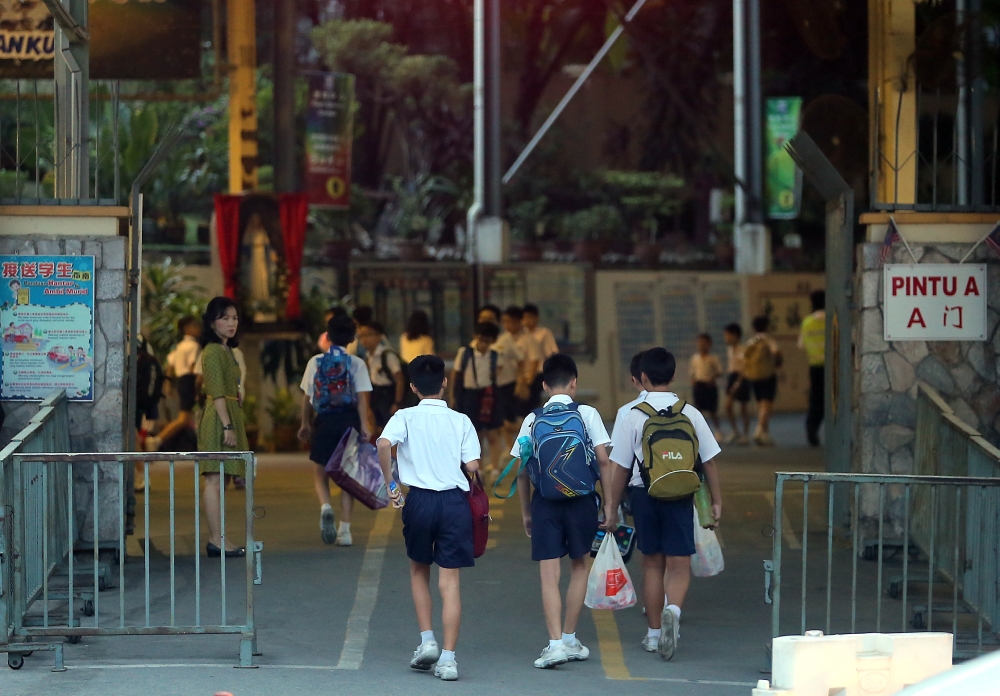
JANURY 16 — When schools reopened recently, several photos showing a sizeable number of non-Chinese students in national-type Chinese primary schools (SJKC), went viral. For some, the images were surprising as the common view is that non-Chinese students typically shun such schools.
For me, it is a very encouraging trend. In fact, diversity in our classrooms, especially at the primary level, should be cherished, and not treated as an exception.
If we truly believe in building a united Malaysia, then our children must grow up learning alongside friends of different religions and ethnic backgrounds. This is how understanding begins, not in speeches or slogans, but in shared classrooms and playgrounds.
We need only look to Sabah and Sarawak, where a Malaysian identity has long been primary, enriched rather than divided by ethnicity. This is the spirit our national education system must nurture.
The truth is, statistics show that national-type schools like SJKC are even more diverse now than national schools (SK). Bumiputera enrolment in SJKC has increased from 11.67 per cent in 2014 to 18.52 per cent a decade later. Meanwhile, non-Bumiputera student enrolment in SK decreased from 6.19 per cent to 4.88 per cent in the same period.
There is a practical reason why this diversity is so important at the primary level. Children who are exposed early to different cultures grow up without fear or awkwardness. When they move on to secondary schools, and subsequently to university and working life, they do not experience culture shock. They are already comfortable in diverse settings.
Integration delayed is integration denied. By the time prejudices harden, opportunities to shape attitudes have already been lost. If we want confident Malaysians who are at ease with one another, the foundation must be laid early.
This is also where the Rukun Negara comes alive. Its principles are not meant to stay on posters in classrooms. They are to be practised daily when children learn to live with differences in the same classroom.
A crucial part of this experience is learning respect through real actions. In SJKs where there are Muslim students and teachers, providing halal food and space for them to practice their religious obligations is a real-life lesson that respect must be matched by deeds.
This will foster the spirit of inclusivity and mutual respect that can grow beyond the school gates. It will also help provide insight to non-Chinese parents to better appreciate the challenges faced by SJKs, such as funding and student welfare.
Beyond unity and respect, there is another important dimension to diversity in schools: choice. Malaysia has always benefited from having multiple education streams. Besides SKs, SJKs, we also have private schools, international schools and sekolah pondok, among others.
These give parents choice. The reality is that parents choose schools for their children based on quality, opportunity and what they believe is best for their children. Ideology has no part in it. Most of the non-Chinese parents who enrol their children in SJK say they do so because they believe these schools deliver superior education.
This is why having multiple pathways could help foster healthy competition among the different types of educational streams that would help lift the standards of our education system as a whole. Our goal should not be to argue over which stream is superior, but to ensure each provides excellent learning and future prospects.
In the end, the debate about diversity in schools should not be reduced to emotion or nostalgia. It is about the kind of society we want to build and the systems we put in place to support that vision.
When children learn to respect differences early, when schools practise inclusion in real ways, and when parents are given genuine choices, we are laying the groundwork for a stronger and more confident Malaysia.
* Ng Kor Sim is the state assemblyman for Jementah, Johor
** This is the personal opinion of the writer or publication and does not necessarily represent the views of Malay Mail.


