JULY 4 — I recently had the opportunity to travel to the east coast for a few speaking engagements. More than merely land, speak and leave (which is usually the case with such trips), I managed to soak in some observations of the beautiful Malay heartland that we sometimes take for granted.
Having been awakened by the co-pilot’s announcement that we were about to land, I looked out the window to re-orient myself to reality. That was when I spotted a lone colourful wau, flying gracefully against the backdrop of coconut trees lining the coast. Kota Baru, here I come!
Kelantan, as we all know, is the land of a unique, melodious Malay dialect, the delightful nasi kerabu, scrumptious kuih akok, the iconic Pasar Siti Khadijah and, believe it or not, women empowerment.
Women have played a central role in the history and development of Kelantan. For example, one cannot tell the story of Kelantan without mentioning the legendary Che Siti Wan Kembang, queen regnant of the area that is today encompassed by the east coast state.
Believed to have ruled from 1548 to 1580, the beautiful and wise Che Siti was also known to be a fearless warrior princess who, together with her daughter Puteri Saadong, led an army of female horse-riders. Today, the Kelantan state emblem carries two deers, a legacy that is traced back to Che Siti, as the ruminant mammals are said to have been her favourite pets.
Soon after my feet touched Kelantanese ground, I was whisked away to participate in a dialogue with the ruling political party’s women’s wing. It was a sociable affair as we got to learn about one another, exchanged words of encouragement and support, and shared experiences and ideas, including personal tips on the correct method of donning the headscarf.
It was certainly an enlightening couple of hours for me. I learned that the Kelantan state government has played a major role in empowering women. Since the 1990s, a special unit for women development had been formed to execute policies in accordance with the Syara’.
Women policies in the state have been designed to both ennoble and enable the role of women in nation-building. Women in Kelantan are recognised as important actors in society, in whatever capacity they assumed -– whether as a wife, a mother, a daughter or plainly as a human being.
After all, as one recently departed Middle Eastern leader once put it: “Women make up one half of society. Our society will remain backward and in chains unless its women are liberated, enlightened and educated.”
Among the many policies implemented to strengthen women’s welfare and their role in family institutions are the extension of maternity leave from 42 days to 60 days in 1991 (far preceding the Federal government), executing development and takaful programmes for single mothers and widows, and providing courses to educate women in household management. Women development centres were also built in every district to encourage activities among women.
The state government also took progressive steps in encouraging female participation in decision-making by appointing women representatives into the Senate, as State Excos, district council members and even penghulus. Today, the state government’s female workforce stands at about 6,000 to 7,000 strong!
The various women-friendly programmes and policies implemented in Kelantan over the years have managed to provide opportunities for women to contribute to nation-building. By empowering women in decision-making and administrative positions, Kelantanese women have been able to live up to their historical reputation as leaders in society.
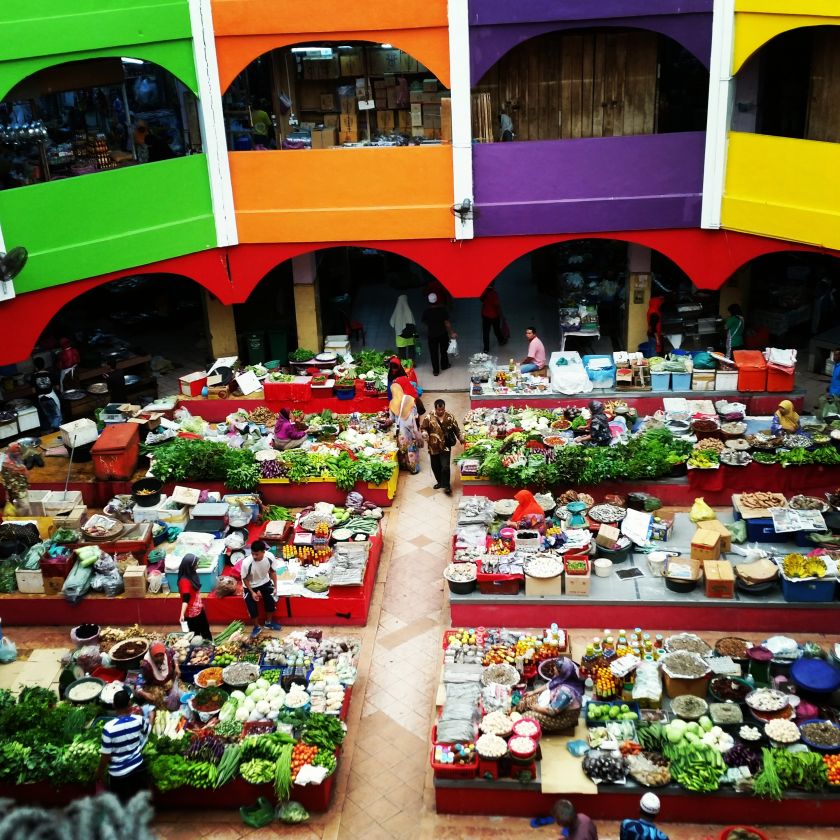
On my last day in Kelantan, we managed to squeeze in an hour to visit the famous Pasar Siti Khadijah, a local wet market mostly run by women. It was a pretty sight (both figuratively and literally), watching local women with their graceful demeanour taking charge and being fully involved in business (in contrast to the motley mix of foreign workers we’re used to in other parts of Malaysia).
I was told the market was named for the entrepreneurial Khadijah Khuwaylid, who is the Prophet Muhammad’s first wife. Her business acumen, impeccable personality and virtuous character made her one of the most prominent merchants among the Quraysh. I personally feel that it was apt to name the iconic market after the most vibrant, liberating and noble spirit of early Islam.
As can be imagined, my precious hour at the market was filled with food-tasting, cloth-admiring, agonising decision-making and attempts to bargain in the foreign Kelantanese dialect.
At the end of my short visit there, I discovered that Pasar Siti Khadijah could be a dangerous place. Not so much because of its wet floors (it is a wet market after all) and the almost non-existent air ventilation, but the ridiculous bargains and the availability of credit card machines!
Ramadan Mubarak!
*This is the personal opinon of the columnist.