


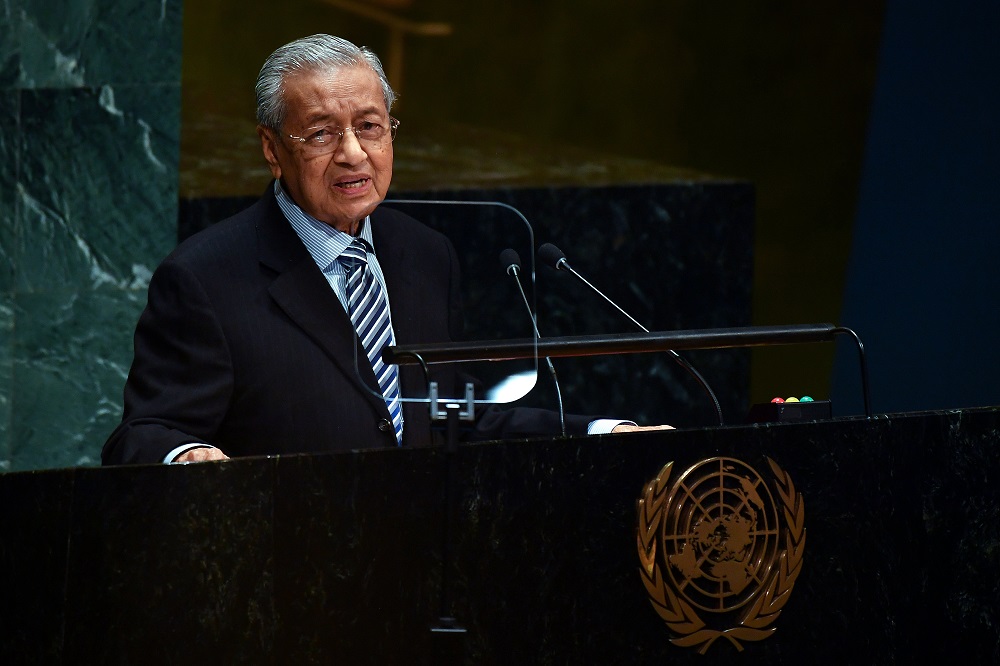


NEW YORK, Sept 28 — Trade wars are wasteful and will hamper the potential for every country to become rich, said Tun Dr Mahathir Mohamad.
“Malaysia is a middle-income country. It depends on trade to grow. Naturally our markets are the rich countries.
“Now the rich want us to balance the trade, to buy more of their goods, to correct the imbalance.
“To do this we will have to spend the money we earn from trade to import the goods of the rich. Our growth will be stunted so that the already rich will become richer, he said in his statement at the General Debate of the 74th UN General Assembly here.
The prime minister reiterated that trade enriches everyone and this has been shown through the ages.
“Malaysia is a trading nation. Our population is too small to provide a good market. We need the world market.
“With the new communication technologies, we can increase our trade with the world. So, don’t impoverish us by forcing us to buy what we don’t need or to reduce our exports,” he added.
Dr Mahathir also touched on the issue of sanctions being imposed, including on Iran.
“We do not know under what laws sanctions are applied. It appears to be the privilege of the rich and the powerful.
“If we want to have sanctions, let us have a law to govern them. The fact is that when sanction is applied to a country, other countries get sanctioned as well.
“Malaysia and many others lost a big market when sanction was applied on Iran,” he said.
While saying he believed in capitalism, he stressed that “capitalism has gone mad”.
“They are already talking of making trillions. It is dangerous for a person or a company to have so much money. It can influence things. It can buy power. Hence the antitrust laws.
“We see in the Trans Pacific Partnership — TPP, when the rich companies had given themselves the power to sue governments. The terms of the agreements were drawn up by them.
“And they are not all like Bill Gates. Most are bent on exploiting the power money gives them,” he added.
Dr Mahathir said the TPP was cooked up in Washington with inputs from their big businesses.
“Fortunately, now the powerful country which prepared these agreements has rejected it. With the exclusion of this country, the Agreement has become more palatable.
“But the agreements still laid down conditions for trade — which negates free trade. We are told that we must remove duties on imports, or reduce it so that foreign products can knock out our infant industries.
“We are reduced to exporting only raw material. How do we industrialise and create jobs for our people?” he asked.


