


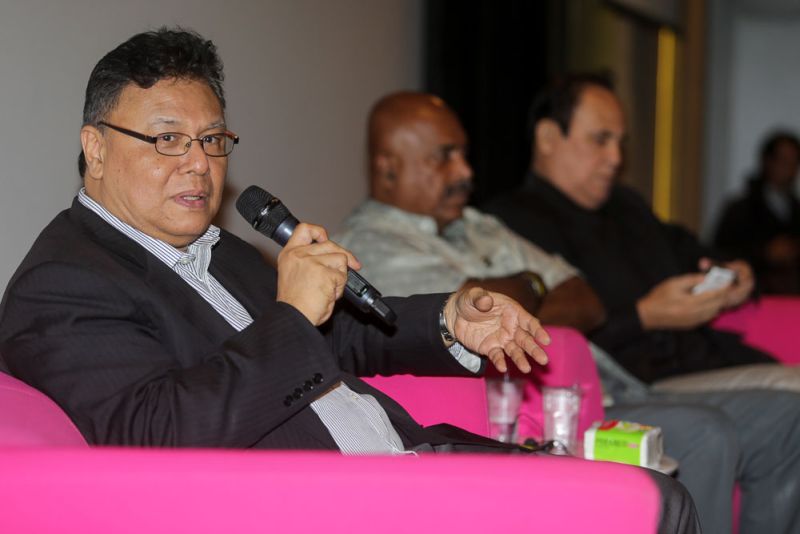
KUALA LUMPUR, Aug 9 ― Renomination is not on the cards for the 28th Malaysia Film Festival Award (FFM), but a reconfiguration of the award categories are possible options for the festival that is less than a month away, the National Film Development Corporation Malaysia (Finas)'s director-general has said.
Amid controversy that erupted last week over the splitting of the awards into Bahasa Malaysia and non-Bahasa Malaysia categories, Finas director-general Datuk Kamil Othman said a review of the existing award categories could be possible.
“I think there won't be renomination, most probably if we do anything, we rearrange the way the awards are being arranged. Rearranging doesn't mean creating new categories,” he told reporters here last night after a public engagement session on the FFM.
Kamil said there is no time left for new categories to be created and that FFM will work with the existing nominees, pointing out that the panel of jury have already viewed and shortlisted all the nominated films and that the evaluation was at the final round.
Options such as the expansion of current award categories or removal of non-Bahasa Malaysia categories for the FFM are “possible”, Kamil said.
But the decision on how the controversy will be resolved will depend on the outcome of the discussion between FFM28's organiser Finas and its strategic partner Malaysia Film Producers Association (PFM), as well as the Ministry of Communications and Multimedia, he said.
Kamil said he hopes that Finas and PFM will be able to issue a joint statement soon in the next few days on this matter.
He said the Communications and Multimedia Minister Datuk Seri Salleh Said Keruak had met him on Monday, with the latter wanting more input on the matter.
Kamil said that the minister wanted to make sure decisions were not made rashly, and that provisions within the Federal Constitution such as Article 152 ― which names the Malay language as the country’s national language is respected.
In the same session yesterday, PFM CEO Pansha Nalliah said FFM organisers were shocked at the sudden accusation of racism over the creation of two additional awards under the non-Bahasa Malaysia category this year, when a similar category had been in place since 2011.
“All these while from the first festival up til the 25th edition, this was for national film, when you say national film, it was the national language. At that time there were no other films, no Chinese film, no Indian films.
“And in 2011 we found that the Chinese film industry and the Indian film industry were beginning to churn out movies, so what PFM suggested is we have one award for best non-Malay (language) movie and it was practised and followed,” he said, adding that the local association of Chinese film producers has come out in support of FFM organisers.
The new non-Bahasa Malaysia category for Best Screenplay and Best Director were introduced as there was a larger number of movies not filmed in the national language this year, he said.
Nancie Foo, who is on FFM's jury selection committee, noted that both the local Chinese film producers association and Indian film producers association organise their own film festivals.
Last week, Kamil told Malay Mail Online that Finas has made it a policy for locally-made films to emphasise at least 70 per cent Bahasa Malaysia usage in their scripts in line with the government’s push to promote the national language, but admitted it would be ideal if the Best Picture category in FFM was open to all films regardless of language.


