


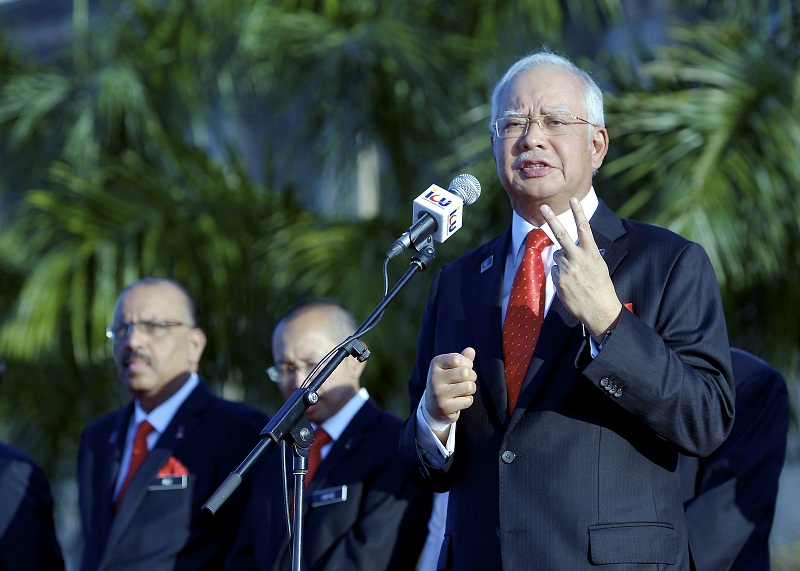
KUALA LUMPUR, Jan 15 ― Moody’s revision of Malaysia’s outlook is unlikely to have major ramifications for the local economy as it essentially brings the ratings firm’s projection to the same level as rival agencies, said economists.
Economist Dr Yeah Kim Leng pointed out that the “Stable” rating that Moody’s assigned to Malaysia, down from “Positive” previously, matches the outlooks by rivals Fitch as well as Standard & Poor’s (S&P).
“Any impact is likely to be muted given that it's not a downgrade which we could see deterioration in Malaysia’s credit fundamentals.
“This is only one of the three global rating agencies… so now it’s a consistent rating among all three rating agencies. It suggests a unanimous expectation of Malaysia’s assessment of its sovereign credit rating,” Yeah told Malay Mail Online.
He also stressed that the change was a revision of the outlook for the Malaysian economy, and not a downgrade of the country’s sovereign credit rating.
On Monday, Moody’s changed Malaysia’s outlook from “Positive” to “Stable” at A3, citing external financial pressures that has weakened the government’s revenue.
Fitch and S&P have Malaysia ranked at the A- level, which brings all three agencies’ rating of Malaysia at the fourth-lowest investment grades, Bloomberg reported on Monday.
Affin Investment Bank chief economist Alan Tan also downplayed the possible repercussions of Moody’s outlook revision given the reactive measures by Putrajaya to maintain its promise to rein in its chronic overspending.
“Going forward, we believe the risk of Malaysia’s actual sovereign rating being downgraded is small, as international rating agencies are likely to consider government's further efforts to bring down the country’s fiscal deficit,” he said in an email to Malay Mail Online.
Prime Minister Datuk Seri Najib Razak is due to announce a revised Budget for 2016 on January 28, but has promised that this will not affect his administration’s plan to trim the deficit to 3.1 per cent this year.
Asian Development Bank’s lead economist Jayant Menon said, however, that the country’s “external position and domestic revenues” may be affected given shrinking reserves coupled with the unfavourable global economic climate due to the slump in oil prices and China’s growth.
“The current account surplus continues to narrow, and the currency continues to depreciate despite reserves falling in an attempt to support it.
“If economic growth slows as a result, it is likely that fiscal targets will also be missed,” he said in an email to Malay Mail Online.
Yeah explained that Putrajaya is on the right path to stave off a possible credit ratings downgrade with its pledge to trim the deficit, but added that the government must also address other factors such as inflation in order to keep economic growth from stalling.
The Malaysian University of Science and Technology (MUST) Business School dean added that Putrajaya could afford to trim its operational and development expenditure by reducing wastages and temporarily shelving low-priority projects.
“All these efforts will raise sovereign credit fundamentals and that'll bring us in line for a potential upgrade if we're able to exceed the fundamentals of other similarly-rated countries,” he explained.
Tan also said that if Putrajaya did not implement strict spending cuts in the Budget revision, it could inadvertently missed its announce deficit reduction target or ― worse ― increase the margin of overspending again.
He said the non-petroleum revenue sources such as the Goods and Services Tax could help mitigate the reduced income caused by falling oil price, but noted that this was dependent on domestic consumption and the world economy remaining favourable
“Without any sharp cut in government expenditures and other fiscal measures, we believe the country’s budget deficit target will increase to -3.5 per cent of GDP this year, from the earlier official budget deficit forecast of -3.1 per cent of GDP,” he said.


