




KUALA LUMPUR, Dec 8 — In a strongly-worded open letter, a group of 25 influential Malays called on the federal government to review Shariah criminal offences and assert the supremacy of the Federal Constitution over Islamic state laws in the country.
The group, dominated by some of the country’s most senior-ranking civil servants who have since retired from duty, expressed its dismay over the unresolved disputes on the position and application of Islamic laws in Malaysia, which it said reflect a “serious breakdown” of the division of powers between the federal authority and the states.
“We refer specifically to the current situation where religious bodies seem to be asserting authority beyond their jurisdiction; where issuance of various fatwa violate the Federal Constitution and breach the democratic and consultative process of shura,” the group said in a statement emailed late last night.
“Where the rise of supremacist NGOs accusing dissenting voices of being anti-Islam, anti-monarchy and anti-Malay has made attempts at rational discussion and conflict resolution difficult; and most importantly, where the use of the Sedition Act hangs as a constant threat to silence anyone with a contrary opinion,” it added.
“These developments undermine Malaysia’s commitment to democratic principles and rule of law, breed intolerance and bigotry, and have heightened anxieties over national peace and stability.”
The group listed down five pressing issues to be dealt with by Prime Minister Datuk Seri Najib Razak, the first being the areas of conflict and overlap between civil and Shariah laws, insisting that the matter must be reviewed after the Cabinet’s directive to do so in 1999 was ignored.
“These laws which turn all manner of ‘sins’ into crimes against the state have led to confusion and dispute in both substance and implementation,” the group said.
“They are in conflict with Islamic legal principles and constitute a violation of fundamental liberties and state intrusion into the private lives of citizens.”
The group also highlighted the lack of public awareness on the legal jurisdiction and limits of the religious authorities’ powers and administration of Islamic laws in Malaysia, insisting that all Acts, Enactments, and even fatwas (religious edicts) are bound for constitutional review.
“The Federal Constitution is the supreme law of the land and any law enacted, including Islamic laws, cannot violate the Constitution, in particular the provisions on fundamental liberties, federal-state division of powers and legislative procedures,” it insisted.
The group asserted that it was the right of all Malaysians to debate the ways Islam is being used to formulate public laws and policies, including promoting the awareness of the rich diversity in interpreting Islamic texts and juristic opinions.
“The Islamic laws of Malaysia are drafted by the Executive arm of government and enacted in the Legislative bodies by human beings. Their source may be divine, but the enacted laws are not divine.
“They are human made and therefore fallible, open to debate and challenge to ensure that justice is upheld,” the group said.
The group urged Najib to assert his personal leadership and to send a clear message that a rational and informed debate on Islamic laws must not be seen as an insult towards the faith or the religious authorities.
“These issues may seem complex to many, but at the end of the day, it really boils down to this: as Muslims, we want Islamic law, even more than civil law, to meet the highest standards of justice precisely because it claims to reflect divine justice.
“Therefore, those who act in the name of Islam through the administration of Islamic law must bear the responsibility of demonstrating that justice is done, and is seen to be done,” it added.
The 25 signatories included several former secretaries-general of the most powerful ministries, including Tan Sri Abdul Rahim Din (Home Ministry), Tan Sri Ahmad Kamil Jaafar (Foreign Ministry), and Tan Sri Dr Aris Othman (Finance Ministry).
Other significant Malays who lent their names to the letter addressed to all Malaysian had previously held the post of director-general in several ministries and government agencies.
Former ambassadors, a former Court of Appeal judge, a retired military officer and a co-founder of the National Heart Institute rounded out the illustrious group.
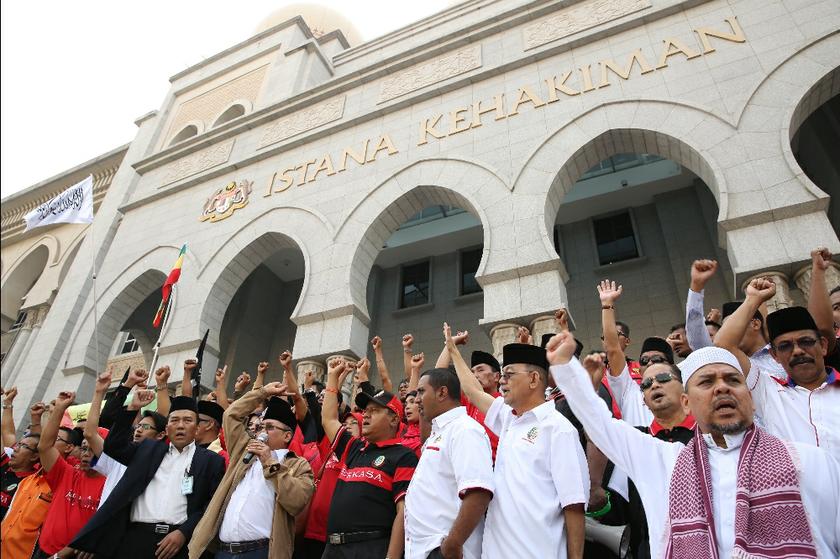
A Court of Appeal landmark decision declaring a Negri Sembilan anti-crossdressing Shariah law as unconstitutional, and the constitutional challenge of Muslim women’s group Sisters in Islam (SIS) against a Selangor fatwa against “liberalism and religious pluralism” has ruffled the feathers of conservative Muslims in recent weeks.
Datuk Seri Jamil Khir Baharom, the minister in charge of religious affairs, had even claimed there was a “new wave” of assault on Islam here, and accused SIS and Muslim transgenders of colluding with enemies of Islam to put its religious institutions on trial in a secular court.


