


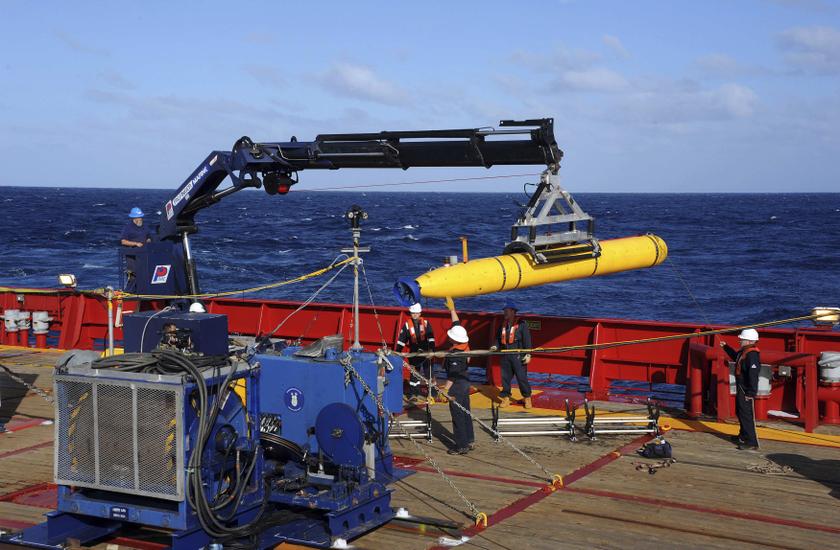


KUALA LUMPUR, April 10 — Its black boxes may well be out of batteries by now but search troops scouring the Indian Ocean for Flight MH370 will likely continue to listen for “pings” from the crucial aircraft recorders for a further “one or two days” before the hunt moves entirely underwater.
According to US Navy Commander William J. Marks, searchers cannot give up just yet on MH370’s black boxes because signals picked up on Tuesday had clearly been emitted by a piece of electronic equipment buried in a part of an ocean that experts have described as one of the loneliest places on Earth.
Marks, who was speaking to CNN live from aboard the USS Blue Ridge this morning, said the US-supplied Towed Pinger Locator (TPL), now attached to Australia’s Ocean Shield, will be used to listen for more signals from the ocean floor for at least a couple more days before an autonomous underwater vehicle (UAV) is deployed for the sonar search.
“We were cautiously optimistic but now that we have the second set (of signals), we are optimistic we’re getting closer and closer,” he told this morning’s Anderson Cooper 360° news programme.
But searchers may have already run out of time with regards to the aircraft’s black boxes, which are only designed to last some 30 days.
Today is the 34th day since flight MH370 disappeared.
At a press conference in Perth yesterday, it was announced that Ocean Shield had picked up a further two “pings” from the Indian Ocean on Tuesday, bringing the number of detections by the TPL to four since Saturday.
Expert analysis of the first two signals by Australia’s Joint Acoustic Analysis Centre also showed that the transmission was not of natural origin and was likely sourced from specific electronic equipment.
The pulses were registered at a 33.331 kHz frequency, which is consistent with transmissions that would come from the aircraft’s recorders, according to retired Australian air force marshal Angus Houston, who is leading search teams in the Indian Ocean.
They were “distinct and clear”, he added, and had consistently pulsed at a 1.106 second interval.
According to Marks today, the second set of “pings” picked up were just 10 to 15 kilometres away from the first set, which is a relatively large search area but still much smaller than before.
“If we can nail that down... that’s the best course of action,” he said.
Asked how long before the less-reliable UAV is lowered underwater for the sonar search, Marks repeated: “one or two days”.
“I can’t answer you definitively... maybe a day or two but I still think there is value in listening with the TPL before you get to the very slow, deliberate, methodical search with the Bluefin-21,” he said.
Marks stressed, however, that there is “no rush” to deploy the UAV for now. The UAV and the TPL cannot be used simultaneously.
“If we take out the TPL now, we are really going to be giving up on the last couple of days of any potential black box ping. So most likely, we will try to maximise that,” he said.
Once MH370’s black boxes go completely silent, however, searchers will have little choice but to rely on the UAV, the Bluefin-21 submersible, to meticulously scour the Indian Ocean inch by inch to try and find the missing plane.
With a search area spanning tens of thousands of square kilometres, the odds of the US-supplied submersible stumbling onto parts of MH370 are astronomically low.
Trundling along at just 8km per hour, the sub is capable of staying submerged to 20 hours and covering just 80km at best in a day.
Then it requires a slow climb back to the surface before search teams are able to download the information it recorded for playback.
At its deepest, the waters in the area go as deep as 4,500m, coincidentally the theoretical maximum depth Bluefin-21 is capable of reaching.
The Malaysia Airlines Boeing 777 aircraft went missing shortly after departing Kuala Lumpur International Airport for Beijing on March 8 and remains missing despite an international search involving over two dozen countries.
The Beijing-bound plane was ferrying 239 people on board.
Search for the jetliner resumed this morning with 10 military and four civil aircraft and 13 ships, all scouring parts of the Indian Ocean where the last few signals were picked up.
Yesterday, several large objects were spotted but none of the items retrieved were connected to MH370, according to a statement by Australia’s Joint Agency Coordination Centre (JACC) this morning.
Today’s search area spans 57,923 square kilometres. The centre of the search area lies approximately 2280 kilometres north west of Perth.


