

KUALA LUMPUR, April 10 — An aircraft searching for the missing Malaysia Airlines flight MH370 has detected a new signal in the Indian Ocean this afternoon, Australian authorities said today.
Australia’s retired Air Chief Marshal Angus Houston, who leads the agency in charge of the search operations, said the country’s AP-3C Orion aircraft picked up a “possible signal” while carrying out an acoustic search.
He confirmed that the “possible signal” was found in the area where Australian search vessel Ocean Shield was located, but said the data needs to be refined.
“The acoustic data will require further analysis overnight but shows potential of being from a man-made source,” said Houston in a brief statement this afternoon.
“I will provide a further update if, and when, further information becomes available,” he added.
The AP-3C Orion belonging to the Royal Australian Air Force (RAAF) comes equipped with 84 sonar buoys, with each having an underwater microphone that can reach depths of 305 metres.
The Indian Ocean is said to have a maximum known depth of 4,500 metres.
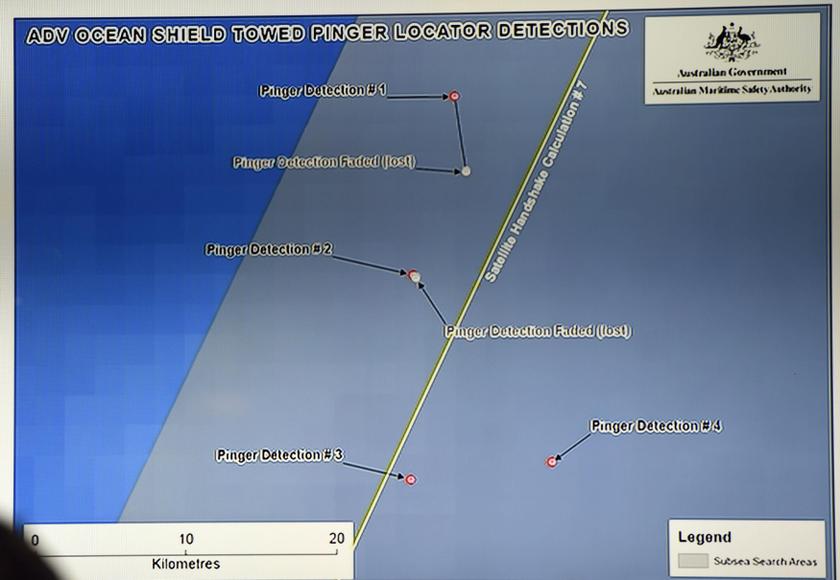
Although the battery of Flight MH370’s black boxes — which record flight and cockpit voice data — was expected to run out this Monday, the search crew has been spurred on by the recent detection of four signals from the Indian Ocean.
At a press conference in Perth yesterday, it was announced that the towed pinger locator (TPL) attached to the Ocean Shield had picked up a further two “pings” from the Indian Ocean on Tuesday, in addition to two other signals over last weekend.
Expert analysis of the first two signals by Australia’s Joint Acoustic Analysis Centre showed that the transmission was not of natural origin and was likely from specific electronic equipment.
The pulses were registered at a 33.331 kHz frequency, which is consistent with transmissions that would come from the aircraft’s recorders, according to Houston.
The black boxes can sometimes exceed the typical 30-day battery life and search teams are rushing to find more signals in a bid to narrow the search area.
Once MH370’s black boxes go completely silent, however, searchers will have little choice but to rely on an autonomous underwater vehicle (UAV), the Bluefin-21 submersible, to meticulously scour the Indian Ocean inch by inch to try and find the missing plane.
The Bluefin-21 sub can reach depths of 4,500 metres and stay submerged for up to 20 hours.
But it can cover just 80km at best in a day with its speed of just 8km per hour.
The Malaysia Airlines Boeing 777-200 ER aircraft carrying 239 people went missing shortly after departing Kuala Lumpur International Airport for Beijing on March 8 and remains missing despite an international search involving over two dozen countries.