


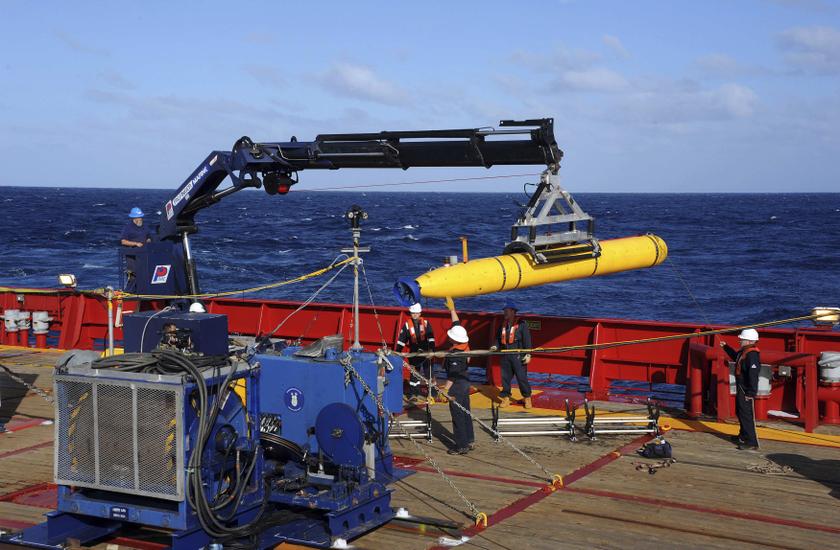


KUALA LUMPUR, April 9 — With the black boxes from Malaysia Airlines flight MH370 staying silent, it will soon fall on the Bluefin-21 submersible to meticulously scour the Indian Ocean inch by inch to try and find the missing plane.
While Australia’s Joint Agency Coordination Centre (JACC) currently leading the search has so far resisted deploying the advanced unmanned craft in the hunt for the plane that disappeared on March 8, continued failure to reacquire locator signals from its “black boxes” may mean that the painfully inefficient option may be the only one left.
With the batteries on the plane’s flight data and cockpit voice recorders only rated to last up until Monday, realisation is slowly dawning that time to once more lock on to their signals may have already run out.
“It is a large area for a small submersible that has a very narrow field of search, and of course, it is literally crawling along the bottom of the ocean,” Air Chief Marshal (ret) Angus Houston who heads the JACC was quoted as saying by UK daily The Telegraph today.
With search area spanning tens of thousands of square kilometres, the odds of the US-supplied submersible, which is meant to work in tandem with the Towed Pinger Locator (TPL), stumbling onto parts of MH370 are astronomically low.
Trundling along at just 8km per hour, the sub is capable of staying submerged to 20 hours and covering just 80km at best in a day.
Then it requires a slow climb back to the surface before search teams are able to download the information it recorded for playback.
The area where two vessels — the Chinese Haixun 01 and Australia’s Ocean Shield carrying the TPL — latched on to two acoustic signals for two distinct periods on Sunday night also present a significant challenge.
At its deepest, the waters in the area go as deep as 4,500m, coincidentally the theoretical maximum depth Bluefin-21 is capable of reaching.
But even with the submersible capable of going so far down, the pitch black conditions will make an already daunting search even more so.
Houston was previously adamant that the submersible will not be sent out until one of two things happen: the locations of the black boxes are fixed or their batteries are conclusively drained.
“We would be getting very close to that point... There is a chance the locator beacon is about to cease transmission or has ceased transmission,” Houston told US news outlet ABC News.
MH370 went missing shortly after departing Kuala Lumpur International Airport for Beijing on March 8 and remains missing despite an international search involving over two dozen countries.
Just a month in, it has already become the most expensive search operation in the history of the world, already eclipsing the US$50 million (RM162 million) spent on the nearly two years it took to locate Air France flight AF447 that crashed in 2009.


