


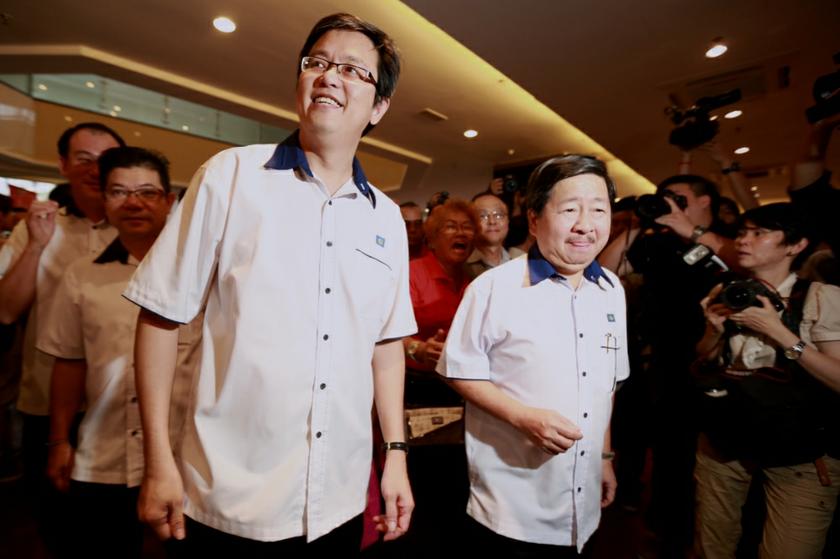


KUALA LUMPUR, Dec 17 — MCA can only be relevant when it is on par with its coalition partners in Barisan Nasional (BN) again, the party’s presidential hopeful Gan Ping Sieu said today.
In unrolling his strategy to reverse the 64-year-old party’s electoral misfortunes, Gan, the youngest of the three candidates, called upon its central delegates to aim higher than the state-level representation it currently has.
He suggested that it is only through ministerial positions that MCA could regain its power and relevance among the Chinese community.
“Now that [the central delegates] have agreed [on accepting] state posts and the local government posts, but yet something is amiss, and that is the federal government posts, that I feel is important but to do so, there must be some basic consensus and understanding... to have equal partnership [among component parties in BN],” he told reporters at Wisma MCA here.
He also said that if elected as the president, he is confident of performing better than the 2008 general election, where MCA had only won 15 seats out of 40 seats.
“2008, we consider an electoral defeat so it has to be better than that and I believe we can do better than that.
“Under my leadership, starting from next week, if I were to lead this party, there is only... one mission for this party which is to win the next general election and to do so, preparations for GE14 will start immediately after the party election,” Gan said.
Gan said he will use the party’s annual returns from its investments to train two to three party grassroots activists at each of the 4,000 branches and 191 divisions nationwide to enhance the MCA’s competence and capability in political discourse.
“That will certainly include the better understanding of the core values and the agenda of the party, the agenda for BN, the agenda for the ruling government and also to counter-attack the politics and the lies of Pakatan Rakyat,” he said.
The opposition Pakatan Rakyat (PR) bloc, especially the Chinese-dominant DAP, had succeeded in wresting bigger support in this year’s general election, especially from the ethnic Chinese voters who reside mainly in the cities.
The 13th General Election saw an increase in Umno seats to 88 out of the 222 parliamentary seats while MCA clawed a total of seven federal seats and 11 state seats.
DAP swept 38 federal seats, de-throning MCA from being the second largest political party in Parliament.
Gan said he believed that his strategy would be able to “reactivate, rejuvenate and also revitalise” its party members.
He also said that the party should re-strategise and not only focus on and engage the Chinese clan associations.
“As far as the Chinese community is concerned, I think MCA has failed to understand the whole landscape of the voters’ profile, the voters’ trend has moved so far away from the traditional MCA ways of running politics.
“We spend most of our time dealing with clan associations for example, the traditional Chinese associations, I’m not saying they are not important, they are very important... but nowadays, MCA must be seen to be relevant ... or engaging the civil society, the special interest groups and the professionals.
“Let’s look at the core problems that we are facing now and if we do not give a proper diagnosis about our own problems, we’ll never get out of it,” Gan said.
MCA delegates will elect their top leaders on Saturday, followed by the party’s annual general assembly the next day.
Gan is up against former president Datuk Seri Ong Tee Keat and incumbent deputy president Datuk Seri Liow Tiong Lai in a fight for the chief’s hat.
MCA’s political fortunes have been on a decline since Election 2008, but the leadership change taking place is still keenly followed as it entails control over the billions of ringgit in assets and shares that include Malaysia’s best-selling English language newspaper, The Star.


