


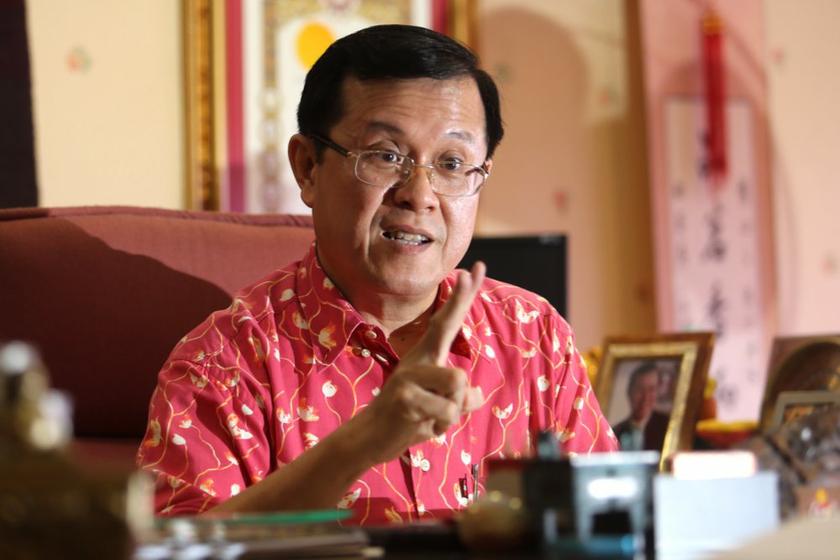


KUALA LUMPUR, Dec 17 — Come Saturday, former MCA president Datuk Seri Ong Tee Keat is making a tilt for the post he lost back in 2010 armed with nothing more than “experience.”
Ong is positioning himself as being ready to “repay” the party by contributing his extensive experience to MCA at its “lowest ebb.”
But is this enough to win against Datuk Seri Liow Tiong Lai and Gan Ping Sieu in what has been touted as a tough three-corner fight for the post?
Ong admitted that the factional politics that led to his ouster back then is still pretty much present within the party now. “I was made the sacrificial lamb in a factional fight. I don’t have any faction but at the end of the day, I was entangled in the factional fight.
“I was outmanoeuvred, outmanoeuvred not because I had betrayed my party, my community or nation but just because of power play, they manoeuvred me out,” the former transport minister told The Malay Mail Online.
Now it seems that the same divisive factional politics may prove to be Ong’s biggest hurdle in being voted in as MCA president in the party polls.
Ong, however, said he was “seasoned enough” to take on the duo. He pointed to his vast experience in MCA where he said he had “risen from rank and file” and in the government where he went through “good acid tests” when serving in various posts such as political secretary, deputy speaker, deputy minister, minister and as an MP for over two decades.
“At this juncture, I would say in the first place, the biggest challenge is how am I going to fight against all odds, against the backdrop of factional politics that has been deeply entrenched, that is always punctuated with political warlords,” he said.
Ong did not go into details on how he would overcome factional politics this time but seemed to suggest that experience would play a big part.
The greater challenge though, he said, lies in restoring the public’s confidence in MCA as the party recovers from its worst polls performance in Election 2013, saying that stopping the infighting was one of the “pre-requisites” to regain voters’ support.
“Even if you say I managed to settle all the factional rifts, that is not enough. Perhaps that is just one of prerequisites when you manage to put your house in order,” he said, saying that he could not do it alone as factions always involve politicians with different interests.
In a bid to stop factional politics, Ong proposed direct elections for the party’s top leadership in 2005, with the idea finally getting endorsement from the party’s presidential council and central committee in 2008.
But “unexpected internal resistance” from party leaders assigned to draw up the direct voting system’s implementation plan forced MCA to shelve the idea in 2009, Ong said.
Now, Ong is again pushing for direct election as part of his electoral pledge, suggesting that divisional delegates could even be given voting rights instead of limiting it to central delegates, but said the voting mechanism can only be drawn up after getting more feedback from the party grassroots.
In his third try for MCA’s top post, Ong also readily admitted that his lack of party position was a “handicap” when contesting against Liow and Gan who are holding the deputy president and vice-president posts respectively.
“That’s my drawback, incumbency will always be an edge in terms of outreach, access to delegates. Of course they have the edge,” said the Kubang Pasu MCA divisional delegate.
He added that he would have to use other strategies including social media to reach out to delegates.
I was outmanoeuvred, outmanoeuvred not because I had betrayed my party, my community or nation but just because of power play, they manoeuvred me out. — Ong Tee Keat
But would age be a problem for the 57-year-old as he is vying for votes against the relatively younger Liow, 52 and Gan, 47?
Ong disagreed, saying that age was not the sole criteria and that political seniority comes with age.
“The disadvantage of being younger sometimes is lack of experience. If you are greenhorn or if you are someone who is junior in the hierarchy, then of course you may be lacking in depth of political management. That means to say, then you are equally lacking in seniority.
“Because in coalition politics, when we come to negotiation or consultation, seniority does have a heavy bearing,” he said.
When elaborating on his promise to revisit the power-sharing deal between MCA and its Barisan Nasional (BN) partners, Ong said there was a need to have good and experienced leaders representing the party at various levels of the government including the Cabinet, state executive councils and local councils.
In BN, Umno is seen as the dominant party with the greatest say on government policies, particularly after it won 88 out of the ruling coalition’s haul of 133 Federal seats in Election 2013, while critics have said that the significance of parties like MCA, MIC and Gerakan have been greatly reduced by their dismal performance.
MCA only won seven federal seats and 11 state seats in the 13th general election and has continued to refuse Cabinet posts since then.


