





KUALA LUMPUR, Dec 4 — Malaysia must implement immediate “radical” reforms to its education system to ensure its youths beat their regional peers at the next global student survey by the Programme for International Student Assessment (PISA), two federal PKR lawmakers said today.
Pandan MP Rafizi Ramli suggested that Putrajaya suspend its School-Based Assessment System (PBS) and improve it, taking into consideration the problems identified as reasons behind Malaysia’s slump in the latest PISA rankings.
He said schools should shift its focus to applications and the understanding of concepts when educating students, instead of emphasising on memorising facts without understanding the logic behind them.
The latest 2012 PISA results, added the PKR strategy director, had been “shocking”, as it not only showed that Malaysia’ 15-year-old were nowhere capable of competing on an international level, but they also trailed behind their regional peers, some among whom come from less advanced economies.
“It was a shocking outcome, particularly as it proved that the quality and effectiveness of our education system clearly lags far behind Vietnam’s, a country torn apart by war, with an economy less advanced than ours,” Rafizi said in a statement here.
“Not only is Malaysia far behind Singapore, which is ranked second globally, we were shocked that schools in Vietnam had improved significantly past many other schools in developing nations and in Europe.
“In 2012, Vietnam succeeded in entering the top ten nations for its achievement in the science subject, taking eight place and beating the US, the UK and other European nations,” he added.
Concurring with her PKR colleague, Lembah Pantai MP Nurul Izzah Anwar said Malaysia should be surging ahead in terms of its education level, particularly at a time when the country was headed towards its dream of becoming a high-income developed nation.
“Imagine this, after nearly 60 years at the helm, the Barisan Nasional government has only succeeded in lowering student performance.
“And while others are doing better at ensuring their future generations are able to compete at the global stage, we are left behind not just at an international level, but regionally too,” she said in a statement here,
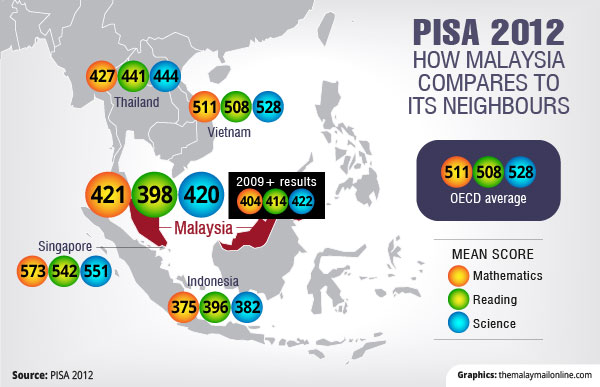 In the latest edition of PISA, Malaysian students trailed far behind their peers in Singapore, who placed second behind top-scorers in Shanghai, China, and even 15-year-olds in Thailand, recording an average score of 421 for mathematics, which was below the 494 mean for countries within the Organisation for Economic Co-operation and Development (OECD) but above the 404 the country registered in the 2009+ edition.
Reading ability fell the most, plunging to an average of 398 in the 2012; Malaysian students in the previous edition had recorded a score of 414, while the current OECD average was 496.
Science scores saw a minor decline versus the older findings, with Malaysians weighing at an average of 420 marks against the 422 that the batch three years ago managed. Students in the 34 OECD countries received an average of 501.
Malaysia was now ranked 55th for science, down two spots from the previous assessment.
The combined results meant Malaysia was 52nd overall out of the 65 countries, and firmly entrenched in the bottom third of the survey.
Noting the dismal results, Nurul Izzah suggested the formation of a bipartisan parliamentary select committee to review and recommend improvements to Malaysia’s education system.
Apart from that, the PKR vice-president also said a National Education Council comprising members from all relevant stakeholders, including political parties, academics and others, to be formed immediately to solve Malaysia’s education slump.
“We must be brave and honest to implement radical reforms to our education system. Cosmetic changes would not be sufficient to prepare our children for the global stage,” she said.
“I hope the dip in our education performance is debated at the ongoing Umno general assembly because a large number of students involved were Malays.
“As a party that claims to uphold the dignity of the Malay race, it would be an embarrassment if this problem is not debated,” she added.
The 2012 PISA assessed 510,000 students between the ages of 15 years 3 months and 16 years 2 months in the 65 participating countries.
This is the second time Malaysia has been included in the survey that first began tracking students worldwide on the three subjects in 2000.
The country was listed in the 2009 edition, which was an expanded version of the 2009 results that tested new entrants in 2010.


