




KUALA LUMPUR, Dec 4 — The government needs to rethink its education strategy to help students learn better, DAP’s Zairil Khir Johari said today after the latest global assessment benchmark showed Malaysian 15-year-olds trailing their regional peers.
The Bukit Bendera MP noted that Putrajaya has been generous with public school funds, but suggested the solution to its education problem lay beyond what money could buy.
“The latest PISA results would not sting so badly had it not come on the back of record investments ploughed into the Malaysian education sector in recent times,”he said in a statement, referring to the 2012 Programme for International Student Assessment (PISA) survey released yesterday.
He noted that the government did not stint when it came to infrastructure or hardware as seen in the RM54 billion set aside for the Education Ministry, or 21 per cent of the 2014 Budget, the largest for any ministry.
He also commended the government’s magnanimity with its purse when drawing up Malaysia’s Education Blueprint 2013-2025, which is more than double the average percentage of the GDP of its Southeast Asian neighbours, and more than what the Organisation for Economic Co-operation and Development (OECD) and other Asian “Tigers” like Korea, Japan and Hong Kong spend on schools.
The PISA scores, and Malaysia’s latest national UPSR assessment examinations for 12-year-olds showed a continuing slide in learning English despite the Education Ministry’s hefty RM270 million investment in hiring three consultancy firms for the past three years.
“It is obvious that greater investment in education does not correlate to better results.
“Therefore, the question is not whether we are spending enough, but whether we are spending on the right things,” Zairil said.
 The federal lawmaker further noted the government is set to pour billions of ringgit more into big-ticket projects such as 1BestariNet to provide hgh-speed broadband access to 10,000 schools nationwide and a more high-tech, digital learning environment.
He said the results of those investments remained to be seen, but added that its forecast was gloomy, based on past results.
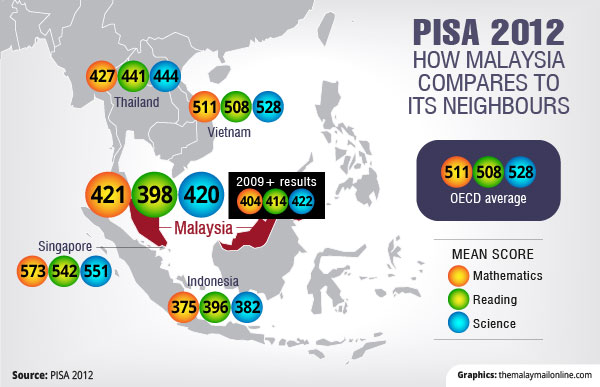
In the latest edition of PISA, Malaysian students trailed far behind their peers in Singapore, who placed second behind top-scorers in Shanghai, China, and even 15-year-olds in Thailand, recording an average score of 421 for mathematics, which was below the 494 mean for countries within the OECD, but above the 404 the country registered in the 2009 edition.
Reading ability fell the most, plunging to an average of 398 in the 2012; Malaysian students in the previous edition had recorded a score of 414, while the OECD average was 496.
Science scores saw a minor decline versus the older findings, with Malaysians weighing at an average of 420 marks against the 422 that the batch three years ago managed. Students in the 34 OECD countries received an average of 501.
Malaysia was now ranked 55th for science, down two spots from the previous assessment.
The combined results meant Malaysia was 52nd overall out of the 65 countries, and firmly entrenched in the bottom third of the survey.
The 2012 PISA assessed 510,000 students between the ages of 15 years 3 months and 16 years 2 months in the 65 participating countries.
This is the second time Malaysia has been included in the survey that first began tracking students worldwide on the three subjects in 2000.
The country was listed in the 2009 edition, which was an expanded version of the 2009 results that tested new entrants in 2010.


