





KUALA LUMPUR, Sept 9 — Vocal and outspoken, these politically-aware and Internet-savvy youths often attract controversy for taking strong stands against government policies.
While student activists are not uncommon in other democracies, they are a rather “new” phenomenon in Malaysia.
The Universities and Universities and Colleges Act 1971 (UUCA) which forbade students from participating in the socio-political life of the country saw to that.
Anwar Ibrahim and Hishamuddin Rais were probably the last well-known student activists of their generation and both men are in their 60s now.
Although the Act has been amended to allow students to join political parties, they are still banned from organising the activities of political parties on campus.
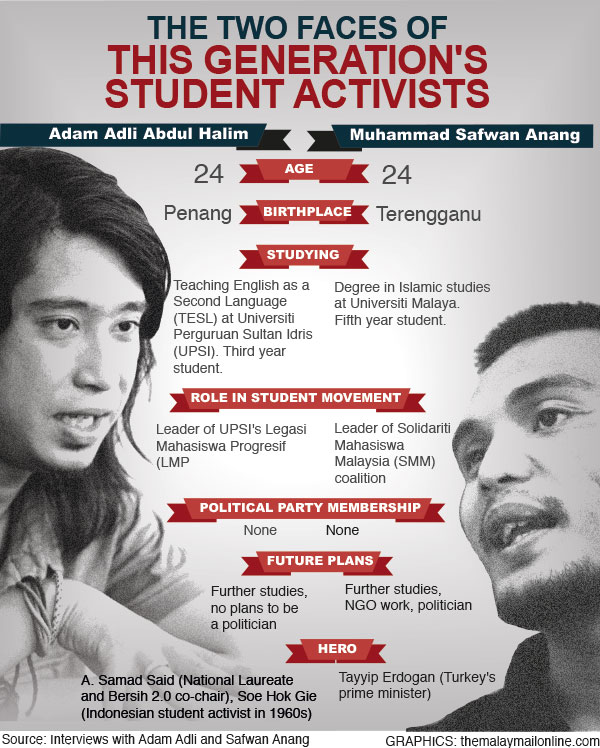
So who are the student activists of this generation? Adam Adli and Muhammad Safwan Anang are two of the more well-known ones.
The Malay Mail Online spoke to the two of them, both from working-class families, to find out what drives them to continue fighting for causes such as free tertiary education and greater academic freedom, despite the multiple arrests and court charges levelled against them.
Adam Adli Abdul Halim, a 24-year-old who was recently arrested under the Sedition Act, had his first taste of activism when he was just entering his teenage years.
Adam said he was part of a group that boycotted a year-end exam, which they found unnecessary, having just finished the compulsory national exam for primary school leavers.
”My very first protest was when I was in Standard Six, I was 12,” said the soft-spoken and unassuming youth who first shot to fame in December 2011, where he was arrested for lowering a banner bearing Prime Minister Datuk Seri Najib Razak’s face during a demonstration for academic freedom.
Even before the December 2011 incident, Adam Adli had helped initiate a successful campaign to press the Education Ministry to provide jobs for the graduates of Universiti Perguruan Sultan Idris (UPSI), the teacher training school where he is currently enrolled.
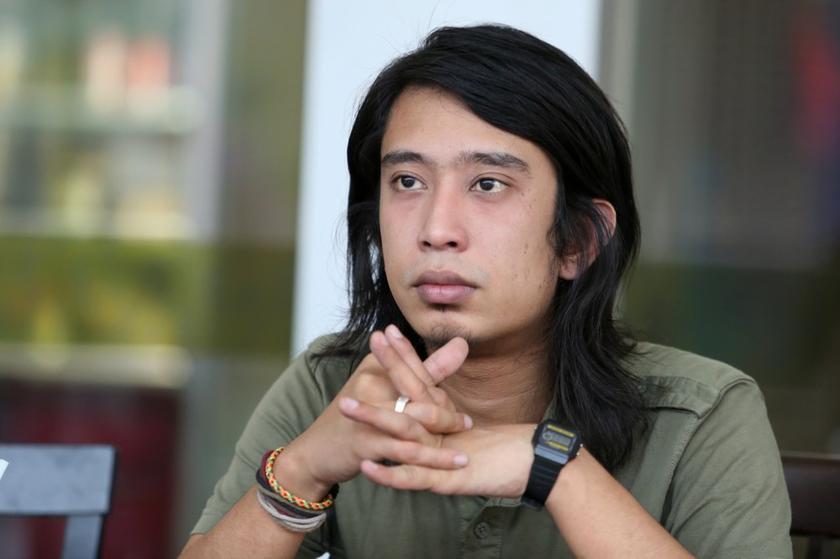
For Adam, he did not start out wanting to be an activist, but had merely stumbled on issues that he felt were worth fighting for.
The greatest challenge for him after gaining national attention was facing the public: “The hardest part is when you know that people will judge you,
“Now people judge the personality more than the idea,” said the Penang-born youth who spent most of his growing-up years in Bangsar, a suburb in the capital city Kuala Lumpur.
“Ten years ago, I never thought someday I’d be arrested, I’d get involved in all these sorts of things, get some attention from media and people,” said Adam, who comes from a modest family background.
His father worked as a train driver and his mother is a factory worker-turned-housewife.
Adam, who was suspended for three semesters by UPSI until this month, said the suspension is a “necessary process” which also gave him more time to engage in activism and community work.
Undeterred by his brief stints in jail and the court cases against him, Adam said he will continue to carry on his activism, expressing his dreams of focusing on activities that would help the poor and the working class.
Adam’s counterpart Muhammad Safwan Anang, a village boy from Terengganu, waded into activism when he first stepped foot in Kuala Lumpur in 2009 as an undergraduate, even as the city saw increasingly more protests and rallies in the run-up to Election 2013.
Driven by a desire for change in Malaysia, the 24-year-old Islamic Studies final-year student remembers joining major demonstrations such as the rally against the now-repealed Internal Security Act (ISA) 1960 and the Bersih rallies for electoral reform.
Although both planned to further their tertiary studies after graduating, the two student activists have different paths in mind.
Safwan already has a plan mapped out for his life as a future politician, saying that he might further his studies first before joining non-government organisations (NGOs) and moving on to political parties.
”For me, the requirement to be a leader now, is the need for more high quality of education. If really want to be a leader, need to prepare for that. I am interested to continue (studying) to the next level. I want to be a politician,” said Safwan, who leads Solidariti Mahasiswa Malaysia (SMM), a coalition of 11 student groups from seven local institutions of higher learning.
But Safwan said he did not harbour dreams of becoming a politician when he first joined the student movement. He merely wanted to take up the baton to do something about the allegations of political corruption.
 “Early stages... just thinking of the current situation, I think we need to change,” he said, pointing out there were still many corrupt politicians.
”Who will replace them? It’s us who will replace,” said Safwan, who remains unaffiliated to political parties.
The ambitious young man’s wife of close to two years—a former student leader herself—is expecting a child this December, and Safwan is already working as a part-time teacher to supplement the family’s income.
Adam was less certain of his future plans, saying that he preferred to carry out political acts such as writing without becoming a politician, observing that politicians are sometimes forced to do things against their will.
”I’m not sure about that. I know the pathway I’m taking is leading me to political arena, I cannot avoid it. But if I were given an option I would love to simply do things which do not involve too much politics but are still very political,” he said.
Although he acknowledged that student activists had became more politically-slanted with some actively campaigning for Election 2013’s candidates, Adam said they had no choice, pointing out that the source of many problems in the country lies with policies formulated by the government of the day.
“There’s no way for you to avoid getting involved in politics anymore, because everything has been politicised in this country,” he said.
Even after Election 2013, student activists continue to find themselves arrested and brought to court for joining in rallies and protests for electoral reform backed by the federal Opposition Pakatan Rakyat (PR).
In late July, Adam and Safwan were among student activists charged with breaching the Peaceful Assembly Act (PAA) in relation to the PR’s final “Black 505” rally to protest the election results.
In the same month, the duo were also among 33 activists charged with illegal assembly and causing a public nuisance for their protest outside Parliament, where they demanded the resignation of the Election Commission chairman Tan Sri Abdul Aziz Mohd Yusof.


