











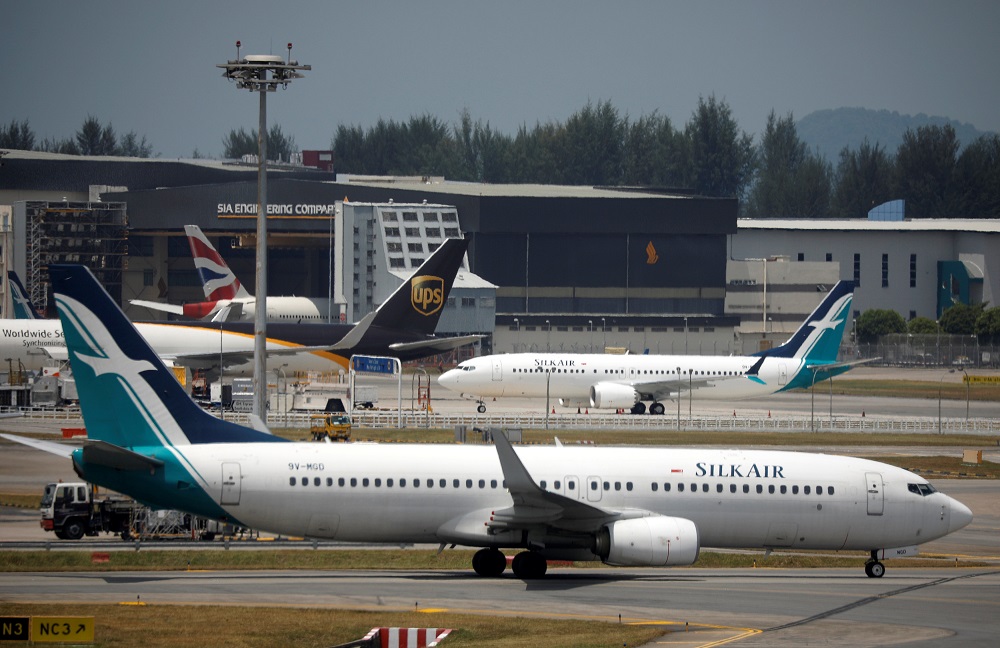


SINGAPORE, March 13 — Singapore joined China, Indonesia and Ethiopia in grounding the Boeing 737 Max planes after a fatal crash on Sunday, but this decision made two days later was criticised as not coming fast enough to assuage passengers’ fears over safety concerns.
Yesterday morning, the Civil Aviation Authority of Singapore (CAAS) made the call to temporarily suspend operations of all variants of the Boeing 737 Max aircraft into and out of Singapore from 2pm the same day.
It came hours after SilkAir, the regional wing of Singapore Airlines (SIA), said on Monday that its Boeing 737 Max 8 flights are operating as scheduled and that it was “closely monitoring developments” following the Ethiopian Airlines crash.
The Boeing 737 Max 8 operated by Ethiopian Airlines was on its way to Nairobi, Kenya, when it crashed not long after take-off, killing all 157 people onboard. This came just five months after a 737 Max 8 flown by Indonesia budget carrier Lion Air plunged into the sea shortly after take-off, killing all 189 passengers and crew.
While investigations are ongoing and no link has been established so far between the two deadly crashes involving the brand new Boeing aircraft —which was launched and put into service only in 2017 — there are already worries among travellers and members of the public.
One of them is Ong Nyuk How, a 55-year-old Malaysian who works in events management. He was leaving Singapore for Jakarta, Indonesia on a work trip.
“It’s only right to stop (the planes) if it is risky,” Ong said in Mandarin. “An incident already happened before, but (the airlines and authority) are only reacting now. It’s too slow.”
A TODAY reader, Sazid Karim, wrote in to question why SilkAir was “still hesitating to ground the Boeing 737 Max 8” after he first read its announcement on Monday.
US aviation regulator, the United States Federal Aviation Administration (FAA), is the certifying body for the Boeing 737 Max and it had given approval for the aircraft to keep flying. Several jurisdictions, including the United States, have not taken the step to ground the planes.
However, Sazid, 56, who works in the maritime consultancy industry, asked: “Why (do) we need to follow (the) US? We as frequent business flyers are worried (that) innocent lives (will be) lost.”
China, Indonesia and Ethiopia were the first to ground the Boeing 737 Max planes on Monday, while Australia has joined Singapore in suspending the operation of these planes flying into and out of the country.
The United Kingdom, France, Austria, Ireland and Malaysia are among other countries which have also suspended the operation of all 737 Max models in their airspace.
Sazid told TODAY that he is particularly concerned because he and his colleagues fly frequently via SilkAir. His next flight is on Friday.
Some online users also had similar criticisms on Facebook, stating that the decision to ground the planes could have been made earlier.
Eloise Van Vuuren wrote: “Long overdue decision... I find Singapore’s delayed decision disappointing.”
Daniel Ding commented: “Silkair & CAAS, please be pro-active not reactive, since precious innocent human lives are at risk.”
TODAY has reached out to the airlines for a response to these comments and to find out how many passengers were affected after CAAS’ announcement.
CAAS said yesterday that it has been in regular contact with SilkAir on its 737 Max operations since last year, and “has been satisfied that it has been taking appropriate measures to comply with the necessary safety requirements.”
“CAAS is closely monitoring the situation and is in close communication with the US Federal Aviation Administration and other aviation regulators, as well as Boeing,” it added.
Flights delayed, cancelled
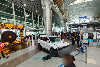
Yesterday afternoon, some SilkAir flights at Changi Airport Terminal 2 — including those to Male, Maldives and Phuket, Thailand — were delayed by about an hour.
In an update on its Facebook page yesterday evening, SilkAir listed six flights to Kuala Lumpur, Malaysia today that will be cancelled.
It added that two supplementary flights will be operated by SIA between Singapore and Kuala Lumpur in view of the situation.
“Information on other flights changes will be progressively updated,” SilkAir said.
On the same day CAAS announced its decision, the Civil Aviation Authority of Malaysia said that none of its carriers fly the Boeing 737 Max 8, but it will be suspending the operations of this aircraft transiting in and flying to or from Malaysia until further notice.
A day earlier, China grounded nearly 100 Boeing 737 Max 8 planes operated by its airlines — more than a quarter of the global fleet of the jets.
‘Better late than never’
At Changi Airport, there were passengers who were glad that CAAS made the call to ground the aircraft.
Indonesian housewife Orchida Ramadhanua, 37, who was here on holiday with her family, said: “It’s better late than never,” she said. “We need answers… we have no idea what’s going on.”
She would like to have “more clarity” on how the aviation industry will deal with this and hopes that there will be a “full disclosure” on the safety issues with the Boeing 737 Max 8 models.
Keerthi Kumar, an India national who was travelling back home to Hyderabad via SilkAir, is relieved that CAAS took action.
The 36-year-old architect was on a business trip to Singapore.
“It’s scary to think about (the two crashes involving the 737 Max) before a flight,” he said.
Another traveller, a Canadian who gave his name as just Alex M, was “glad” that the plane he would be taking to Penang on a SilkAir flight with his family is not a 737 Max.
The 46-year-old retired lawyer said: “We made a conscious effort to search it up (before coming to the airport).”
He added: “Canada has not grounded their (737 Max) planes yet, so this (grounding here) made us feel better.”
Many factors to consider
Two analysts interviewed by TODAY said that safety regulators usually take into account several factors before deciding to ground a plane.
Greg Waldron, Asia managing editor of aviation news site FlightGlobal, said: “They are going to keep a careful eye on things like the safety records of individual airlines, the safety record of the aircraft, and even the safety records of individual jurisdictions.
“In this case, the CAAS clearly saw that there were two major disasters regarding this type (of plane) in a relatively short amount of time.
“Regulators tend to be fairly conservative when it comes to safety, while they may be erring on the side of caution, they would prefer that to having something happen.”
Asked whether airlines could have taken a more pro-active approach, Mr Waldron said that the accidents in the last few months were an “unprecedented set of events”.
“You have a brand-new aircraft, recently certified, involved in two major air disasters in a fairly short time. So really, (the airlines and regulators themselves) are kind of in uncharted territory”.
The Boeing 737 Max plane is the latest model of the 737, the world’s bestselling single-aisle jet. More than 5,000 of the aircraft have been ordered worldwide since 2017.
On one hand, Waldron said, regulators and airlines could decide not to take any chances. But on the other hand, as there is no conclusive evidence yet to tie the two fatal crashes together, regulators could also allow the planes to continue operating.
“So neither approach is right or wrong,” he said.
Associate Professor Lawrence Loh from the National University of Singapore’s Business School, said that in managing the safety concerns of passengers over the Boeing 737 planes, “simply giving assurances through general statements by airlines is insufficient”.
“It has to be backed by disclosures of concrete actions particularly in mechanical checks and pilot trainings,” he said.
The CAAS’ suspension of all Boeing 737 Max flights in and out of its airport is a broad-level safety timeout that is “most sensible”, Loh said.
“While it is fair to let the investigations take its course, we should be more conservative in terms of passenger safety, which is paramount.”
Even without regulatory action, passengers “ultimately vote with their feet”, he said, and they will choose not to take Boeing 737 Max flights if they do not have the confidence in the plane safety. — TODAY