














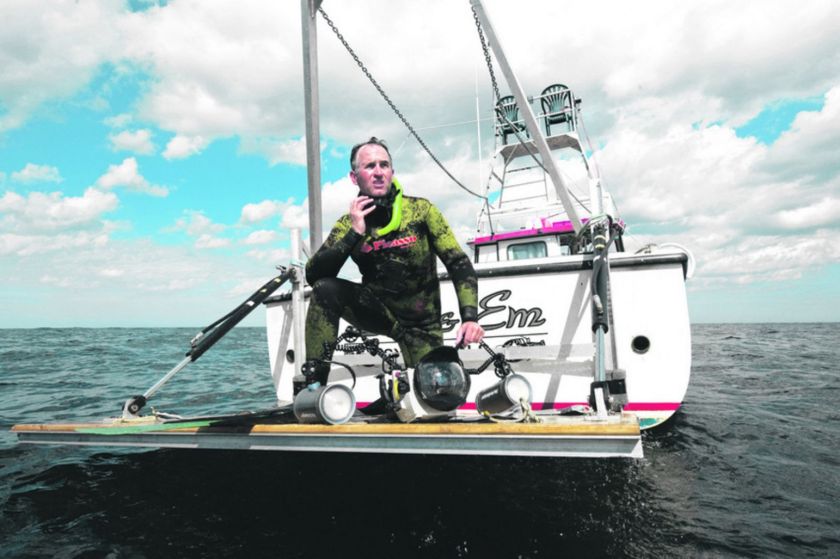
SINGAPORE, Jan 7 ― He has spent more than 10,000 hours underwater using his camera to tell the story of some of the ocean’s most elusive inhabitants. For renowned National Geographic underwater photographer Brian Skerry, the allure of the oceans started way back when he was a boy living in New England.
“I would go out to the beaches and wonder what was going on down there. As I got older, I’d look at National Geographic magazines and Jacques Cousteau documentaries and see these sharks, dolphins and coral reefs and be fascinated by the notion of exploring these things,” the 53-year-old shared ahead of his talk, “Ocean Wild With Brian Skerry”, which happens at the Esplanade Theatres on Jan 24.
While he’s keen to explore this part of the world — such as the waters of Indonesia, Palau and Fiji — finding time for a holiday isn’t easy.
“I never seem to have any free time. I began working for National Geographic in 1998. I usually spent eight to nine months in the oceans and the rest of the time planning, researching and packing,” he said. “My last vacation was in 1993. My wife and I went to the Grand Canyon and we hiked through the canyon. It was a nice change from being in the oceans.”
Q: What can we expect from your talk in Singapore?
A: It’s essentially a story that unfolds with a background about me, my inspirations and I’d take the audience with me on assignments and get them to meet a cast of characters under water. Come eye to eye with giant whales and seals and sharks. There’s also a bit of conservation theme. The audience will be taken on a roller coaster ride and I hope they learn some things they didn’t know before.
Q: You have been at National Geographic for a long time: Do you think the issues of conservation, nature, travel and culture championed by the magazine will be lost with the recent takeover by 21st Century Fox?
A: I do think we’ll be able to continue to push the same issues. I don’t see that changing at all. I am told a number of measures have been put in place to ensure journalistic integrity. Having worked there for two decades, my fellow photographers and writers are not about to stop doing these kinds of stories. There will probably be changes as the magazine is now a for-profit business for the first time. It’s an exciting time for storytelling and there are now more resources with the larger organisation. I’m cautiously optimistic.
Q: What’s your most unforgettable trip so far?
A: I have had so many tremendous encounters with animals. One that tops the list is a trip to Auckland Islands, which is about a one-and-half, two days of sailing from (New Zealand’s) South Island. I was there to photograph a newly discovered population of right whales. We went during winter and it was a purely speculative trip as we weren’t sure if we would get to see them. I was blown away the moment I got there seeing these 15m-long, 70-tonne creatures. It was off the scale magical.
Q: Everyone loves beach vacations. How can travellers take better care of the seas and oceans when they travel?
A: I do believe people care about their actions. Travellers can think about the choices they make. For example, plastics in the ocean are a real problem. I haven’t seen a beach in the world that doesn’t have plastic bottles, (so) travel with a metal container or a water bottle you can reuse and not contribute to the glut. The next thing is the consumption of food. Seafood is very popular, but if you’re eating snapper or tuna, you’re taking wildlife away. I hope nobody’s eating shark. There are other choices such as freshwater fish that are more sustainable or seafood farmed properly. Our choices matter and we should be aware of them. — TODAY