




KUALA LUMPUR, April 9 — In life, they say every second counts. But if you are in the major financial markets like London, New York, Tokyo or Hong Kong, where the volume is in the hundreds of millions a day, frantically buying and selling shares, then every microsecond counts.
That’s one millionth of a second, if you’re counting. Every fraction of a second matters.
It is as ‘real time’ as one can get. Yet Andrew Tiang, founder and managing director of N2N Connect Bhd, which builds trading platforms for brokerage houses and stock exchanges, still likes to ask, “How real is real time?”
Answering his own question, he goes into an explanation about the stakes involved, of ensuring a brokerage has the best infrastructure available, the most efficient processes and algorithms to crunch the data coming in, and then spitting it out almost instantaneously in the hopes it can match with a sell or buy order.
And if he finds he is losing your attention, he throws out this gem: “And did you know that Merrill Lynch used to spend US$50 million (RM181.505 million) annually to improve its infrastructure to gain one millisecond in performance?”
Even more exciting for him is that N2N is soon going to roll out a trading platform to deliver trades at the microsecond speed. This will be for the Hong Kong market, with a second quarter (Q2) target, and he expects it to contribute significantly to revenue by Q4.
The Japan Stock Exchange, the market of his main shareholders, is targeted next in Q3.
With RM250,000 in fees, the cost for this conformant (a form of certification) in Hong Kong would not have been something Tiang could have swallowed two years ago.
This is where the RM109 million cash injection N2N received in May 2014 from Japanese media heavyweight Nikkei Corp, and Quick Corp, a member of Nikkei Inc and Japan’s largest financial information provider, comes in handy.
“We no longer have to plan guided by available funding,” Tiang tells Digital News Asia (DNA).
Not being able to plan due to funding limitations is one thing, but with the injection from Nikkei, Tiang is now dreaming really big. He wants to take on Bloomberg and give it a run for its money in Asia by replacing its terminals with his own.
It was not a target he established out of the euphoria of that capital injection last year.
“We have been working on this from 18 months back, before our equity deal was even announced,” he says of the partnership between N2N, Nikkei Corp and Quick.
The outcome of this joint development will become the info services component of N2N’s trading product called TcPRO.
A quick demonstration by Tiang showed some familiar features that Bloomberg Terminal users will be comfortable with.
With Bloomberg setting the bar high with its terminals, he knows that he will have to at least match that. He seems confident enough, telling DNA, “We will be competitive.”
His confidence stems partly from the capabilities his Japanese partners bring to the table, and also from his 100-strong team of researchers, with almost 20% of them having Master’s and PhDs.
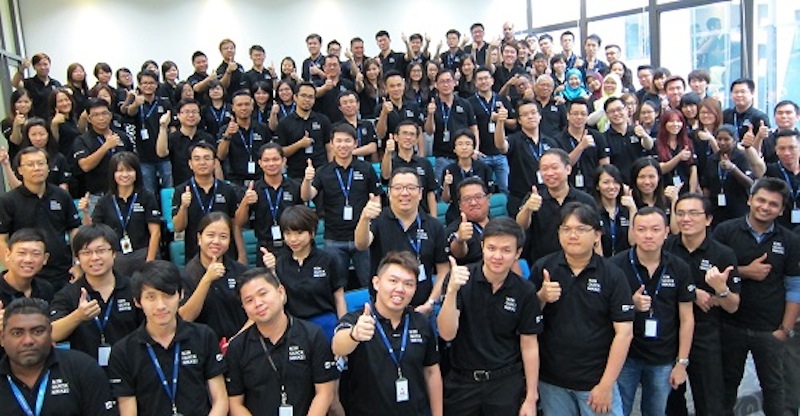
With N2N’s trading products built entirely inhouse, Tiang likes to highlight the fact that slightly over 100 of his 160-strong overall team are in research and development (R&D).
He also enjoys claiming that no other locally owned MSC Malaysia status company has close to the number of R&D people that he does.
From its RM34 million in expenses last year, RM12 million was in operational expenditure from the R&D team, he says.
“Make no mistake, R&D drives our growth. Without it, we would not have a competitive and new product line to bring to customers such as our Paired Trade or what some call algorithmic trading,” he argues.
While a reliance on R&D means organic product development, at the same time Tiang reaffirms that N2N “is serious about M&A (merger and acquisition) opportunities and is looking around in the region.”
N2N reported 2014 revenue of RM34.24 million, higher than its 2013 revenue of RM31.32 million.
Net profit for 2014 was higher than in 2013 at RM6.9 million versus RM6.04 million. — DNA
* This story was first published here.


