


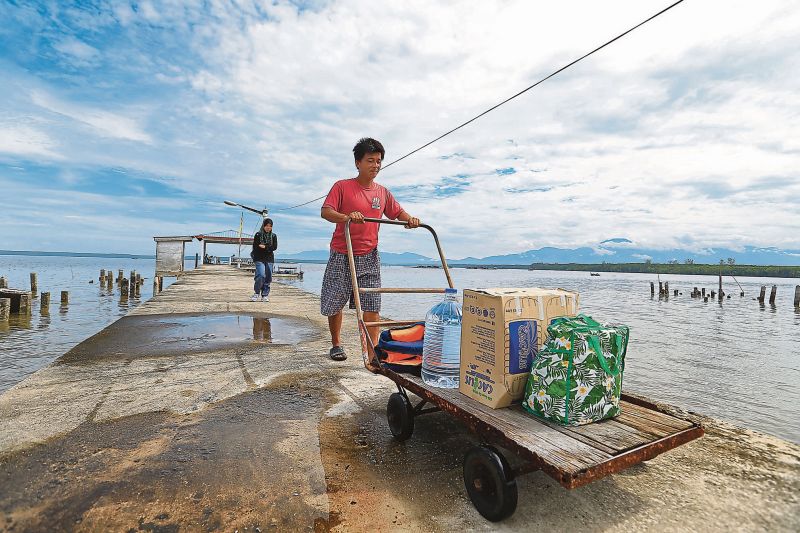
TAIPING, Dec 1 — It is difficult to imagine that Pulau Pasir Hitam was once a self-reliant fishing community with 3,000 people thriving on an island that held a future for generations to come.
Today, the village has dwindled to 100 hardy fishing folk over 40 who refuse to leave their traditional occupation that brought in the dollars that put food on the table and their children through school.
There are only two students in the 77-year-old SJK (C) Aik Hua that may close next year due to a total absence of enrolment after young couples left for greener pastures on the mainland.
The Hokkien village of 30 families with a jetty that has seen fewer fishing boats docking over the years, policemen with an almost crime-free community, a government health clinic that treats nothing more serious than coughs and colds is in its death throes.
The village on stilts and measuring only 300 metres across has a Taoist temple and two coffee shops.
There is no electricity or piped water with everything from food to clothing being brought over by boat from the village of Sungai Kerang an hour's boat ride away.
Pulau Pasir Hitam is not an island in the strictest sense of the word as it is connected to a mangrove swamp during low tide.
At dusk, it turns into an island separated from the mainland by an expanse of dark water.
Boatman Lim Xian Huat, 60, said he had been giving rides to villagers wanting to go to Sungai Kerang for almost 40 years.
Ah Huat, as he is called by locals, leaves the Sungai Kerang jetty around 9.30am daily for the island to also sell fishing bait to fishermen.
“In a week, only five people take a ride on my boat to and from the island. Few outsiders visit the island,'' he said.
He brings in the meat, vegetables and provisions that islanders buy from the mainland.
Another villager, who wanted to be known as Ah Seng, is the unofficial postal representative whose task is to travel to the Sungai Kerang post office daily to bring back mail for villagers.
He also helps by buying them supplies that they may urgently need.
Life was not always in the doldrums with old timers talking about how business was bustling on the island in the 1970s.
It had a five coffee shops and a variety of small commercial enterprises including an abattoir, a motor workshop and sundry shops. Back then, residents also reared chickens, ducks, and pigs for sale.
Two speedboats made two daily round trips from the island to the mainland and back.
Villagers owned more than 100 fishing boats which have fallen to only 30 today.
Things began to spiral downwards when the young began to leave in droves for the bright lights in Ipoh, Kuala Lumpur, and Singapore for better-paying jobs.
“Most of the shops closed as they were unable to turn a profit after the population fell,” said coffee shop owner Teoh Geok Soon, 58.
Fisherman Tang Chong Heng, 50, said he had tried his hand at washing dishes in Singapore but could not handle the stress after the quiet of the island.
“So I came back home. This is the life I have always known and I don't think I will ever leave,” he said.
Lim Eng Sing, 57, said he could be the present generation could be the last on the island.
“It isn't something we talk about. We leave it in god's hands,” he said.


