




KUALA LUMPUR, June 16 — A DAP lawmaker sought for the Yang diPertuan Agong to convene a special sitting of the Federal Court to decide on Malaysia’s religious status, after Putrajaya today insisted the country is not a secular state.
Puchong MP Gobind Singh Deo said the Agong was empowered under Article 130 of the Federal Constitution to refer the matter to the country’s apex court to seek its opinion on the long-standing issue.
Gobind said the issue needed finality as the federal government was now insisting that it has taken the correct position despite a 1988 Supreme Court ruling that held that the law of Malaysia is secular.
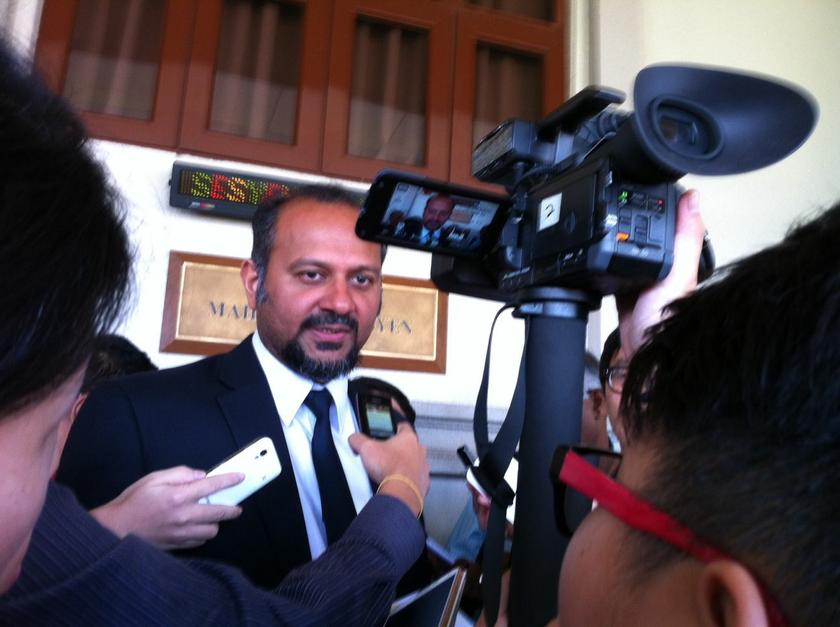
"The Yang di-Pertuan Agong has the power to refer to the Federal Court for its opinion a question as to the effect of any provision of the Federal Constitution," Gobind said at a news conference in the Parliament lobby.
"This issue has come up time and again. It is a matter of general public importance. There is a need for clarity on the point as it involves a provision of the Federal Constitution, a Supreme Court ruling and varying positions taken on it by the government.”
"Given the magnitude of importance of the matter, it is my respectful view that it should be dealt with and resolved by a full bench of the Federal Court soonest possible," he said.
Earlier today, Minister in the Prime Minister’s Department Datuk Seri Jamil Khir Baharom said in a written parliamentary reply that Malaysia is an Islamic state based on several constitutional provisions that afford Islam a venerated status in the country.
He argued that Malaysia’s status differs from other countries that practise secular law, as those countries do not have a religion of state and religion is a separate and private matter.
Gobind today explained that Article 130 of the Federal Constitution affords the Agong the power to refer to the Federal Court for its opinion on “any question as to the effect of any provision” in the apex law, and that the court shall give its ruling in open court.
“The other remedy is for Parliament to legislate this clearly, but there are already provisions to deal with this.
“The former MP for Bukit Gelugor, the late Karpal Singh, had in 2012 made a similar call so as to resolve the matter once and for all.
“It is only proper for the Federal Court to deal with this... that is what Article 130 is for,” Gobind said.
Meanwhile, DAP’s Sibu MP Oscar Ling Chai Yew — who posed the question on Malaysia’s secularity and the implementation of hudud to Jamil — said Putrajaya’s position went against provisions under the Malaysia agreement signed between Malaya, Sabah, Sarawak and Singapore in 1963.
“In Sabah and Sarawak, this doesn’t apply, and it is not fair to us. We don’t have a state religion. We are secular,” he said at an earlier news conference in the Parliament lobby.
Fellow DAP MP for Bandar Kuching, Chong Chien Jen, added that Jamil’s reply was “clearly wrong” from a legal perspective as the apex court had already ruled that Malaysia follows secular law.
“To have a minister come up with such a statement... Jamil Khir should retract this statement,” he said.
The argument of Malaysia’s secularity resurfaced along with the latest push to implement hudud in the country.
Earlier this year, a few PAS lawmakers mooted a plan to table a private member’s bill in Parliament to debate the implementation of Islamic criminal law.
The Kelantan state assembly passed a bill to implement hudud in the state in 1993, but it has been put on hold until now as was considered to be in conflict with the Federal Constitution.


