




KUALA LUMPUR, June 8 — The Malaysian Bar urged the Johor government today to temporarily withdraw its housing board bill until all references to the Sultan is removed, warning that granting administrative powers to the Ruler would expose him to possible criticism.
In a statement here, Bar Council chief Christopher Leong said the move would also be a departure from the principles of a constitutional monarchy, which was not envisaged under the Johor Constitution and the Federal Constitution.
“Under such a system of government, while powers and functions are carried out in the name of the head of state, the exercise of executive functions and powers must lie with the State Government that is democratically elected by the rakyat,” he said.
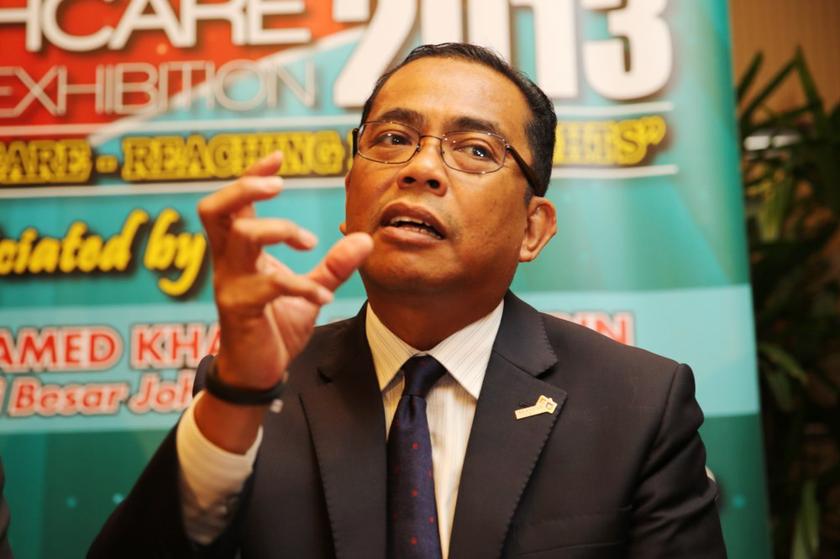
Leong said the Bar “is unable to agree” with the contention of Mentri Besar Datuk Seri Mohamed Khaled Nordin who argued recently that the Johor Sultan would not have direct executive control under the proposed Bill, the Johor Housing and Property Board bill, that is set to be tabled on Monday.
In a report on New Straits Times yesterday, Khaled was quoted as saying that executive powers remain with the mentri besar — who would automatically assume the post of chairman of the board under the proposed enactment.
“Under the bill, the Sultan of Johor can appoint members of the board on the advice of the mentri besar, which is similar to the power that the sultan has at the moment,” he said.
“The news report today (yesterday) that said the Sultan of Johor would be given authority over the board is not true. This is because I will be the chairman of the board, with executive powers,” Khaled added.
But in disagreeing, Leong pointed out today that the bill provides that the “Ruler or the State Authority may at any time direct such person as he may appoint to make an investigation of the books, accounts and transactions of the Board”.
The bill further requires the housing board to submit to the “Ruler and the State Authority the annual budget, annual audited accounts and the annual report of the Board”, he noted.
Explaining, Leong said that under the present constitutional and legislative scheme, the term “State Authority” means either the state government, or the Ruler, acting on the advice of the state government.
In this case, the Ruler is obliged to accept and act in accordance with the advice of the state government, he said.
Leong cited the example of Selangor Housing and Real Property Board Enactment 2001, which is the equivalent to the proposed Johor bill, but does not make specific mention to the “Ruler”.
In the Johor housing board bill, Leong noted that specific references are made to the “state government”, the “state authority” and the “Ruler”.
As they are mentioned as three distinct entities, he said they cannot then mean the same thing in the Bill.
“Therefore, the provisions in the Johore Bill that accord to the Ruler specific executive responsibilities and powers mean that these responsibilities and powers are exercisable by the Ruler himself, without the need to be bound by, and to act upon, the advice of the State Government.
“This is in breach of the provisions of the Eighth Schedule to the Federal Constitution and Article 7 of the Constitution of Johore, which vouchsafe the concept of a constitutional monarchy,” he said.
Leong added that enacting such legislation would mean burdening the Sultan with functions and responsibilities that should typically be taken on entirely by the state government.
“They expose the Ruler to scrutiny and possible criticism and opprobrium. This affects the dignity and stature of the institution of the monarchy,” he said.
“The Malaysian Bar therefore calls upon the State Government of Johore to withdraw the Bill from consideration by the State Legislative Assembly, and to make appropriate amendments to the Johore Bill to remove all references therein to the Ruler.”


