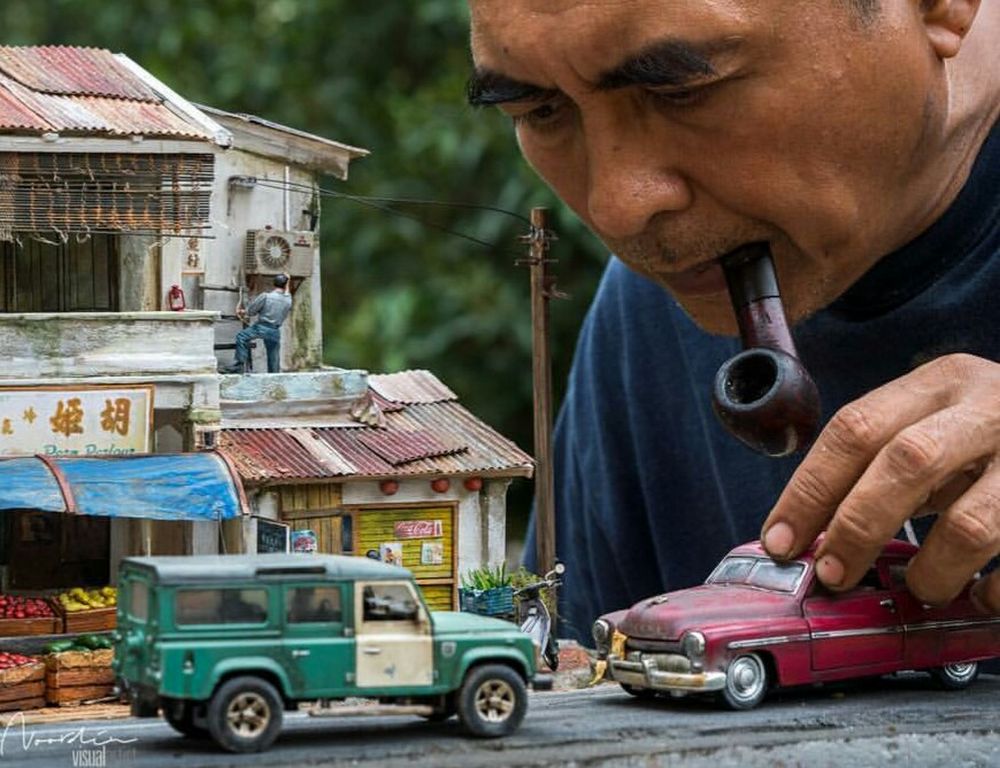
KUALA LUMPUR, May 5 — An artist’s best way of telling a story is through his art and Eddie Putera’s dioramas present an interesting tale.
Equipped with his main tools, a paint brush and tweezers— the 51-year-old recreates garages, sceneries, a village and more at a minute 1:64 scale.
That means each of his creations is 64 times smaller than the original object.
Dioramas are models that represent a scene with three-dimensional objects.
It can either be miniatures or larger than life. Some are recreated from his childhood memories while others come from experimental processes or commissioned work.
His kampung house in Hulu Langat stores his masterpieces and he is usually found sitting at his metre-long work table.
“It’s (making dioramas) getting too tiny for my old eyes,” he told Malay Mail.
Age, however, is just a number for Eddie.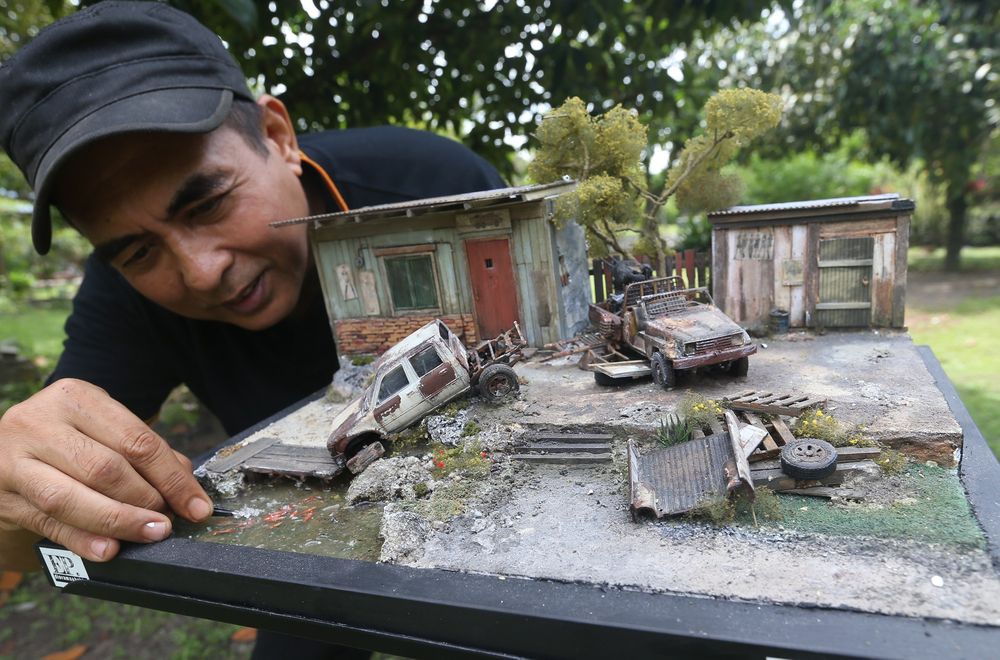
After all, he found this passion only three years ago when he was 48.
“I’ve been doing two-dimensional work all my life — photography and painting — I thought why don’t I do three-dimensional art too.
“I stared at my miniature car collection that is sitting on my shelves and felt like I needed to build an environment for it.
“I started off with a garage and soon I am hooked.”
After three months of trial and error, his first diorama was completed.
It was a 30cm x 30cm warehouse and workshop he built for a Gundam character he put together.
“It was difficult as it was my first.
“Yes, you see a lot of my dioramas on sale and for display but you do not know how many of them ended up in the bin.
“I never imagined doing this when I was a kid, if I could, I would have just done this for a living.”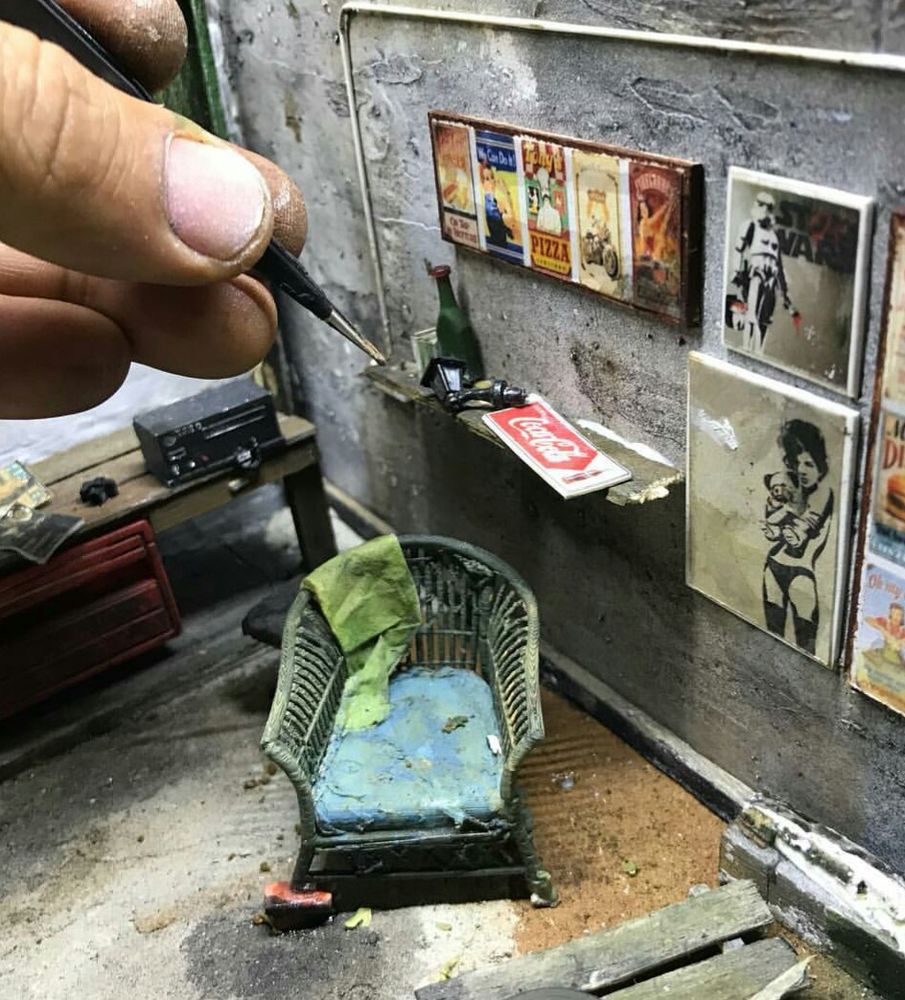
Small in size, big in details
Being a photographer by profession, the Kedah-born artist said nothing satisfies him more than details.
“I used to shoot sports such as football and golf, and even then if I didn’t like the placement of the ball or the angle I would be disappointed.
“Every millimetre matters.”
Growing up he spent most of his time painting — a skill that gave him an advantage over other miniature artists.
“I understand colours while some can just build but fail to make their dioramas come to life due to their painting skills.”
Eddie also collects inspiration from some of the street photography he has done over the years.
“When I’m bored you can find me shooting close up shots of a rusty car, a pothole or an abandoned house.
“I analyse these pictures when I get home and try to recreate them through my sketches or dioramas.”
Materials needed
Eddie’s materials range from soft wood, polystyrene, cardboards, clay, and even cigarette and pipe ash.
“Cigarette ash is the texture of rust. I lay it out on a car before I paint to give that matte and rusty look.”
The bases of all his dioramas are made of polystyrene while rocks, stones, sand are used to recreate a road.
Herbs such as basil, oregano, parsley and rosemary are used to give the roads some dried leaves and also used to make trees.
“I even collect dry leaves from my garden as I use it to add ‘life’ to my trees.”
The trees are made up of wire mesh while fibre cotton is used to make the bark.
His main ingredient is the plaster of Paris that he used to sculpt landscapes.
“This is my ‘staple ingredient’, without it nothing can be done.”
Clay is used to make the walls while transparent wax makes the water and epoxy resin gives the water a shiny effect.
Most of the other items such as accessories or even an air conditioner unit are made of stuff from his collection of toys.
“I have to look at things differently. My favourite place to shop is Daiso and Art Friend because they have a lot of items that are useful to me.
“It may be a coin box, but I must imagine how I can make it into something else.”
‘Little’ hobby grown huge
Eddie has made about 100 dioramas since his first Gundam masterpiece at the end of 2015.
During exhibitions, he displays close to 30 dioramas and has sold about 50 to date.
“Each diorama costs RM1,000 upwards and it depends on the details and the client’s budget.”
He has invested about RM30,000 since he started.
He admitted it is hard to calculate the amount of time to create one but his latest work, recreating his childhood kampung, took him more than two months.
“While I’m waiting for the glue to dry from another piece, I’ll work on another piece so it’s hard to know exactly how much time I have spent.”
Eddie’s orders and passion have taken up so much that he was forced to stop watching Netflix as he was not getting enough sleep trying to do both.
He has participated in many exhibitions, the biggest being the Kuala Lumpur International Craft Festival last November and the Petronas Gallery in Suria KLCC.
His next exhibition will be in Kangar, Perlis at the soon-to-be opened library.
“I’m remaking the old library and it will be the highlight of the event.
“It is a three feet by two feet model and it will be displayed at the library for two months.”
Everyday he gets about 1,000 messages — some admiring his art, some buyers, and some requesting him to help them build a diorama.
“I’ve had to turn down a lot of requests because I’ve a lot of orders to meet.
“People from all parts of the world message me.
“One wanted me to do a Beauty and the Beast scene and one from Yugoslavia wanted me to recreate a village there.”
“I’m interested. Can I start doing dioramas too?”
He welcomes anyone who wants to take up the art but warned them that you do not have regular hours.
“You need time and passion, you need to be in the zone.
“Can a normal person work for three days straight without showering and break, only accompanied by water and a bowl of instant noodles?”
Eddie said he starts at 7pm and only finishes at about 8am at times.
He said the scene is growing in Malaysia and toy collectors are slowly getting more creative in bringing their collection to life.
“Young people these days are more interested in this.
“They are thinking the same way I do. Why not bring your collection to life?”
To boost the scene even further, Eddie will be hosting a few classes in Hulu Langat soon.
“I do not know how to teach techniques, but I’ll share my basics with those interested.
“Detailing is hard to teach, it’s all in the artist’s hands.”