MAY 30 — For decades, oil has dominated discussions of energy security in the Gulf.
Today, however, a less visible but equally strategic resource is emerging as a critical vulnerability in the global economy: helium.
Often dismissed as a gas used for balloons and scientific experiments, helium is in fact one of the indispensable inputs of the modern technological age.
It is essential for semiconductor manufacturing, magnetic resonance imaging (MRI), aerospace engineering, fibre optics, quantum computing, advanced manufacturing, and military technologies.
As the ongoing confrontation between the United States and Iran continues to disrupt shipping routes and commercial confidence in the Gulf region, the world is beginning to discover a painful reality: semiconductor industries cannot remain immune to a prolonged helium shortage.
The issue is particularly serious because the semiconductor industry sits at the heart of the twenty-first-century economy.
Every smartphone, laptop, electric vehicle, satellite, telecommunications network, missile guidance system, and artificial intelligence platform depends on advanced semiconductor chips.
The race for technological supremacy between the United States and China, the growth of AI data centres, and the expansion of digital economies across Asia all require uninterrupted access to chips. Yet chips themselves require helium.
Helium plays a crucial role throughout semiconductor fabrication.
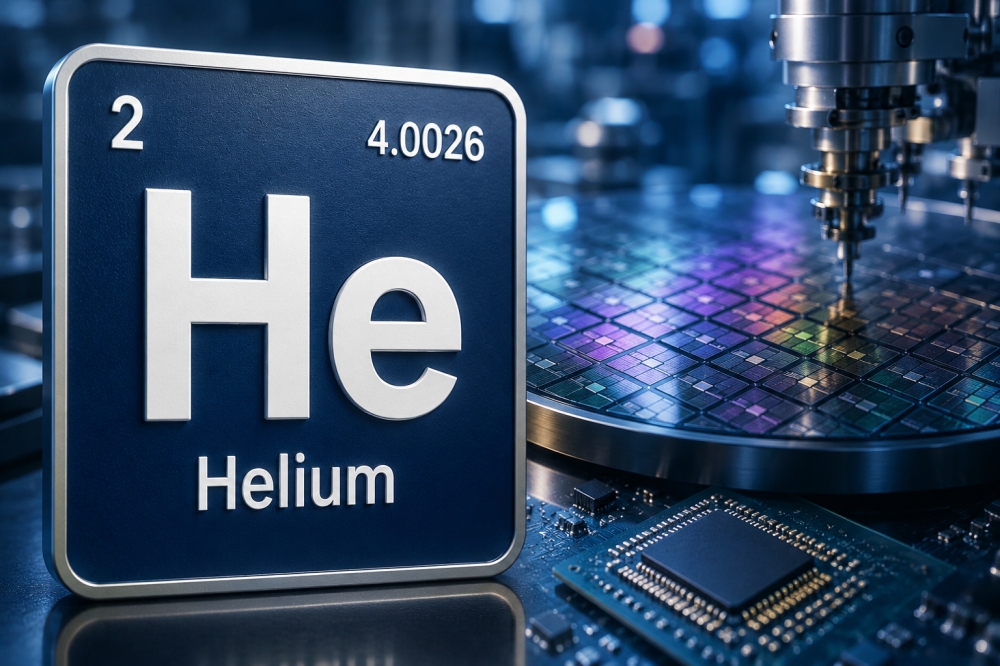
It helps cool semiconductor wafers during production, maintains stable temperatures in highly sensitive manufacturing environments, and supports the precision processes required to etch and produce advanced integrated circuits.
Without sufficient helium, chip fabrication becomes slower, more expensive, and less efficient.
The importance of helium is growing rapidly.
According to industry estimates, global demand for helium from semiconductor manufacturers could increase more than fivefold by 2035.
This growth is being driven by the expansion of artificial intelligence infrastructure, advanced computing systems, electric vehicles, and next-generation telecommunications.
The timing could not be worse.
The ongoing blockade dynamics surrounding Iran and the Strait of Hormuz have already disrupted global energy markets. While most attention remains focused on crude oil and liquefied natural gas (LNG), helium is increasingly becoming part of the same strategic equation.
The Gulf region remains one of the world’s most important sources of helium production and export. Qatar, in particular, has long been among the largest suppliers of helium globally.
Any disruption to shipping routes, processing facilities, or export infrastructure immediately reverberates throughout global supply chains.
Unlike oil, helium cannot easily be replaced.
Alternative suppliers exist in countries such as the United States, Algeria, Australia, Canada, and Russia.
Yet these producers cannot immediately compensate for a major disruption in Gulf supplies.
Helium production requires specialised extraction, purification, transportation, and storage infrastructure. Expanding production takes years rather than months.
This is why semiconductor manufacturers are increasingly nervous.
South Korea, home to some of the world’s most important semiconductor producers, has reportedly accumulated sufficient helium inventories to sustain operations through at least June. This stockpiling effort provides temporary reassurance.
Yet inventories are not permanent solutions. If disruptions continue for months or even years, existing reserves will eventually be exhausted.
The challenge extends beyond South Korea. Taiwan, Japan, Singapore, Malaysia, and China are deeply integrated into global semiconductor value chains.
Any prolonged helium shortage would affect every stage of semiconductor production, from wafer fabrication to packaging and testing.
For Asean, the implications are profound.
Malaysia occupies a particularly important position in the global semiconductor ecosystem.
The country accounts for a substantial share of semiconductor packaging, assembly, and testing activities worldwide.
Major multinational firms maintain extensive manufacturing facilities in Penang, Kulim, Melaka, and Johor.
Malaysia’s aspiration to become a regional semiconductor powerhouse depends not only on talent, investment, and infrastructure but also on secure access to critical industrial inputs. Helium is one of those inputs.
A sustained disruption could raise production costs, delay exports, and weaken the competitiveness of regional manufacturing hubs.
The consequences would be felt throughout Asean’s increasingly digitalised economy.
The implications are equally serious for defence industries.
Modern military systems are increasingly dependent on advanced semiconductors.
Precision-guided munitions, air-defence systems, drones, satellites, secure communications networks, radar systems, and artificial intelligence-enabled command structures all require sophisticated chips.
Thus, helium shortages are no longer merely industrial concerns. They are national security concerns.
The paradox is striking. Much of the contemporary strategic discourse focuses on rare earth minerals, lithium, cobalt, and advanced AI algorithms.
Yet a colourless and odourless gas may emerge as one of the most important constraints on technological development.
The lesson is clear: supply chains are only as strong as their least visible component.
Governments and corporations therefore need to adopt mitigation strategies immediately.
First, semiconductor producers must invest in helium recycling technologies.
Many fabrication facilities already recover portions of helium used in production, but recovery rates can be improved substantially.
Second, strategic helium reserves should become part of broader national resilience planning.
Just as countries maintain petroleum reserves, critical technology economies should consider dedicated helium stockpiles.
Third, Asean, Japan, South Korea, and China should deepen cooperation on critical industrial inputs. The semiconductor supply chain is inherently transnational.
No single country can guarantee complete self-sufficiency.
Fourth, diversification of helium sources should become a strategic priority.
Investments in new production facilities outside conflict-prone regions would reduce vulnerabilities over the long term.
Finally, diplomatic efforts to stabilise West Asia remain essential.
The semiconductor industry may seem geographically distant from the Gulf, but the two are connected through increasingly complex supply chains.
Notwithstanding the hope of a Memorandum of Understanding to pause the war between Iran and US over the next 30 to 60 days, the ongoing blockades by the two powers demonstrate how regional conflicts can generate global technological consequences.
A disruption that begins in the Strait of Hormuz can ultimately affect chip production facilities in Penang, Hsinchu, Busan, Tokyo, and Silicon Valley. This interconnectedness is the defining characteristic of the modern economy.
In the age of artificial intelligence, technological competition, and digital transformation, the world often focuses on software, algorithms, and computing power.
Yet the foundations of these advances remain rooted in physical supply chains.
Without helium, semiconductor production slows.
Without semiconductors, artificial intelligence, advanced manufacturing, and digital economies suffer.
And without stable supply chains, even the most ambitious technological visions become difficult to realise.
The helium challenge therefore serves as a powerful reminder that the future of the global economy may depend not only on geopolitical stability, but also on securing access to the quiet and often overlooked resources that make modern civilisation possible.
* Phar Kim Beng is a professor of Asean Studies and director, Institute of Internationalisation and Asean Studies, International Islamic University of Malaysia.
** This is the personal opinion of the writer or publication and does not necessarily represent the views of Malay Mail.