


OCTOBER 10 — Petronas’s dividend to the federal government has plunged from RM32 billion to RM20 billion this year — a near 40 per cent fall that has unsettled Malaysia’s fiscal balance. While weaker oil prices and global market conditions explain part of the decline, another factor is home-grown: the unresolved and increasingly fractious relationship between Petronas and Sarawak’s state-owned Petros.
Despite a joint declaration in May that was meant to end their dispute, both sides are back in court. The lawsuits never truly stopped — a clear sign that the accord was high on symbolism but low on sincerity.
A fragile peace built on contradictions
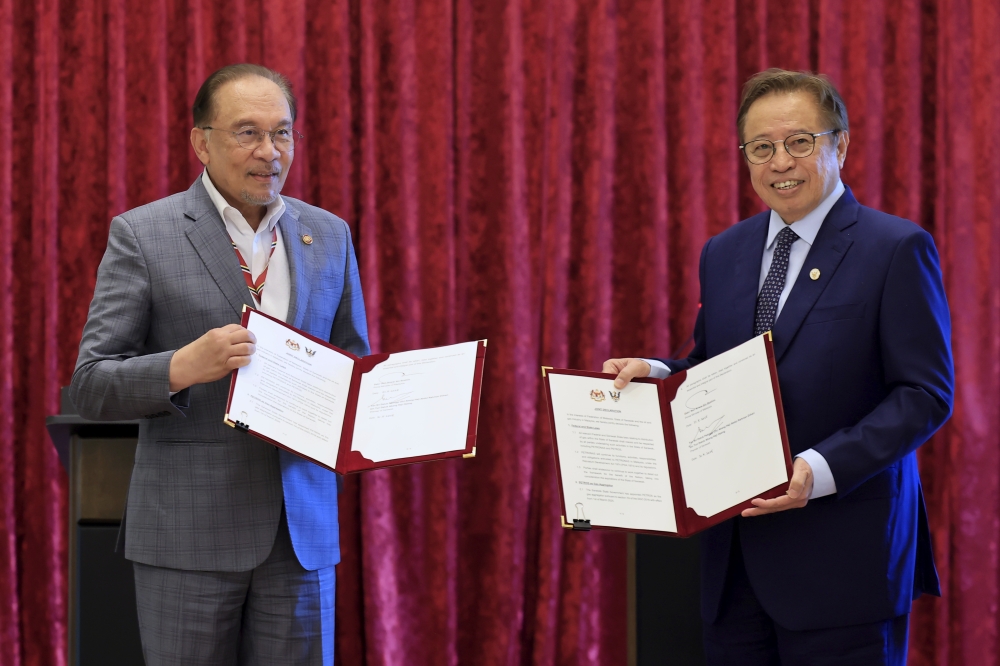
When Putrajaya and Kuching signed the joint declaration on May 21, 2025, it was hailed as a historic reset. The deal saw the federal government, through Petronas, recognise Sarawak’s Distribution of Gas Ordinance (DGO) 2016, while Sarawak affirmed the Petroleum Development Act (PDA) 1974 — the law that for five decades has anchored Malaysia’s oil and gas governance.
Yet five months later, harmony has given way to renewed litigation. On October 1, 2025, the Petronas–Petros case resumed in the Kuching High Court, centred on a RM 7.95 million payment dispute. Petros is asking the court to order Petronas to return funds paid under a bank guarantee, arguing that Petronas supplied gas in contravention of the DGO because it is not licensed as a state gas aggregator. Petronas counters that it does not need to be licensed by the state government, as its operations fall under the PDA — which remains the federal law governing petroleum development.
That the case proceeded despite the joint declaration shows how thin the commitment to peace really was. If sincerity existed, litigation would have been withdrawn once both parties pledged mutual respect. Instead, Sarawak has pressed on, treating the declaration as a political gesture rather than a foundation for genuine cooperation.
The DGO’s late arrival and misplaced assertiveness
For almost 50 years, the PDA provided Malaysia with a coherent, unified system for petroleum exploration and gas development. It enabled Petronas to plan nationally, attract global partners, and contribute more than RM 1.5 trillion to public coffers.
Then came Sarawak’s DGO 2016, which took effect in 2018. Its goal — to regulate gas distribution within the state — but its rollout collided with the long-standing PDA regime. Introducing a new state law without a clear harmonisation framework effectively threw a spanner into a system that had worked for decades.
The sudden insistence that Petronas obtain state licences or relinquish its gas-aggregator role was bound to spark friction. It was a political move more than an administrative one — and in that sense, a reflection of insincerity. True sincerity would have meant gradual alignment, not a unilateral assertion of authority.
Political defiance and the erosion of trust
Beyond the legal disputes, Sarawak’s actions have also undermined the very political goodwill that made the joint declaration possible. When Prime Minister Anwar Ibrahim announced earlier this year that Petros would serve as an aggregator of gas within Sarawak — carefully omitting the word sole — it was meant as a balanced compromise. His phrasing preserved state pride while safeguarding federal participation through Petronas.
Yet almost immediately, the Sarawak government contradicted him publicly, declaring that Petros was the sole aggregator. It was a direct challenge to the prime minister’s calibrated position, and it sent a clear signal: Sarawak would define the terms unilaterally, even if it meant overruling the spirit of consensus reached in Putrajaya.
Gas allocation already addressed
Sarawak’s push to become the sole gas aggregator is rooted in a grievance long articulated by its legal adviser, JC Fong, who has argued that about 94 per cent of the state’s gas output is exported, leaving only 6 per cent for local industries. He contends that by controlling aggregation, Sarawak can ensure more gas is channelled into domestic use and downstream development. The concern is legitimate — but it has already been addressed.
Putrajaya has agreed to allocate 1 billion cubic feet of gas per day for Sarawak’s domestic needs, a significant step-up from past allocations. Yet the state continues to press for sole control. It raises a fundamental question of sincerity: if the goal was simply to secure more gas for Sarawak, that objective has been met. Why, then, continue to push for total authority?
The 94 per cent figure has also been used to portray the situation as grossly unfair — as if Putrajaya had deliberately deprived Sarawak of its own resources. That narrative is misleading. Until recently, there was no coordinated gas roadmap to manage domestic allocation or downstream development within the state. Once such a framework was proposed, the federal government had no hesitation in agreeing to supply 1.2 billion cubic feet of gas per day for Sarawak’s use.
To continue framing the issue as federal exploitation misrepresents the facts and undermines the cooperative intent of recent negotiations. It is insincere to keep painting Putrajaya as a colonial power when the reality shows willingness, not resistance, to share control.
The injunction that shouldn’t have been necessary
The sincerity gap was also visible in the injunction involving Shell MDS (Malaysia), which became trapped between competing claims from Petros and Petronas. Petros sought to block payments to Petronas, forcing the court to step in. Petronas eventually prevailed, but the episode should never have happened — especially after the May declaration.
Instead of demonstrating cooperation, the injunction fight signalled disunity, wasting time, energy, and money — and weakening Malaysia’s reputation for regulatory certainty in the eyes of investors.
The cost of insincerity
Each unresolved case erodes confidence and delays investment. It confuses project approvals and fractures a governance model that has kept Malaysia’s energy sector stable for half a century. The sharp fall in Petronas’s dividend is a tangible reminder that the cost of legal brinkmanship is borne not by either side, but by the nation.
Sincerity now means action: aligning the PDA and DGO through structured dialogue, jointly withdrawing overlapping suits, and establishing a standing federal–state coordination council.
Malaysia’s energy future depends on unity, not dualism. Until sincerity replaces symbolism, the Petronas–Petros peace will remain fragile — and Malaysia will keep paying for it in lost revenue, lost time, and lost trust.
By Jabir-Abdullah Amir, Advocate & Solicitor, Partner, Faris Abrar & Co
* This is the personal opinion of the writer or publication and does not necessarily represent the views of Malay Mail.


