JUNE 4 — The upcoming Johor state election like the Olympics focuses on the medal tally, with Barisan Nasional, Pakatan Harapan and Perikatan Nasional trying to hog the limelight.
Indeed, it will be a minor miracle if none of them hold the mentri besar post when the counting is done.
Then why bother with the certain also-rans? Because how they fare determines whether they have a future.
To know if they are set to be serious players in the general election — regardless if months away or in 2028.
It can also decide if Malaysia is set to have four significant coalitions, or just three restructured ones.
In the outside lanes
Muda, Bersama, Reset Malaysia and Pejuang can get to the starting line, but are they all just as keen?
Let’s read their vitals.
The easiest one first.
Pejuang did contest in the last Johor polls in 2022. Forty-two races, trounced in all, losing all deposits.
A picture of consistency when eight months later at the general election, they and all their allies under Gerakan Tanah Air lost every parliamentary and state race — 168 in total — and lost every deposit. They might have funded the Election Commission’s Xmas party.
The humiliations included party president Mukhriq Mahathir and his dad, Mahathir Mohamad.
Since the debacle Mahathir has left the party. He plays musical chairs in heading and advising a series of parties and movements bent on race first. He is still prominent in Pejuang’s promotional material even after ditching them.
It’s probably far less difficult to explain quantum physics than to describe exactly what Pejuang is today and what purpose it serves.
If they throw their hat in Johor and sustain their failure performance rate, when is it time to call it quits?
Pejuang wants to partner with others to be relevant. Unfortunately, the intended targets prefer Pejuang being irrelevant.
BN and Pakatan are non-starters and PN has too many suitors. At this pace, Pejuang might talk itself into oblivion.
Muda won one state seat courtesy of co-operation with Pakatan in 2022, Puteri Wangsa.
It’ll defend that one as president Amira Aisya Abdul Aziz (4A) is the incumbent and newly minted as party president.
The tragedy, however, is that ex-president Syed Saddiq Syed Abdul Rahman remains a large shadow; Amira lacks charisma, and Saddiq produces more catchy youth content in a week than Muda has in the past three years.
Its new leaders fumble most lines between saying they want youth, youth and youth, and then in the next breath urge all Malaysians to back them.
They have an equally dysfunctional relationship with exclusivity as Umno has, only with colossally less history and victories.
In its last election foray, the 2023 August polls — Perak, Penang, Selangor and Negeri Sembilan — all 19 Muda candidates lost their deposits.
If Amira loses this time, and further loses her deposit, what is the party left with?
Reset Malaysia, let’s be honest, is waiting for a suitable arrangement with PN before nomination day.
PAS are stuck in a three way love fest, holding Bersatu with their right hand reluctantly and reluctant to let go Bersatu rebels on their left.
Already PAS Info Chief Fadhli Shari has declared support for ex-Bersatu man Wan Saiful Wan Jan wherever he contests. That’s not an endorsement that makes Bersatu President Muhyiddin Yassin smile.
It was 39 days or almost six weeks between dissolution and nomination day in Sabah last year.
Hamzah Zainudin’s motley crew face a countdown with no option to reset. Bersatu for their own survival will run down the clock and leave Hamzah ashen.
PAS being PAS will expect the rest to conclude matters for them. Indecision will dominate and Muyiddin’s field marshall Azmin Ali cannot countenance parity for Hamzah’s unregistered group.
And Hamzah won’t touch Pejuang with a long barge pole, which further isolates him. He understands best how home ministers tend to be massively unkind to those out of power, like himself.
Not sure he’d be thrilled to use the mangosteen or tractor for his yikes, independent candidates!
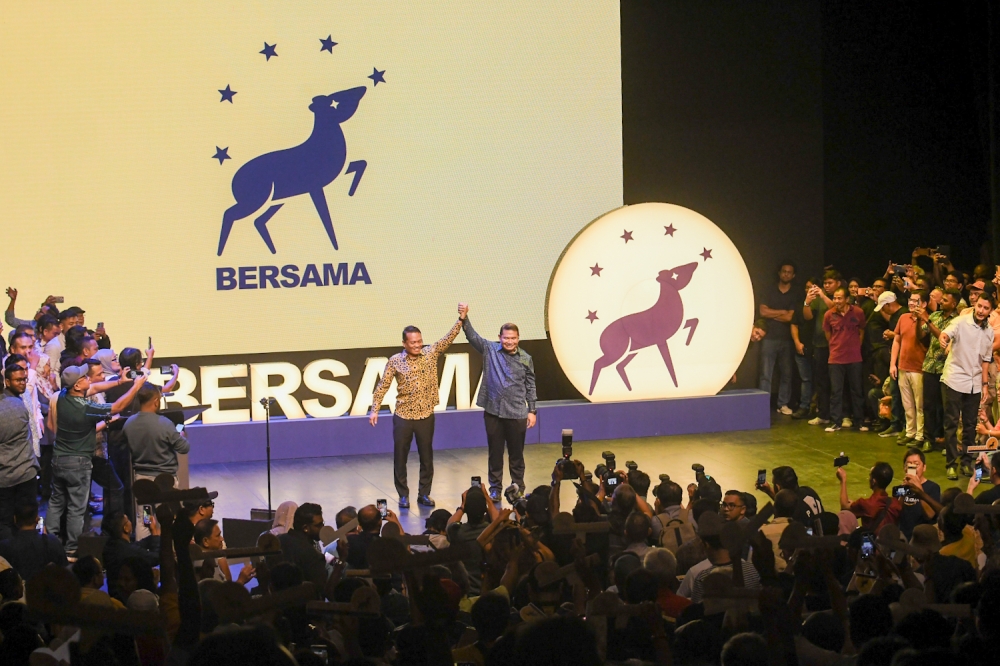
The final outsider contestant is Bersama. Terengganu-born Rafizi Ramli is probably looking at the electoral roll and using several AI tools to spit out the right number of candidates to field.
He is always convinced electoral victory is a formula away rather than a strong, consistent and honest message away.
And PKR, already under fire, will want to squash its former deputy president.
He’d be attacked by his own protege Akmal Nasir, the former PKR youth chief, Johor Baru MP and currently helming the ministry Rafizi exited.
Akmal would be expected by the party to trample on Bersama. It is obvious that Bersama targets PKR seats.
It is unfortunate Bersama is asked to contest so soon after kicking off but it cannot choose to shy away from this battle.
No podium, potential in being competitive
Firstly, the goal for these future champions or far too soon to disappear phenomenons is not to win the state but to establish a beachhead.
Which of the four possess the nous to prevail?
Then look at the measures used to evaluate potential.
The “candidate to deposit loss” ratio enables a plain view of survivability. Can one in eight voters dare support your party?
Pejuang never recovered from 2022 and Muda from 2023. This is the figure used by the Internet to denigrate second tier parties. In politics it is better to be hated than to be laughed at.
Second, exhibiting a spine in electoral arrangements, if it comes to it, matters plenty. Operating from a weakened position they cannot choose to ignore overtures.
The outcome is beyond small players, as BN, Pakatan and PN dictate terms.
But they cannot let the process chip away at their credibility. But being beggars shooed away from the negotiation table downgrades parties, demeans them.
Muda was perpetually treated like that by Pakatan and if they think PN are a classier bunch, they are asking for a repeat.
Malaysians are aware the big boys prefer fewer players and use electoral pacts to bury the competition.
Eighteen years ago Parti Sosialis Malaysia was unregistered but had an MP and assemblyman each thanks to a partnership with Pakatan.
Last year, as a registered party but long ignored by Pakatan, it mustered 6 per cent in Perak’s Ayer Kuning’s by-election and lost the deposit.
The reality check for PSM is that compared to recent years’ outcomes, Ayer Kuning was not a horrible result.
Strangely, Bersama has a chance to fail spectacularly but impress a nation. Rafizi is the only politician east of Mandalay who identifies himself as a kamikaze and thinks that’s a good thing.
Spoiler alert, the Japanese did damage the enemy in the Second World War using kamikaze pilots but ultimately lost the war. But Rafizi was a boarding school Malay language debater, those sorts do not let facts get in the way of a story.
In pursuit of a beautiful defeat, he might spark interest in his party. But that’s the conundrum, he needs to excite people about his party, not just him.
Which means the candidates and their stories. They are the ones who need to run into machine-gun fire in a ritual of democratic zeal. But that’s not Rafizi’s style.
Nik Nazmi Nik Ahmad is the natural number two to him not because they were long-time PKR leaders, short-lived ministers and alumni of Malay College, but rather due to Nazmi being happy to let Rafizi corner the attention.
Though, Rafizi might ultimately prove all of us wrong.
Say Rollo Tomassi
In the first-past-the-post dynamics of our Westminster Parliamentary system, it is a high bar to clear for a party to survive infancy.
Until 2008, the country had half a century of a fixed coalition against under-strength and divided opponents. Almost a one-party nation.
By 2020 we accelerated through deceit and backroom deals, into a three-way game.
Parliamentary democracies naturally limit themselves to two sides until untidy and quick splinters occur which crowd the field and frustrate voters.
Johor may be the first of several obstacles to test the mettle of the established three and the newer players.
For the former, to top the game, for the latter, to stay in the game. In a cruel way, it is far harder for the pretenders to stay relevant than for the big three to win.
For the four, it is also auditions. Notch up support for themselves or increase voter turnout or turn into Internet sensations, then the big three have to consider partnerships.
And from there to the general. There are too many moving parts for now.
They all won’t hurt their chances if they put on their strategy wall throughout this election this reminder: Go big or go home!
* This is the personal opinion of the columnist.