















NEW YORK, Jan 18 — About 10 years ago, the playwright John Guare got a call asking if he wanted to meet David Bowie to discuss a theatre project.
As Guare remembered it, Bowie was “in a very dark place” (it was shortly after he had had a heart attack onstage in Berlin), and a mutual friend, the English producer Robert Fox, was trying to coax him back to a creative life. Guare immediately said yes.
He and Bowie met at each other’s homes in New York to throw around ideas, and sometimes they went out. “We would take walks around the East Village,” Guare said. “And I was always praying somebody would run into us so I could say, ‘Do you know my friend David Bowie?'”
It never happened.
Guare was at first puzzled and then amazed at how Bowie — the stage creature, the persona, the guy he saw command an audience at Radio City Music Hall in 1973 with his spiky orange hair and snow-white tan — could walk the city streets unrecognized.
“He travelled with this cloak of invisibility — nobody saw him,” Guare said. “He just eradicated himself.”
People often forgot, but up until his death, last Sunday at 69, Bowie was a New Yorker. He said so himself, emphatically. “I’m a New Yorker!” he declared to SOMA magazine in 2003, after he’d been here a decade.
He and his Somali-born wife, Iman, who is a model fluent in five languages, spent almost their entire marriage, more than 20 years, as residents of the city. Anyone will tell you they were one of New York’s most glamorous, graceful couples, made all the more so by the dignified and private way they lived.
And though Bowie was enormously wealthy, he wasn’t one of those rich guys who kept an apartment in the city, along with a portfolio of global real estate holdings, and flew in. Aside from a mountain retreat in Ulster County, New York, his Manhattan apartment was his only home.
You may not have considered all this because Bowie was an apparition in the city, rarely glimpsed. You heard it mentioned that he lived here. Somewhere downtown, someone thought. But seeing him out? Good luck.
Michael Musto, the veteran night life columnist (and occasional New York Times contributor), met him at a party in the 1970s but saw him very few times after that, he said. Gerard Malanga, the poet and Warhol associate, who lived three blocks from Bowie and had friends in common, described himself as “one of the millions who never encountered David on the street or anywhere.”
Bowie wasn’t a Garbo-level recluse. He got around enough to avoid the terrible fate of having his privacy draw more attention to him. But if people did spot him at Lincoln Centre or out to dinner with Iman, they usually gave him wide berth, out of respect and also a sense of intimidation.
“I had always thought he was unapproachable,” Musto said. “But he was quite lovely and accessible.”
“The fabulous identities he had,” Guare said — meaning Ziggy Stardust and Aladdin Sane and the Thin White Duke and even the Bowie of the ‘80s, who looked like the world’s most elegantly dressed serial killer — “bore no reflection on the person who was carrying them.”
“I think he had complete access to David Jones,” Guare added, referring to Bowie’s birth name. “And that’s who I knew.”
Bowie heard New York before he ever saw it. When he was 19 and still living in England, his manager, back from the States, gave him an acetate record of “The Velvet Underground and Nico,” obtained directly from Andy Warhol.
“I was hearing a degree of cool that I had no idea was humanly sustainable,” he later wrote in an essay for New York magazine.
As had been widely chronicled, Bowie left America for Berlin, partly to flee his druggie lifestyle.
In 1980, after recording the albums Low, Heroes and Lodger — which became known as his Berlin trilogy — he was back in New York, this time as the Elephant Man at the Booth Theatre on Broadway. (“He is splendid,” The Times wrote.) In 1982, with Nile Rodgers producing, he recorded the album Let’s Dance at the Power Station on West 53rd Street, a sonic and commercial triumph. But for all his victories and nocturnal good times in the city, Bowie seemed unable to commit to it.
When Iman met Bowie at a dinner party in 1990, he was living in Switzerland as a tax exile, a citizen of the world. She wasn’t having it, she once told The Guardian: “I’m a New Yorker. I was like, ‘Let’s go home.'”
The couple married in 1992 and moved into a conventional prewar apartment on Central Park South. They had a daughter, Lexi. In 1999, they paid US$4 million (RM16.4 million) for two penthouses (an upstairs-downstairs) on Lafayette Street in SoHo, where they remained. That’s also where fans gathered in the numbing cold after he died to lay flowers, many unaware, until that day, that he’d been a fellow New Yorker.
Over time, Bowie did become a real New Yorker. He absorbed the city’s attitude and cultural quirks. He wrote a song (Slip Away) about Uncle Floyd, the host of a weird, low-budget, quasi-children’s TV show that aired locally back in the UHF days.
After the September 11 attacks, he performed movingly at the Concert for New York City at Madison Square Garden. He announced from the stage, before singing Heroes: “I’d particularly like to say hello to the folks from my local ladder. You know where you are.”
In photographs, you can see how subdued and grown-up Bowie’s second go-round in the city was. “He did the ballet, all the fun cultural stuff,” said Patrick McMullan, who photographed him over the years, though much less after Bowie’s heart attack in Berlin.
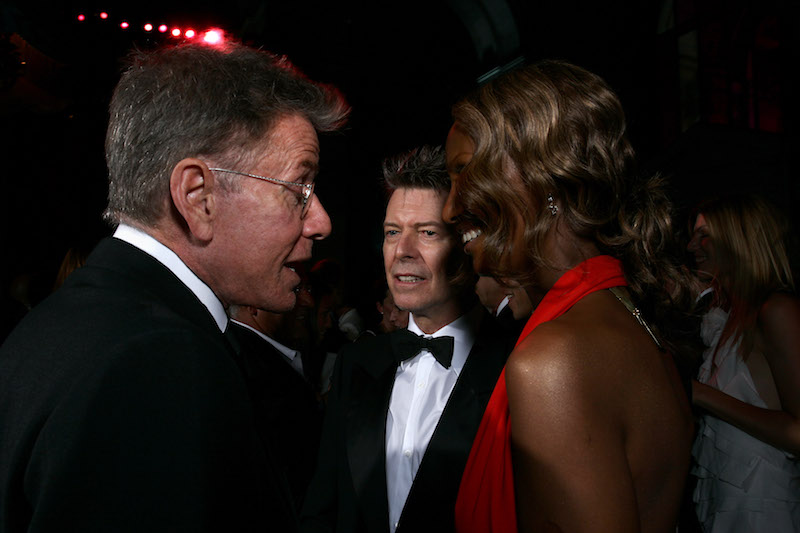
He was always in a sharp suit or tux. Regularly at the Met Gala or the Council of Fashion Designers of America Awards to support his wife. Never caught stumbling out of the hot club at 4am. He’d already been to a lifetime’s worth of parties.
Iman once described Bowie as a “homebody”; The Onion imagined him as a “pansexual alien” staying in to “do lasagna for dinner." He led a pretty normal-seeming life. He shopped for groceries once a week at Dean & DeLuca. He loved the chicken sandwich with watercress and tomatoes at Olive’s on Prince Street. He liked to rise at 6am and get his “buzz” by walking the still-empty streets of Chinatown.
He read a lot. He collected art. He painted. He and Iman socialised with the parents of their daughter’s friends at school. He spent his remaining time meaningfully and productively, and largely here.
Bowie stopped touring in 2004. He left New York only when work demanded, and during his stunning end-life creative burst, he found a way to never leave his neighbourhood.
Lazarus, the show for which Bowie composed songs and resurrected the displaced alien he played in the 1976 film The Man Who Fell to Earth, was staged at New York Theatre Workshop, on East Fourth Street, less than 10 blocks from his house.
Both his 2013 album, The Next Day, and the demos for his final record, Blackstar — which was released, incidentally, on his birthday and just two days before he died — were recorded at the Magic Shop recording studio on Crosby Street — 283 steps from his front door.
Bowie would have ridden the elevator down from his penthouse, exited his building, crossed Lafayette Street, slipped through the little alley called Jersey Street and walked on cobblestones until he came to the studio’s unmarked metal doors.
Brian Thorn, a recording engineer for the Next Day sessions, said Bowie worked “very humane hours,” as rock stars go. “We’d start by 10,” Thorn said. “He would get there with or before the musicians. The studio would have his coffee order ready,” a double macchiato from La Colombe.
Thorn remembered overhearing Bowie and his guitarist talking one day. The guitarist was going on about an art exhibit, and how much Bowie would love it. Then he caught himself, realizing whom he was talking to, and said, “Oh, you can never go there; there’s too many people.”
Bowie answered, slyly, “You’d be surprised the places I’m able to go.” — The New York Times